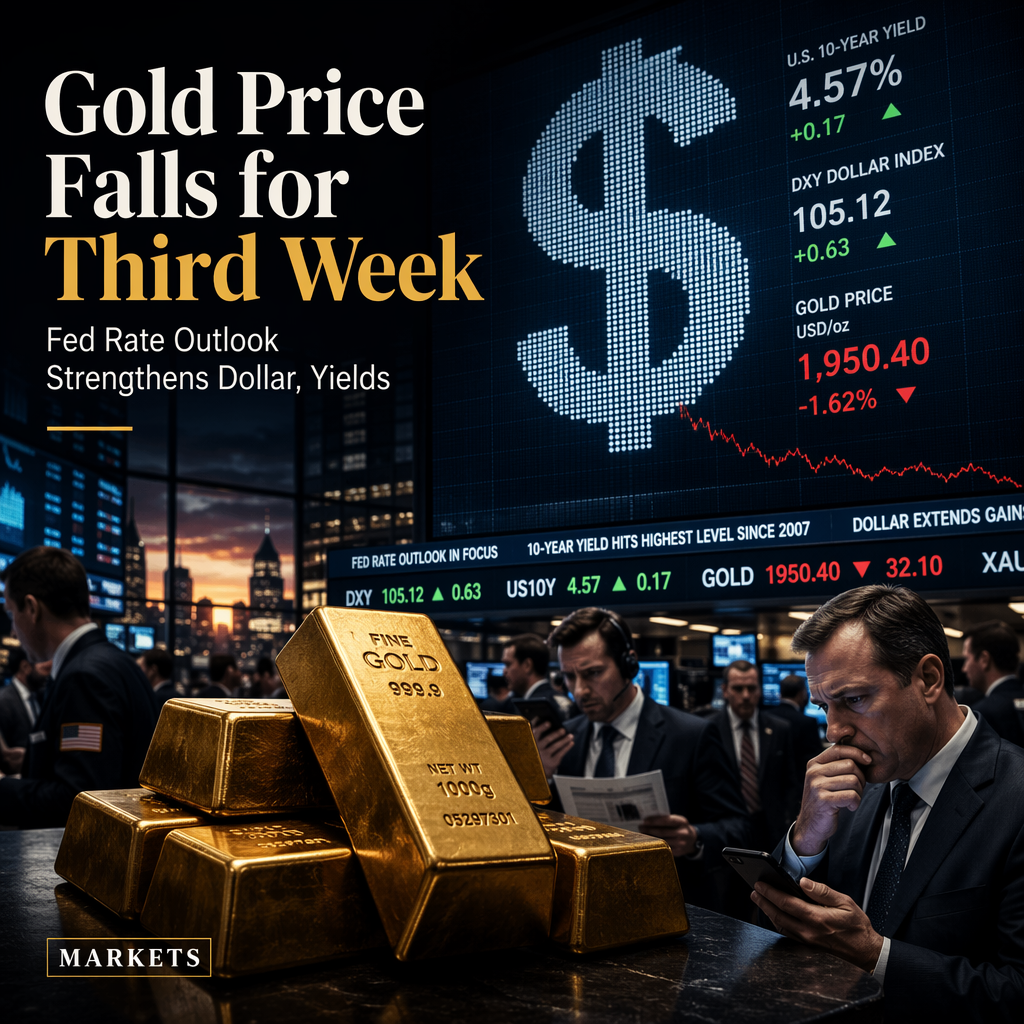
Gold (XAU/USD) extended its selloff on Friday, dropping approximately 1.69% and trading at $4,147, marking its third consecutive week of losses. The decline was attributed to the strengthening US Dollar, which reached 13-month highs above 101.00 on the US Dollar Index (DXY), and rising US Treasury yields following the Federal Reserve's decision to maintain higher interest rates for a longer period [1]. The 2-year Treasury note yield, which is particularly sensitive to rate hike expectations, surged by 13 basis points after the Fed's meeting, pushing gold prices to six-day lows of $4,121 [1].
Market sentiment was further influenced by geopolitical developments, including the US-Iran deal and subsequent reports of a potential ceasefire between Israel and Hezbollah. The reopening of the Strait of Hormuz helped ease oil supply disruptions and inflationary pressures. Meanwhile, major central banks such as the European Central Bank and the Bank of Japan also raised rates, with the ECB hiking by 25 basis points on June 11 and the BoJ following suit on Tuesday. The Federal Reserve signaled that nearly half of its FOMC board members are considering at least one rate hike in 2026 [1].
Money markets are currently pricing in 18 basis points of Fed tightening at the September 16 meeting, indicating a 72% probability of a rate hike [1]. In response to the evolving market dynamics, Goldman Sachs revised its gold price forecast downward to $4,900 per troy ounce by December, a $500 reduction from its previous estimate [1].
From a technical perspective, gold remains in a bearish trend, having fallen below the 200-day Simple Moving Average at $4,466. The price action shows a pattern of lower highs and lower lows, with a potential break below $4,100 opening the path to challenge the year-to-date low of $4,023 set on June 11. The Relative Strength Index (RSI) also indicates continued bearish momentum, though it is not yet in oversold territory [1].
Looking ahead, investors are focused on next week’s US economic data releases, particularly the final Q1 2026 Gross Domestic Product (GDP) figures and the Core Personal Consumption Expenditures (PCE) Price Index, which is the Fed’s preferred measure of inflation [1].
CONCLUSION
Gold prices are under significant pressure due to a stronger US Dollar, rising Treasury yields, and expectations of further Fed tightening. With technical indicators pointing to continued downside and a major investment bank lowering its price forecast, the market outlook for gold remains bearish in the near term. Upcoming US economic data will be closely watched for further direction.