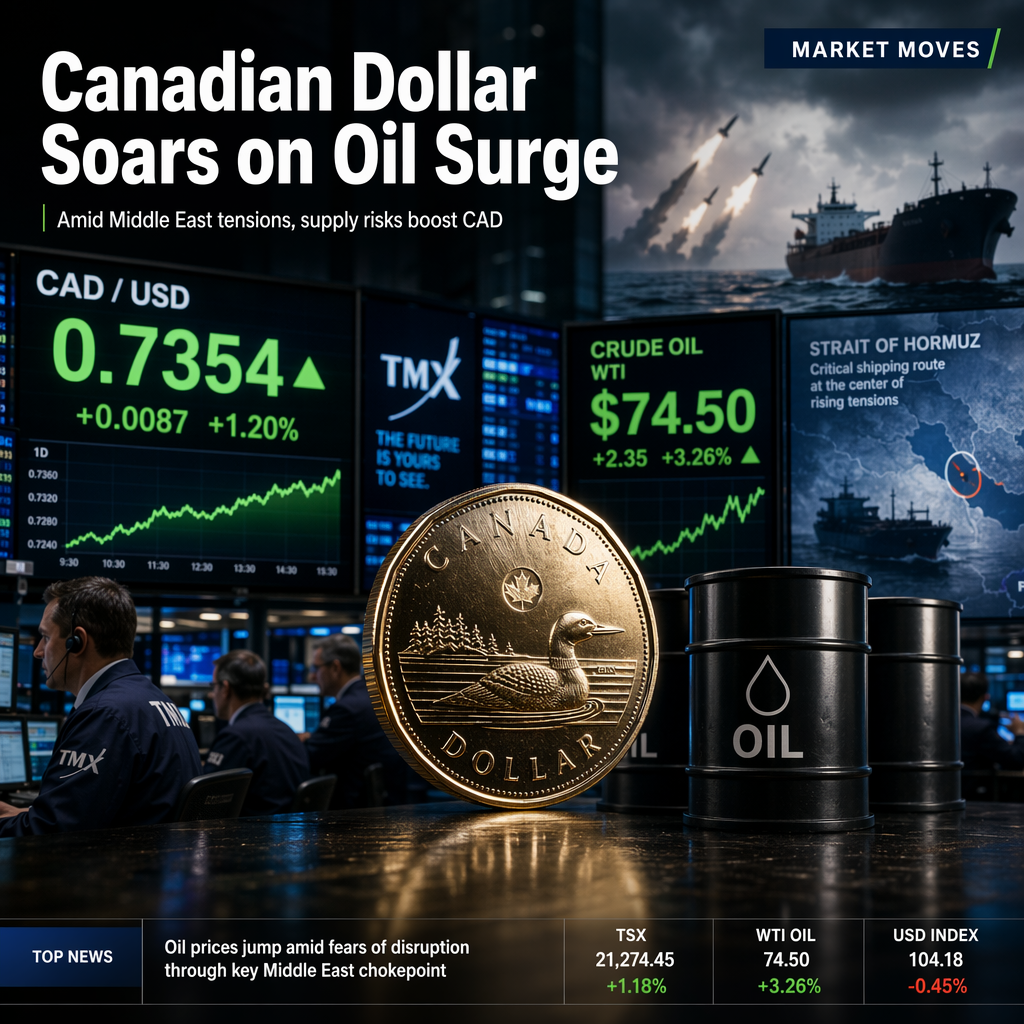
The Canadian Dollar (CAD) outperformed most of its major peers on Monday, driven by a surge in Oil prices following renewed tensions in the Middle East and fresh risks of supply disruption in the Strait of Hormuz [1]. At the time of reporting, USD/CAD traded around 1.4144, marking the fifth consecutive day of weakness for the US Dollar against the Loonie. West Texas Intermediate (WTI) crude traded near $74.50, up over 4% on the day, providing strong support to the commodity-linked Canadian Dollar due to Canada’s status as a major Oil exporter [1].
The escalation in the Middle East involved the United States and Iran exchanging missile and drone attacks over the weekend. Tehran claimed to have closed the Strait of Hormuz to tanker traffic, a critical chokepoint for global Oil shipments. However, US President Donald Trump countered this claim, stating on Truth Social that the strait 'is OPEN, and will remain OPEN, with or without Iran,' and asserted that the US would act as the 'guardian' of the Strait, seeking reimbursement at a rate of 20% on all cargo shipped through the waterway [1].
The US Dollar Index (DXY) reflected volatility, trading around 101.14 after briefly dipping below 101.00 earlier in the day, as traders assessed the evolving geopolitical situation [1]. The spike in Oil prices has also reignited inflation concerns, increasing pressure on central banks to consider tighter monetary policy. The Bank of Canada (BoC) is set to announce its policy decision on Wednesday and is widely expected to keep its interest rate unchanged at 2.25% [1]. BNY’s Geoff Yu commented that markets anticipate no change at least until Q4, though easing could be considered if inflation surprises to the downside. Yu also noted that the recent uptick in core inflation and labor market improvements support maintaining the current stance, but BoC Governor Tiff Macklem has indicated readiness to 'take action' if inflation expectations shift [1].
Looking ahead, the US Consumer Price Index (CPI) data due on Tuesday and Fed Chair Kevin Warsh’s congressional testimony are expected to provide further clues on the Federal Reserve’s next steps. The Fed is widely expected to leave interest rates unchanged this month, with the CME FedWatch Tool indicating a 71% probability of a rate hike in September [1].
CONCLUSION
The Canadian Dollar has gained significant ground due to surging Oil prices amid heightened Middle East tensions and supply risks. While the Bank of Canada is expected to maintain its current policy stance, ongoing inflation concerns and upcoming US economic data could influence future central bank actions. Market volatility is likely to persist as geopolitical developments and monetary policy expectations evolve.