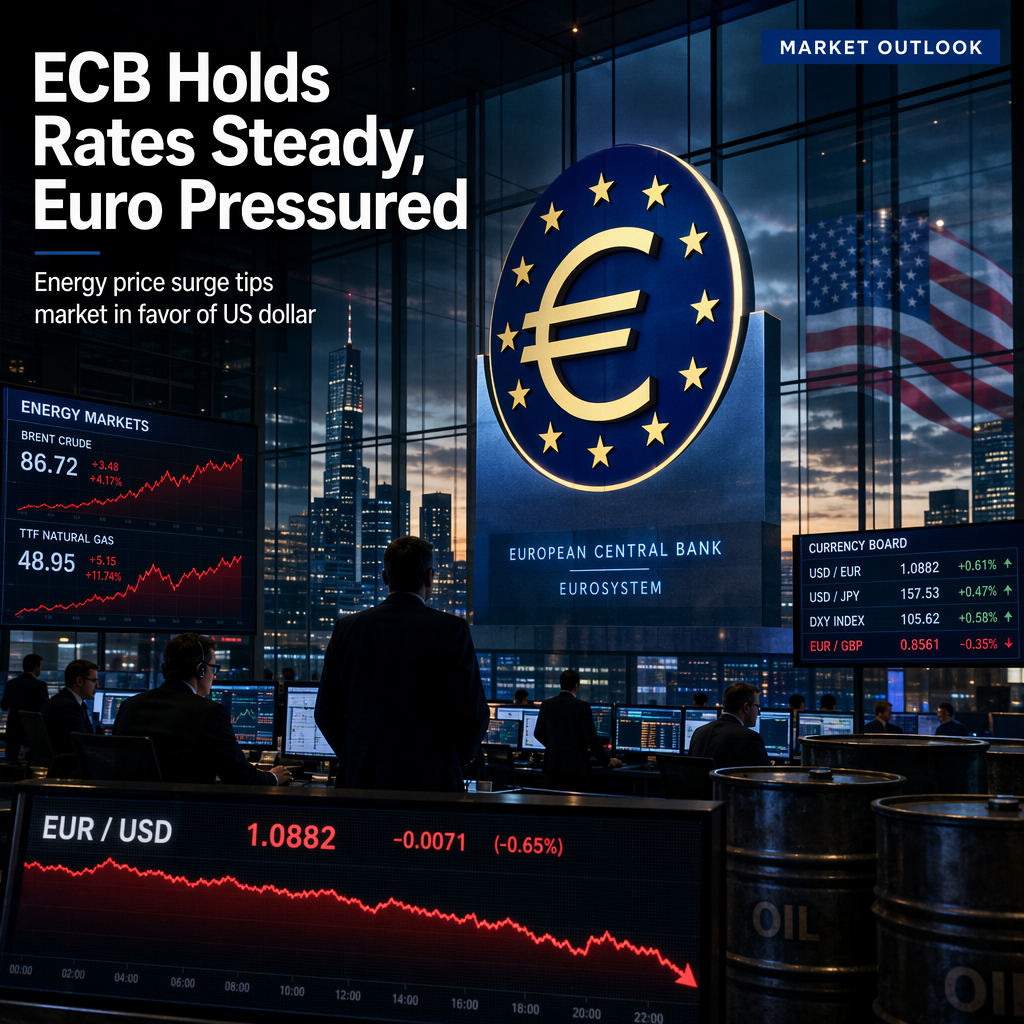
The European Central Bank (ECB) kept interest rates unchanged in July, aligning with market expectations, and did not push back against market pricing for a 25 basis point hike in September, which would bring the rate to 2.50% [1]. OCBC analysts Sim Moh Siong and Christopher Wong anticipate at least one more 25 basis point increase in September, with risks tilted towards the possibility of an additional hike [1].
Despite the ECB's hawkish bias, the Euro remains disadvantaged against the US Dollar due to rising energy prices, which have shifted terms-of-trade in favor of the USD [1]. Europe’s position as a net energy importer, contrasted with the US as a net energy exporter, makes the Euro more vulnerable to sustained increases in oil prices [1].
The report also notes that energy-linked currencies such as the Norwegian Krone (NOK) have outperformed, while other net energy importers, including the New Zealand Dollar (NZD) and Swedish Krona (SEK), have lagged behind [1].
No specific market reactions or analyst forecasts beyond the expectation of further ECB tightening and the ongoing vulnerability of the Euro to energy price dynamics are mentioned in the source [1].
CONCLUSION
While the ECB maintains a hawkish stance and is expected to raise rates further, the Euro remains under pressure against the US Dollar due to unfavorable energy terms-of-trade. Rising oil prices continue to benefit the USD and energy-linked currencies, leaving the Euro and other net energy importers at a disadvantage.