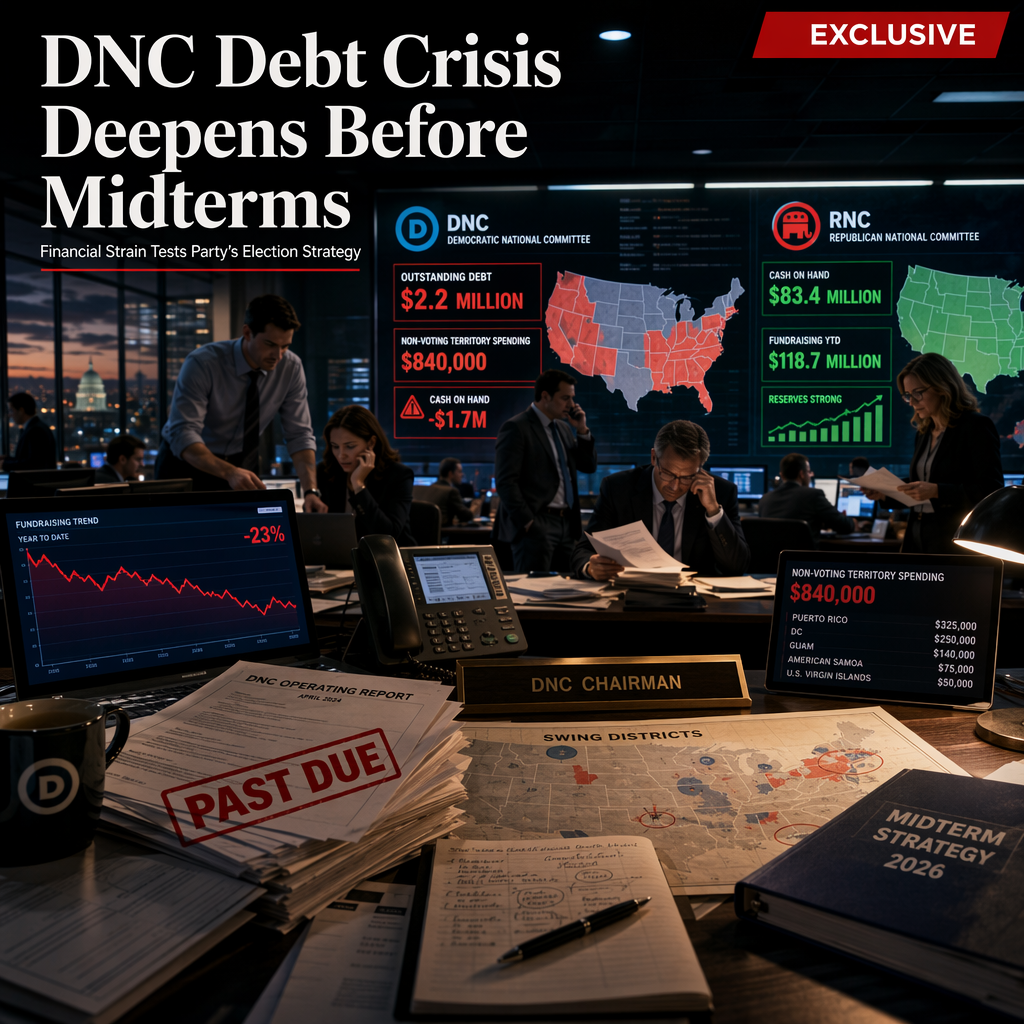
The Democratic National Committee (DNC) entered the final 100 days before the midterm elections with debts exceeding cash by more than $2 million, raising concerns about its financial stability and ability to support key House races in swing districts [1]. According to Federal Election Commission filings, the DNC ended June with $16.3 million in cash and $18.5 million in debts, resulting in liabilities approximately $2.2 million above its reserves [1]. In contrast, the Republican National Committee (RNC) reported approximately $128.5 million on-hand and no outstanding debt [1].
The DNC and an affiliated committee spent approximately $840,000 on Democratic organizations in five non-voting U.S. territories since last year, a move that has drawn scrutiny given the committee's financial position [1]. The New York Times reported that the DNC asked vendors to delay spending bills until after the elections and informed congressional leaders it would not make its traditional transfers to the House and Senate campaign committees [1]. Veteran DNC member Donna Brazile emphasized the urgency of the situation, stating, "Ken needs help — H-E-L-P," in reference to DNC Chairman Ken Martin [1].
The cash disparity extends to the committees directing resources into House races, with the National Republican Congressional Committee ending June with $92.7 million compared to $79 million for the Democratic Congressional Campaign Committee (DCCC), according to Axios [1]. The recent Supreme Court decision allowing unlimited coordinated spending between parties and candidates has made committee reserves more consequential in competitive districts, with control of the House potentially turning on fewer than 20 races, as reported by The Associated Press [1].
Despite these challenges, DCCC Chair Suzan DelBene highlighted the committee's strong second-quarter fundraising and the performance of Democratic candidates, asserting that Democrats are assembling "people-powered campaigns ready to win in November and make Hakeem Jeffries the next speaker of the House" [1]. DNC Executive Director Roger Lau disputed the characterization of the vendor discussions as evidence of financial distress, describing them as "nothing more than standard negotiations with vendors over contracts and payment processes" [1].
Democrats are attempting to win back control of the House for the first time since Republicans regained the majority in 2022, while Republicans also control the U.S. Senate after winning the majority in 2024 [1].
CONCLUSION
The DNC's financial challenges, including a $2.2 million debt and significant spending in non-voting territories, have raised concerns about its ability to support key races ahead of the midterms. While party leaders emphasize strong fundraising and campaign momentum, the cash gap with Republican committees and delayed payments to vendors highlight ongoing financial pressures.