
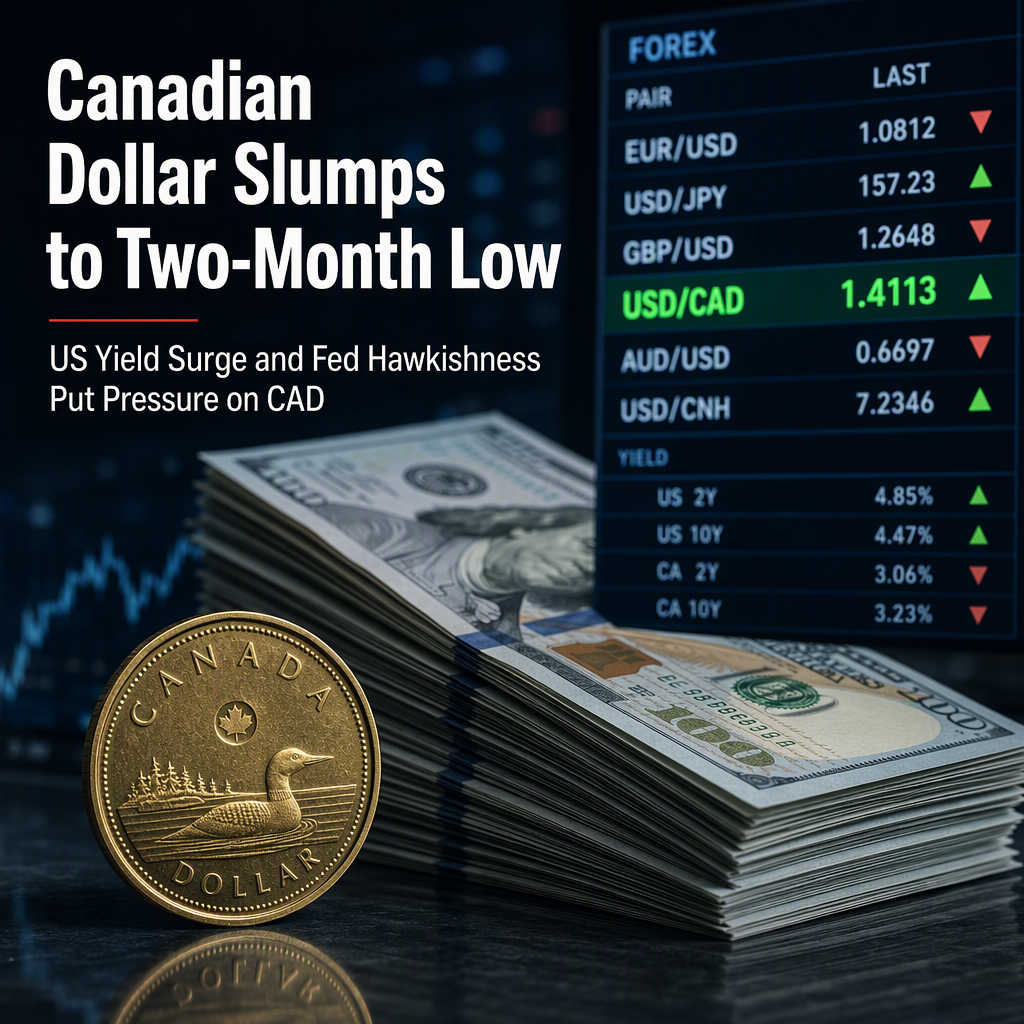
The Canadian Dollar (CAD) fell to a two-month low against the US Dollar (USD) as the USD/CAD currency pair extended its advance, reaching its highest level since mid-July. At the time of reporting, USD/CAD traded around 1.4113, marking a nearly 2% increase so far this month [1]. This move reflects diverging monetary policy outlooks between the Federal Reserve (Fed) and the Bank of Canada (BoC), with the US-Canada yield gap widening significantly. The two-year US Treasury yield stood at approximately 4.89%, compared to Canada’s two-year government bond yield near 3.40%, creating a gap of almost 150 basis points in favor of the USD [1].
Canadian Retail Sales data provided little support for the CAD, as headline sales fell 0.7% month-over-month in July, which was slightly better than the expected 0.8% decline. Sales excluding automobiles also dropped 0.7% [1]. Meanwhile, rising US Treasury yields have been driven by expectations that the Fed may raise interest rates again later this year. The Fed recently delivered a 25-basis-point hike, bringing the federal funds rate to 3.75%-4.00% [1]. The US Dollar Index (DXY) traded around 101.37, its highest level since July 29, reflecting broad demand for the Greenback [1].
Recent US economic data has reinforced the case for further tightening. Initial Jobless Claims rose slightly to 197,000 from 196,000, but remained below the 201,000 forecast, indicating limited layoffs. The S&P Global Composite PMI climbed to a five-year high of 58.4 in September from 56.0 in August [1]. Fed officials, including New York Fed President John Williams, have kept the possibility of another rate hike open, with Williams stating, “We need to get inflation back to target in a timely manner,” and calling another rate hike by year-end "reasonable." The CME FedWatch Tool showed the probability of an October rate increase at around 65%, up from 55% a week earlier [1].
In contrast, the BoC maintained its policy rate at 2.25% for the seventh consecutive meeting, citing little evidence of higher energy prices feeding into broader inflation. Inflation excluding gasoline was at 2.2%, with core measures close to 2% in July. The BoC acknowledged increased upside inflation risks but also warned that new US tariffs could cloud the growth outlook. Despite higher oil prices, interest-rate expectations have outweighed the typical support the CAD receives from commodities [1].
CONCLUSION
The Canadian Dollar's decline to a two-month low is primarily driven by the widening US-Canada yield gap and expectations of further Fed tightening, which have boosted the USD. Despite stable BoC policy and higher oil prices, the CAD remains under pressure as market participants favor the Greenback. The outlook for the CAD will likely remain subdued unless the BoC signals a shift in its policy stance or US rate expectations change.