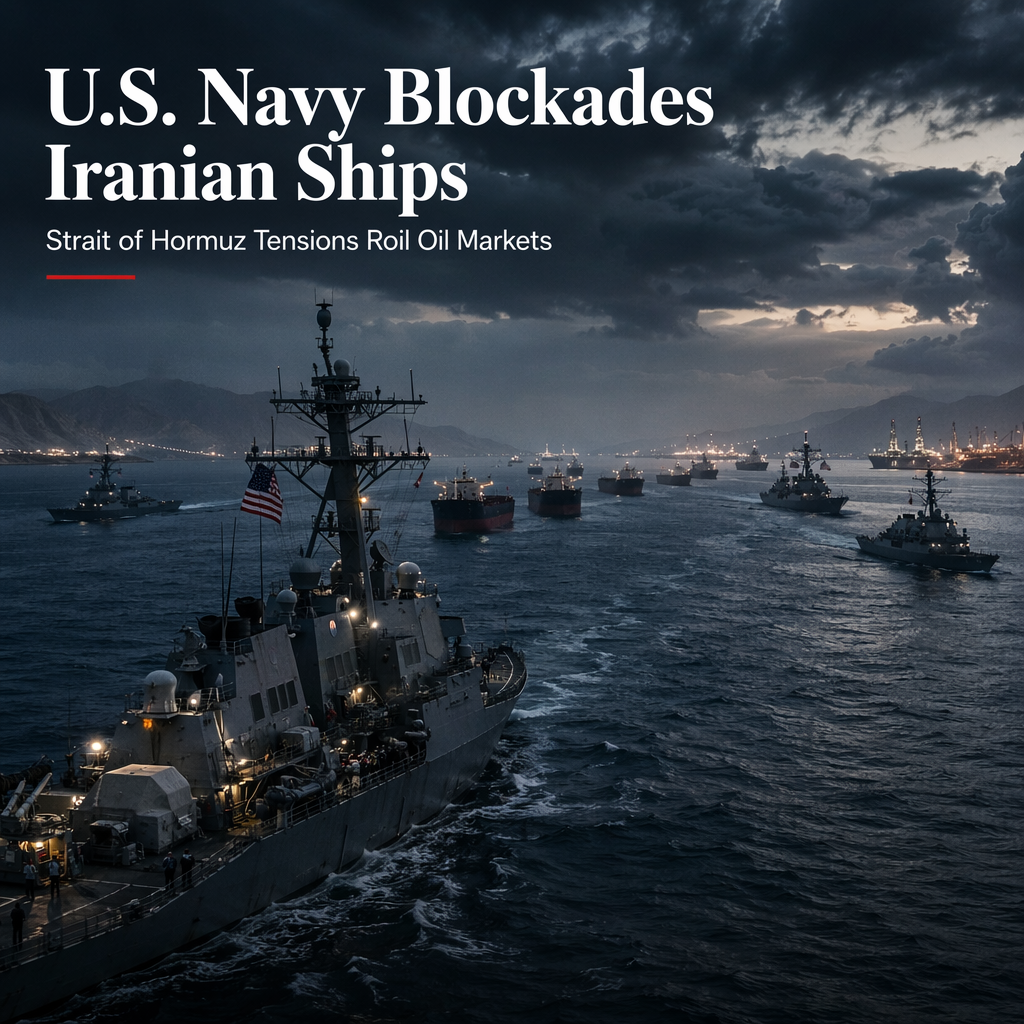
President Trump announced that the United States will reinstate a naval blockade targeting Iranian ships in the Strait of Hormuz, a strategic waterway critical for global oil shipments, amid ongoing military exchanges between the U.S. and Iran [1]. This decision follows a series of retaliatory missile and drone attacks between the two nations, with U.S. forces remaining on high alert in the region [1]. President Trump stated, "We will not allow Iranian vessels to threaten international shipping or further destabilize the region," emphasizing the U.S. commitment to ensuring the free flow of commerce and protecting national interests [1].
The Strait of Hormuz is a vital chokepoint for petroleum transport, and any disruption in its shipping lanes has the potential to significantly impact global oil prices and energy markets [1]. Market analysts have warned that increased military activity in the area could cause sharp spikes in crude oil prices, with Brent crude potentially testing resistance levels near $90 per barrel if shipping is disrupted [1]. Conversely, a de-escalation or successful reopening of the strait could see prices retreat to support near $75 per barrel [1]. Technical indicators suggest heightened volatility in energy commodities in the coming days as traders react to the evolving situation [1].
Shipping companies have been advised to review their risk exposures and consider rerouting vessels if necessary, while risk premiums on oil futures have widened, reflecting increased market uncertainty [1]. Traders are encouraged to monitor key price levels, official statements, and technical signals such as volume spikes and moving average crossovers for short-term trading opportunities in the oil sector [1].
No further details were provided regarding the specific timing or scope of the blockade, but energy market participants are closely watching developments and adjusting their positions accordingly [1].
CONCLUSION
The U.S. decision to launch a naval blockade in the Strait of Hormuz has heightened geopolitical tensions and injected significant uncertainty into global energy markets. With the potential for sharp oil price spikes and increased volatility, market participants are closely monitoring the situation for further developments and official guidance.