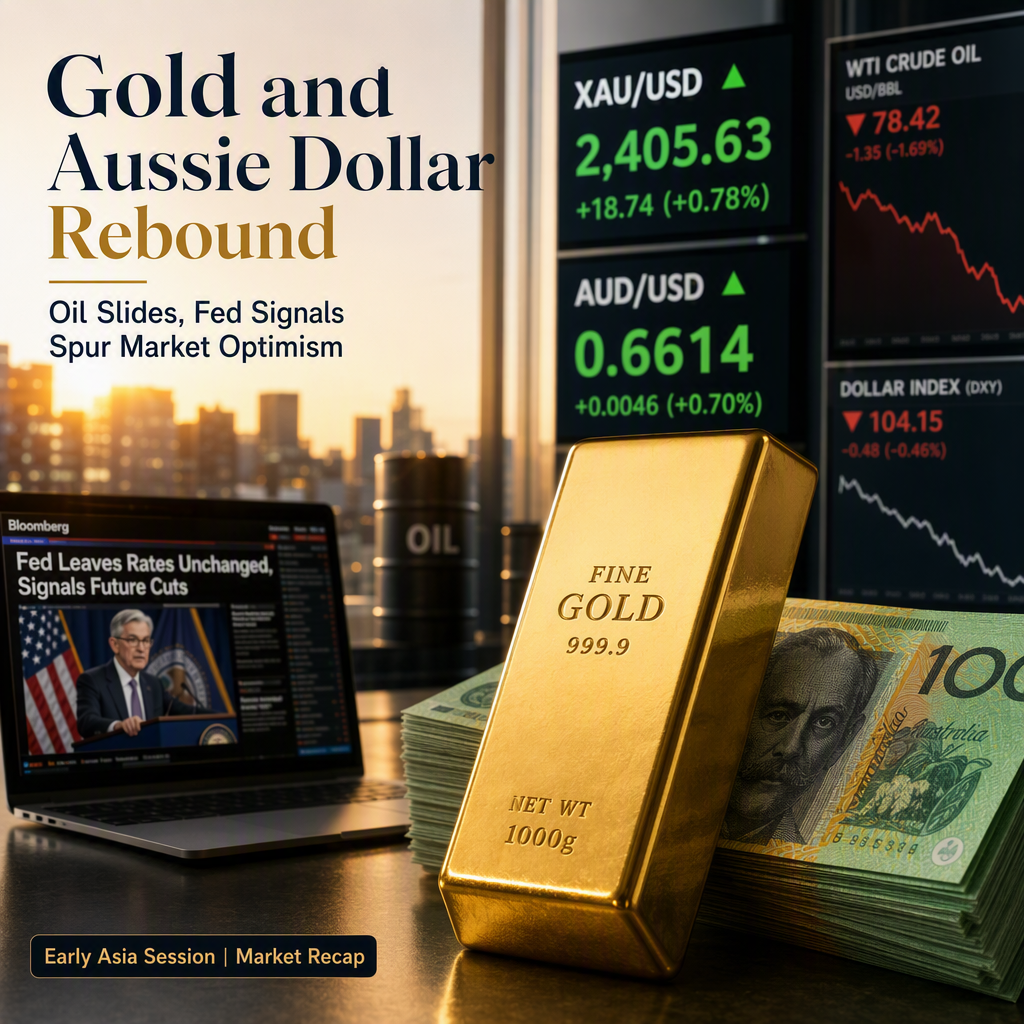
Gold prices (XAU/USD) rebounded to near $4,345 during the early Asian session on Friday, recovering from a six-week low. This move was driven by falling oil prices and a weaker US Dollar, as traders assessed the latest Federal Reserve (Fed) rate hike and policy signals. Crude oil prices dropped to a one-week low amid signs that supply disruptions in the Middle East could ease, with Saudi Arabia seeking to partially restore flows through a key pipeline. These developments have eased inflation concerns and provided support to gold in the near term, according to David Meger, director of metals trading at High Ridge Futures, who noted that lower energy prices are removing some inflationary pressure from the gold market [1].
The US Federal Reserve raised its interest rate by 25 basis points to a range of 3.75%–4.00% on Wednesday, marking the first hike in three years. Fed officials' projections indicate at least one more increase this year, with traders pricing in a 53.1% chance of another rate hike at the October meeting, up from 44% a day earlier, according to the CME FedWatch tool [1]. The Fed's dot plot suggests the Fed funds rate is around 4.10%, and the Personal Consumption Expenditures (PCE) index is forecast to remain at 3.7% this year, gradually approaching the Fed's 2% target by 2028 [2].
The Australian Dollar (AUD/USD) also recovered, trading at 0.7110 after bouncing off the confluence of the 50- and 100-day SMAs. The US Dollar Index (DXY) fell 0.10% to 100.23, reflecting the weakening of the Greenback as oil prices retreated and optimism grew over a potential de-escalation of the Middle East conflict. Saudi Arabia reported that its crude production would return to half capacity within days, further pressuring the US Dollar [2].
Strategists at OCBC observed that gold reversed lower after the FOMC meeting due to a stronger USD and rising US Treasury yields, with the 2-year yield nearing 4.75% and the 10-year yield around 5%. They noted that elevated yields and a firmer USD may continue to cap gold in the near term, but softer US data could pull yields and the dollar lower again, potentially restoring support for gold over the medium term [1]. Technical analysis shows gold holding above the 100-day SMA with neutral RSI momentum, indicating buyers are defending the broader uptrend [1].
US jobless claims for the week ending September 12 decreased from 206K to 196K, beating forecasts, and attention is now on upcoming speeches and industrial production data. In Australia, no major economic releases were noted, but RBA Governor Michele Bullock is expected to speak soon [2].
CONCLUSION
Both gold and the Australian Dollar rebounded as falling oil prices and a weaker US Dollar eased inflation concerns following the Fed's rate hike. While elevated US yields and a firmer dollar may cap gold in the near term, softer US data could restore support for the metal. The market remains attentive to further Fed policy signals and upcoming economic data releases.