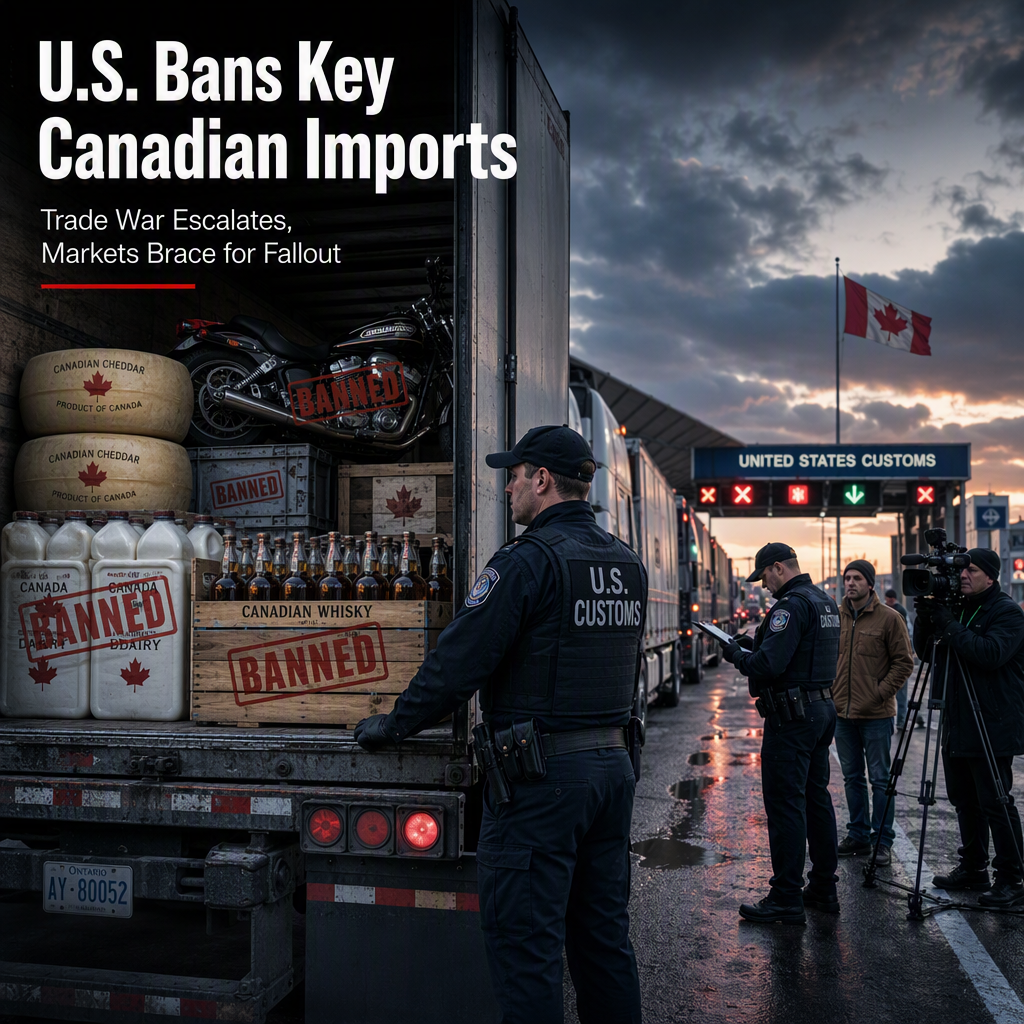
President Donald Trump has announced a sweeping ban on imports of Canadian dairy products, most alcoholic beverages, and motorcycles, marking a significant escalation in the ongoing trade dispute between the United States and Canada [1][2]. The White House stated that these restrictions will take effect in three weeks, with NBCBusiness specifying the date as September 29 [1][2]. The move comes in direct response to Canada’s retaliatory tariffs on $20 billion worth of U.S. imports, which took effect at 12:01 a.m. Tuesday after trade negotiations between Washington and Ottawa collapsed late last month [1][2].
The new U.S. measures were signed into law under Section 338 of the Tariff Act of 1930, a statute that had not been used until Trump implemented new tariffs on Canada in late August [2]. In addition to the import bans, the Trump administration removed tariffs on cement, road salt, and hospital pads, replacing them with duties on all-terrain vehicles, some cheeses, and motorboats [2]. The White House also directed the General Services Administration to declare Canadian products ineligible for long-term U.S. government contracts until Canada allows what it called "full and fair reciprocity" for American products [1].
Canada’s retaliatory tariffs, which impose duties of 15%, 25%, and 50% on hundreds of American products—including steel, aluminum, dairy products, appliances, clothing, and farm equipment—affect about 6% of the $333.6 billion in U.S. exports sent to Canada last year [1]. Several Canadian provinces had already restricted or halted sales of U.S. alcoholic beverages in response to previous U.S. trade actions, leading to a more than 70% year-over-year decline in U.S. spirits exports to Canada, according to the Distilled Spirits Council [1].
Industry leaders and officials have voiced concerns about the escalating dispute. Chris Swonger, President and CEO of the Distilled Spirits Council, emphasized the need for both governments to negotiate an end to the conflict and restore a zero-for-zero tariff framework for the spirits sector [1]. Canadian Prime Minister Mark Carney defended Canada’s response, stating that the country would accelerate efforts to diversify its trading relationships and reduce economic dependence on the United States [1]. Meanwhile, U.S. Trade Representative Jamieson Greer highlighted that only China and Canada have retaliated against U.S. trade measures, underscoring the severity of the situation [2].
Looking ahead, the White House indicated that Trump’s plan for 50% duties on cars and trucks remains under consideration, with a potential implementation date of January 1 [2]. Trump also threatened Canadian jet maker Bombardier, suggesting it should no longer be able to sell its products in the U.S., though Bombardier responded by noting its support for thousands of U.S. jobs [2].
CONCLUSION
The Trump administration’s sweeping ban on key Canadian imports and Canada’s substantial retaliatory tariffs mark a sharp escalation in the U.S.-Canada trade conflict, with significant implications for both economies. Industry leaders and officials on both sides are calling for a negotiated resolution, but further trade actions remain possible if the dispute continues. The market impact is expected to be high, particularly for affected sectors such as dairy, spirits, and automotive.