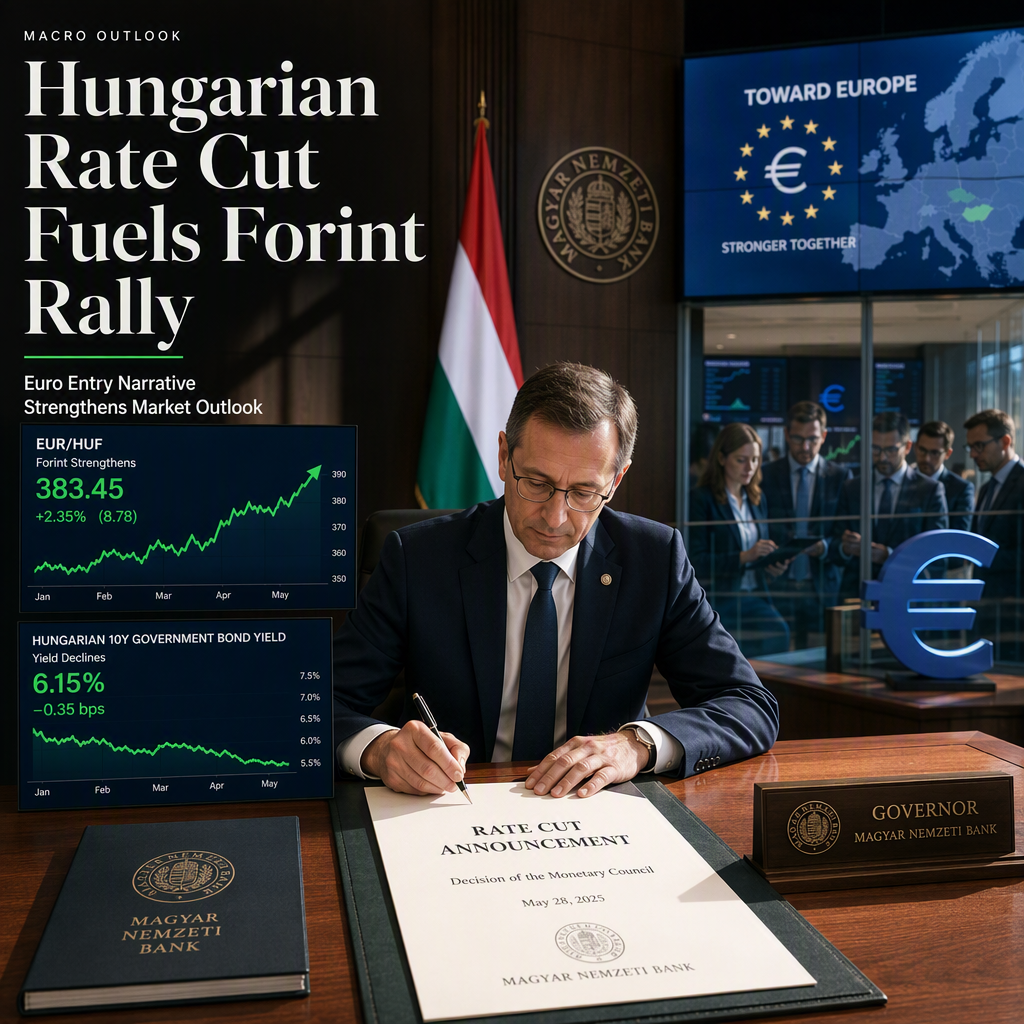
The National Bank of Hungary (NBH) has reduced its policy rate by 25 basis points to 5.50%, a move that was widely anticipated by market participants, according to ING’s Chris Turner [1]. ING's Chief Economist in Hungary, Peter Virovacz, projects a terminal rate of 4.75%, although the NBH provided minimal forward guidance during the announcement [1].
A key theme supporting Hungarian assets is the ongoing narrative around Hungary's potential entry into the eurozone. This includes the prospect of eventually shifting the NBH's inflation target from the current 3.00% to 2.00%, aligning more closely with eurozone standards [1]. ING draws a parallel to the positive market reaction seen in South African assets when the South African Reserve Bank lowered its inflation target in 2025 [1].
ING’s year-end forecasts for the EUR/HUF exchange rate and the ten-year Hungarian government bond yield are 350 and 4.75%, respectively, compared to current levels of 360 for EUR/HUF and 5.43% for the ten-year yield [1]. These projections suggest expectations for further strengthening of the forint and a decline in government bond yields as Hungary moves closer to euro convergence [1].
While the NBH did not provide substantial forward guidance, the combination of rate cuts and the euro entry narrative is seen as broadly supportive for Hungarian financial assets [1].
CONCLUSION
The National Bank of Hungary’s rate cut and the ongoing euro entry narrative are seen as supportive for Hungarian assets, with ING forecasting a stronger forint and lower bond yields by year-end. The lack of detailed forward guidance from the NBH leaves some uncertainty, but the overall market sentiment remains cautiously positive.