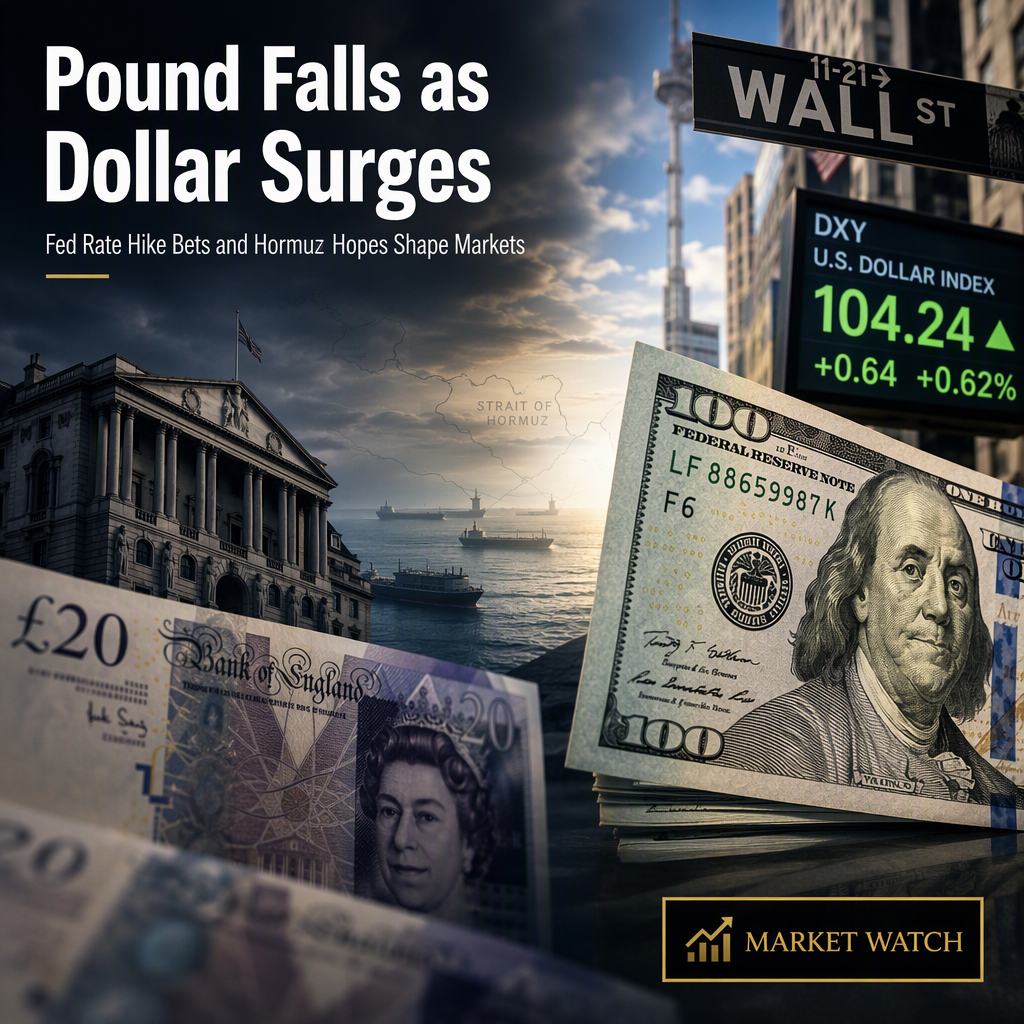
The British Pound (GBP) declined by over 0.17% against the US Dollar (USD) on Tuesday, with GBP/USD trading at 1.3343 after reaching a peak of 1.3387 earlier in the session [1]. This move came amid reports that Tehran intends to reopen the Strait of Hormuz if the United States meets certain conditions, specifically lifting the blockade on Iran and halting military operations. Kyodo reported that Tehran told the US administration it would open the Strait in seven days if these demands are met [1].
Despite the geopolitical headlines, the US Dollar remained strong, supported by growing speculation that the Federal Reserve (Fed) may raise interest rates once more before the end of the year. The US Dollar Index (DXY) rose 0.27% to 100.69, marking a two-month high [1]. The ADP Employment Change 4-week average increased from 16.75K to 20K, indicating continued strength in the US labor market. Boston Fed's Susan Collins stated that she supported a rate hike last week due to concerns that inflation could become entrenched above 2%, emphasizing that monetary policy can now focus on returning to price stability [1].
In the UK, Public Sector Net Borrowing for August rose to £18.26 billion, surpassing expectations of £15.7 billion. This pushed the UK deficit to £77.3 billion for the first five months of the fiscal year, £8.1 billion higher than the Office for Budget Responsibility's forecast [1]. Speculation regarding a Bank of England (BoE) rate hike at the upcoming November meeting stands at 65% according to Prime Terminal, which has helped prevent GBP/USD from falling below the 1.3300 level. However, if the interest rate differential between the US and UK widens in favor of the US, further downside for GBP/USD is possible [1].
Technically, GBP/USD maintains a bearish tone, trading below clustered simple moving averages around 1.3481 and several broken ascending trend lines. The Relative Strength Index (14) near 31 suggests the sell-off is stretching into oversold territory, rather than signaling a sustainable base [1].
CONCLUSION
The British Pound's decline against the US Dollar is driven by strong US economic data and speculation of further Fed rate hikes, overshadowing geopolitical hopes for the reopening of the Strait of Hormuz. UK fiscal concerns and uncertainty about BoE policy add to the bearish outlook for GBP/USD. Market sentiment remains cautious, with technical indicators pointing to continued downside risk.