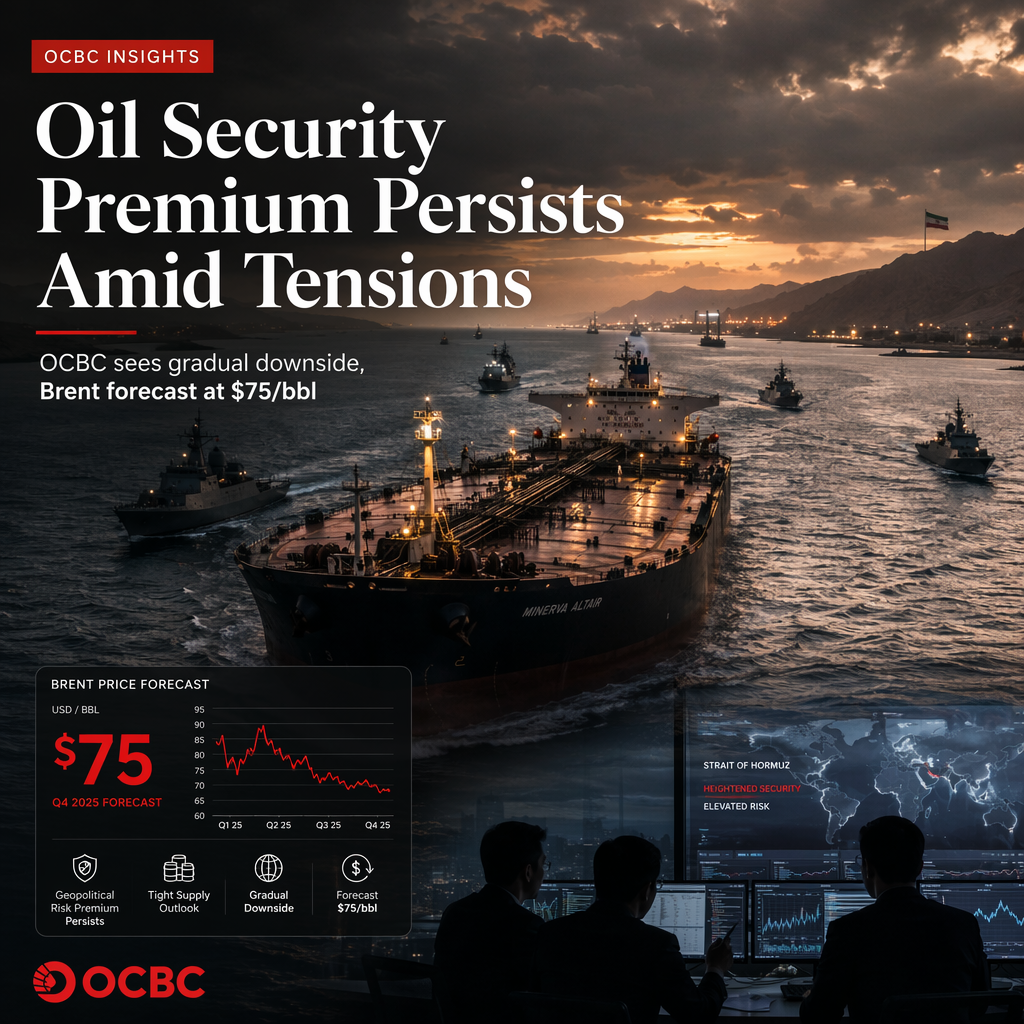
Oil prices experienced a rally driven by renewed concerns over US-Iran tensions, following Washington's decision to revoke its waiver for Iranian oil sales after attacks on three vessels in the Strait of Hormuz [1]. This development, combined with tech-led equity weakness, contributed to a stronger US Dollar, higher global bond yields, and a retreat in gold prices [1]. OCBC Bank analysts Sim Moh Siong and Christopher Wong noted that the security premium in oil prices, reflecting ongoing disruption risks, is expected to persist and slow the pace of any price decline [1].
OCBC maintains its Brent crude oil price forecasts at USD75 per barrel by the end of 2026 and USD71 per barrel by mid-2027, indicating an expectation of only a gradual downside in oil prices rather than a sharp correction [1]. The analysts highlighted that a return to full-scale US-Iran conflict is unlikely, as US political pressure is mounting to keep oil prices contained ahead of the November midterm elections [1]. However, there is still no clear path to fully securing the Strait of Hormuz, and the US is expected to continue leveraging economic pressure in negotiations with Iran [1].
Another factor influencing the oil market outlook is the potential for increased Chinese imports, particularly after reports of China purchasing discounted Saudi crude [1]. The combination of geopolitical risks and uncertain demand dynamics is keeping inflation and terms-of-trade risks elevated, according to OCBC [1].
CONCLUSION
OCBC expects oil prices to decline only gradually due to persistent security risks and geopolitical tensions, maintaining Brent forecasts at USD75/bbl by end-2026 and USD71/bbl by mid-2027. Market sentiment remains cautious, with elevated yields and a stronger US Dollar reflecting ongoing uncertainty in the oil market.