
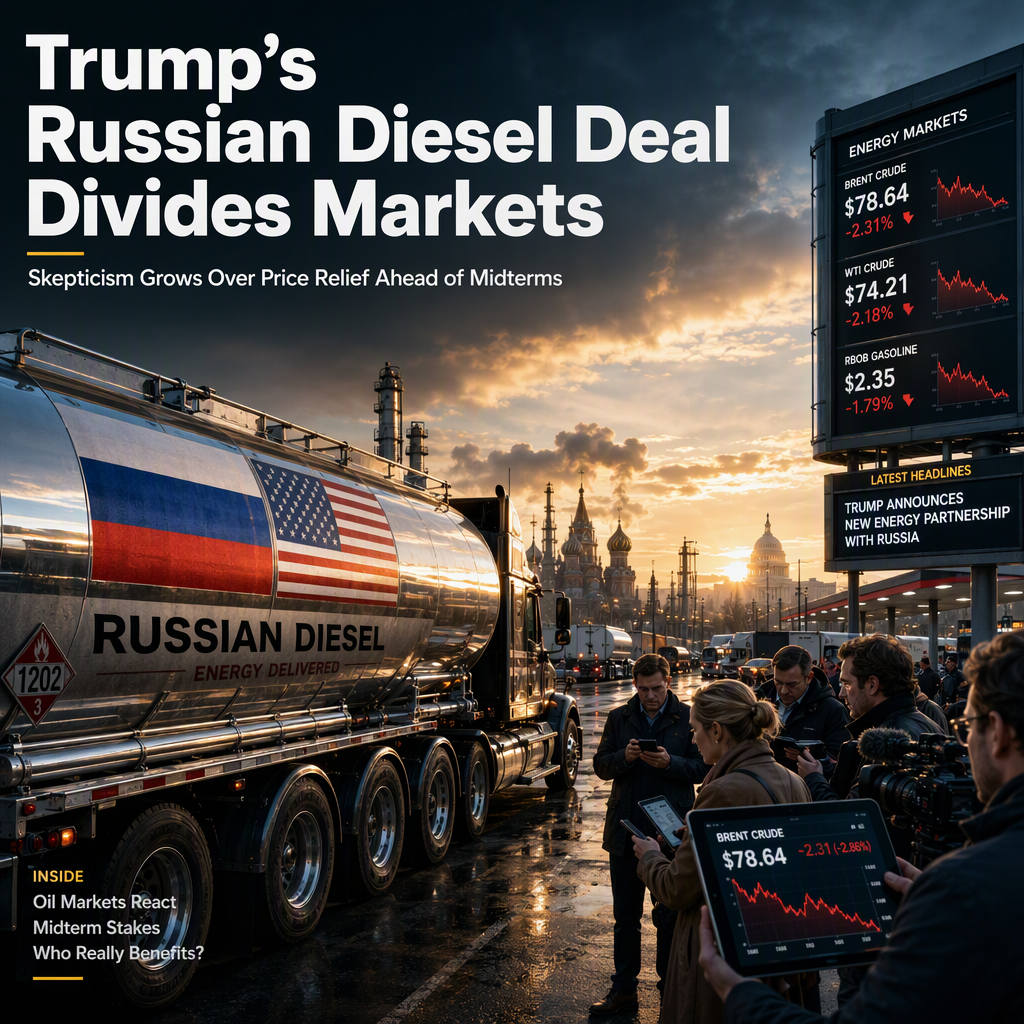
U.S. President Donald Trump declared an 'energy ceasefire' between Russia and Ukraine on Sunday via Truth Social, surprising global policymakers and prompting an initial dip in oil prices on Monday, despite Russia striking a power plant shortly after the announcement [1]. Trump announced a deal for Russia to immediately release 300,000 metric tons of diesel to the U.S. and global markets, with an additional 500,000 tons in November and 1 million tons thereafter. Moscow is expected to deliver another 3 million tons of diesel, contingent on the condition of Russia's refineries, according to Trump [1].
The move is aimed at addressing a diesel supply crunch and taming inflation ahead of the November midterm elections, where Trump's Republican Party faces the risk of losing both houses of Congress. According to the Pew Research Center, 84% of registered voters consider the economy 'very important' to their vote [1]. Diesel prices had reached a record high average of $6.5276 per gallon in late September, driven by the wars in Ukraine and the Middle East impacting supply [1].
Analysts remain skeptical about the deal's effectiveness. Mohit Kumar, chief European economist at Jefferies, noted that while increased supply could ease some pressure on diesel prices, the agreed volumes are unlikely to make a substantial difference [1]. The deal has also drawn opposition from within the U.S. and European leaders, as it would bypass existing Russian sanctions [1]. Lombard Odier analysts highlighted that announced shipments are not equivalent to delivered volumes, and questioned Russia's capacity to fulfill the agreement [1].
The U.S. Treasury has issued a temporary license easing sanctions on Russian diesel to facilitate the deal announced by Trump on Friday [1]. Lombard Odier analysts also pointed to Chinese plans to resume refined-fuel exports as potentially significant for the global diesel market, but cautioned that actual deliveries remain uncertain [1].
CONCLUSION
President Trump's deal with Russia to boost diesel supply ahead of the midterms has led to a temporary dip in oil prices, but analysts doubt the agreement will significantly lower diesel prices or ease inflation. The deal faces skepticism over Russia's ability to deliver the promised volumes and concerns about bypassing sanctions. Market participants remain cautious, awaiting actual deliveries and further developments.