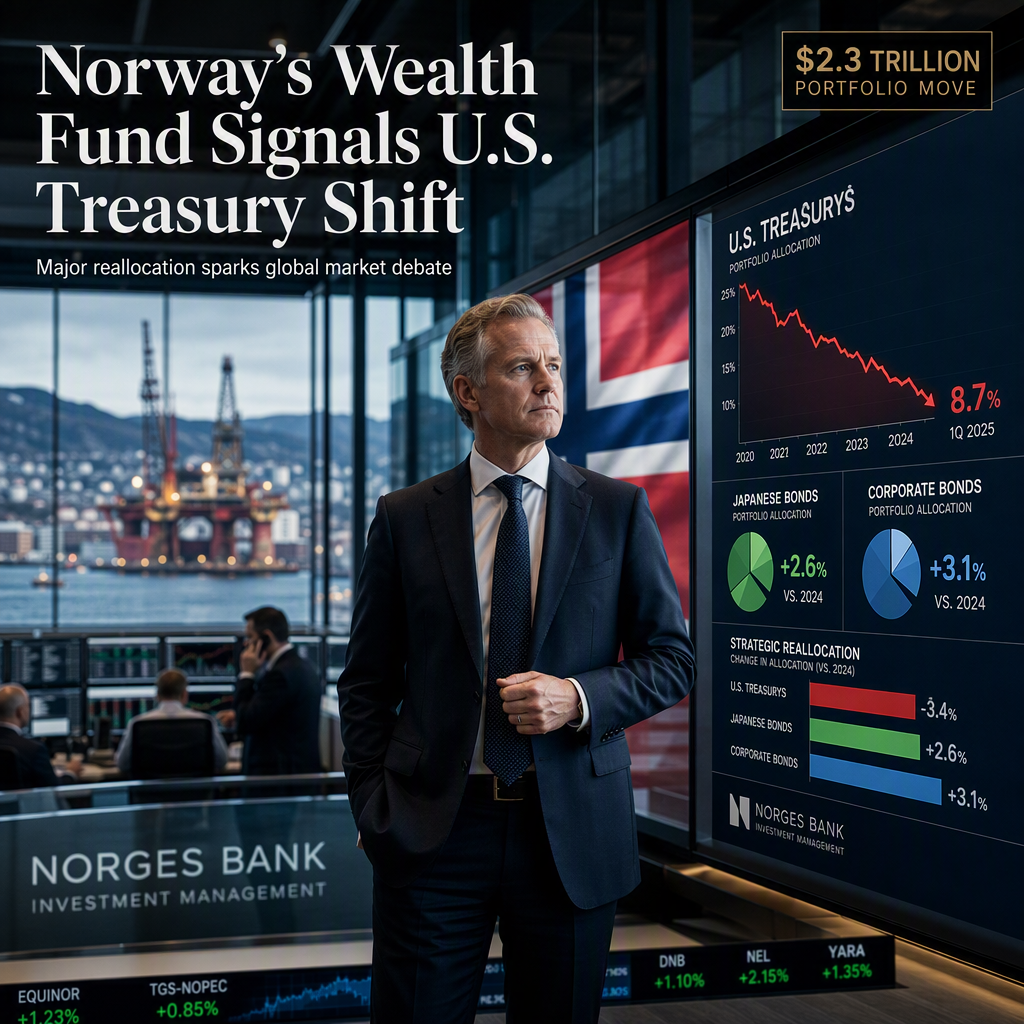
Norway's sovereign wealth fund, managed by Norges Bank Investment Management (NBIM), has proposed a significant reduction in its allocation to government bonds within its $2.3 trillion investment portfolio, with the most notable impact on its holdings of U.S. Treasurys [1]. In a letter to Norway's finance ministry, NBIM recommended lowering the government subindex of its bond holdings from 70% to 50%, aiming to maintain liquidity during market turbulence while seeking higher returns through diversification [1]. This reallocation would gradually decrease NBIM's Treasury holdings from 34.1% to 21.9%, reduce euro area holdings from 16.8% to 14.1%, and increase Japanese government bond exposure from 4.6% to 7.4% [1]. NBIM also intends to shift its weighting methodology for government bonds from GDP to market value, citing the high debt levels across developed economies [1].
The timing of this proposed shift is particularly sensitive for the U.S. Treasury market, as long-dated yields have reached decade-highs amid concerns over the U.S. fiscal trajectory and mounting debt [1]. Economist Mohamed El-Erian commented that "Reliable buyers and holders of U.S. Treasurys are under pressure," referencing Japan, China, and Gulf countries, and emphasized that NBIM's move, while not large in size, sends a significant signal about the reliability of traditional Treasury buyers [1].
In addition to reducing government bond exposure, NBIM plans to increase its holdings of non-government U.S. fixed income, such as corporate bonds, from 16.2% to 27.6% [1]. CEO Nicolai Tangen and central bank chief Ida Wolden Bache stated that the fund could earn higher premiums by diversifying into riskier assets, including mortgage-backed securities, which they believe are well-suited for long-term investors and can help reduce portfolio volatility during crises [1]. NBIM currently holds approximately $1.65 trillion in equities, representing ownership of nearly 1.5% of all shares in the world's listed companies, and $592 billion in fixed income [1].
The fund, established in 1998 to invest Norwegian oil revenues, has recently achieved record profits from investments in U.S. and Asian tech firms, particularly those benefiting from the AI boom, such as semiconductor stocks [1]. However, Tangen has cautioned that these high returns are unsustainable in the event of a market downturn, as evidenced by a $40 billion loss in the first quarter of 2025 when investors shifted to risk-off positions [1].
CONCLUSION
Norway's sovereign wealth fund's proposed reduction in U.S. Treasury holdings signals a shift among traditional buyers and could have significant implications for the Treasury market. The fund's move toward greater diversification and riskier assets reflects a strategic response to changing market conditions and concerns about sustainability of recent high returns. Market participants may view this as a warning of reduced reliability among major Treasury holders, potentially increasing volatility in government bond markets.