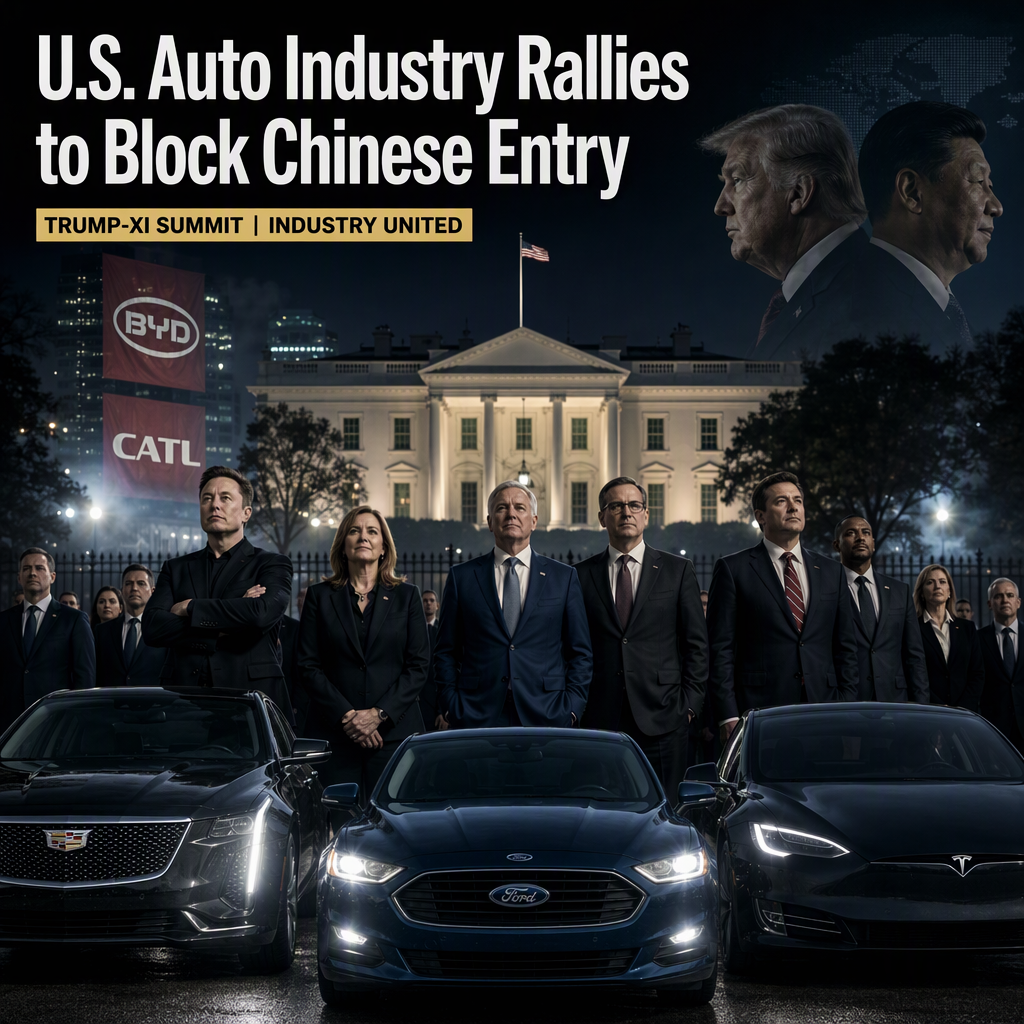
As President Donald Trump prepares to meet with Chinese President Xi Jinping, the U.S. auto industry and lawmakers are intensifying efforts to prevent Chinese automakers from entering the American market [1]. Bipartisan bills to ban Chinese automakers from the U.S. are advancing in Congress, and more than two dozen Democratic lawmakers have sent a letter urging Trump to maintain current restrictions [1]. The unified stance includes automakers, franchised dealers, and suppliers, who have collectively urged Trump to reconsider his earlier statement that he might be 'OK' with Chinese automakers entering the U.S. if they produce vehicles domestically [1].
Industry experts, such as Michael Dunne, a former General Motors executive, have warned that the U.S. could experience a surge of Chinese vehicles similar to what Europe has seen, describing the potential entry as a 'Pandora's box' for the domestic industry [1]. Senator Elissa Slotkin emphasized the bipartisan nature of the issue, stating, 'It's about whether we want to make cars in America and whether we want a manufacturing base that can pivot when we need it' [1].
The upcoming meeting between Trump and Xi is expected to include high-profile attendees such as Wang Chuanfu, founder of BYD, and Robin Zeng, founder of CATL, highlighting the significance of the event for the U.S. auto sector [1]. GM CEO Mary Barra and Tesla CEO Elon Musk are also expected to attend the state dinner, while Ford declined to disclose CEO Jim Farley's attendance and Stellantis confirmed CEO Antonio Filosa will not be present [1].
The pressure campaign from the U.S. auto industry and lawmakers comes amid rapid expansion of China-made vehicles in international markets, raising concerns about the potential impact on American manufacturing and jobs if Chinese automakers gain access to the U.S. market [1].
CONCLUSION
The U.S. auto industry and lawmakers are presenting a unified front to keep Chinese automakers out of the American market as Trump meets with Xi Jinping. The outcome of these discussions could have significant implications for domestic manufacturers and the competitive landscape of the U.S. auto industry.