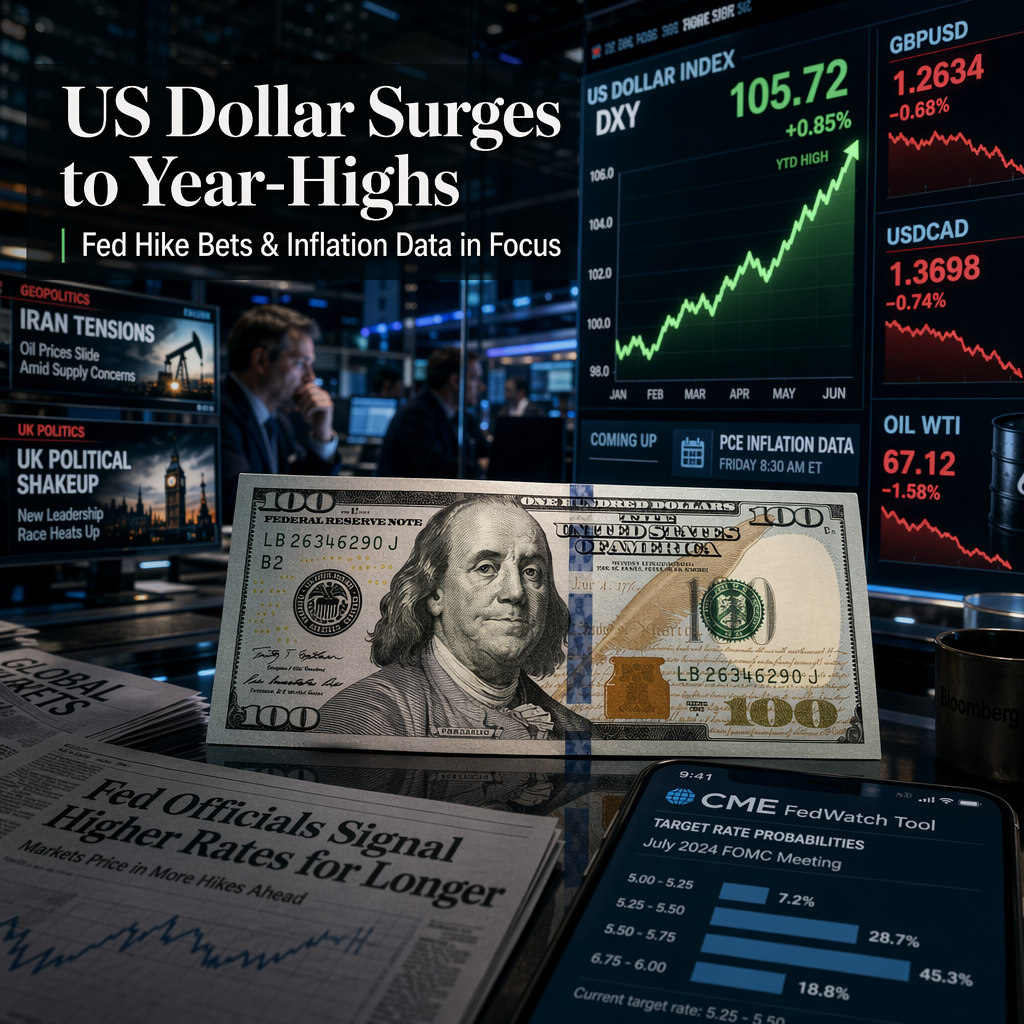
The US Dollar has surged to its highest level in over a year, with the US Dollar Index (DXY) trading around 101.60–101.70, following a hawkish Federal Reserve (Fed) outlook and increased market expectations for further rate hikes this year [1][2][3]. After the June 16-17 FOMC meeting, money markets are now pricing in nearly an 86% chance of a Fed rate hike by December, up from around 61% before the meeting, according to both FXStreet and the CME FedWatch tool [1][2]. However, DBS Group Research notes a discrepancy, citing a 54.6% chance of a 25-basis-point hike to 4.00% at the September 16 FOMC meeting [3].
The strengthening US Dollar has weighed on other major currencies. The Canadian Dollar (CAD) dipped, with USD/CAD trading higher around 1.4230 after reaching a more-than-one-year high at 1.4239, pressured by lower oil prices and widening yield differentials in favor of the US Dollar [1]. The British Pound (GBP) also fell, trading 0.38% lower at around 1.3150 against the US Dollar, as hawkish Fed bets and technical breakdowns reinforced a bearish near-term bias for GBP/USD [2].
Geopolitical tensions, particularly between the US and Iran, have further supported demand for the Greenback. Iranian President Masoud Pezeshkian stated that Tehran’s ballistic missile program will not be part of negotiations with the US, while former US President Donald Trump disputed Iran’s claims regarding international inspections, adding to market uncertainty [1].
Looking ahead, all sources highlight the upcoming release of the US Personal Consumption Expenditures (PCE) Price Index for May as a key risk event. This report, the Fed’s preferred inflation gauge, could provide fresh guidance on the near-term monetary policy outlook [1][3]. DBS’s Philip Wee cautions that the current US Dollar rally is vulnerable to surprises in the PCE print, especially as lower crude and pump prices may create a disinflationary effect on headline inflation [3].
In Canada, Bank of Canada Governor Tiff Macklem warned that global financial flow imbalances could increase financial stability risks, while in the UK, political uncertainty persists following Prime Minister Keir Starmer’s resignation and the Labour Party’s defeat in local elections [1][2].
CONCLUSION
The US Dollar's rally to year-highs is driven by hawkish Fed expectations and global uncertainties, putting pressure on major currencies like the Canadian Dollar and British Pound. However, the upcoming US PCE inflation data poses a significant risk to the Dollar's dominance, with markets closely watching for any surprises that could alter the Fed's policy trajectory. Investors remain cautious amid geopolitical tensions and shifting global economic conditions.