
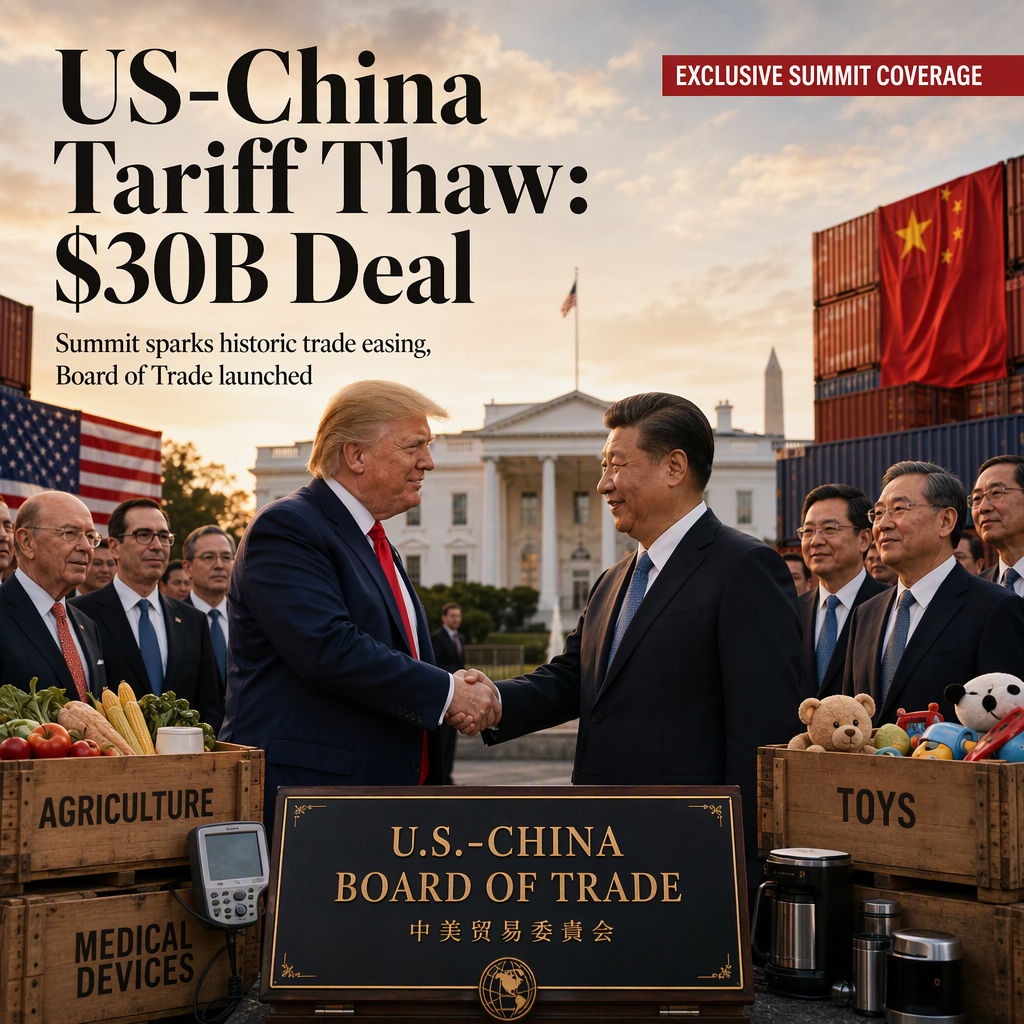
The United States and China have reached an agreement to lower tariffs on $30 billion worth of goods traded between the two countries, following a three-day summit in Washington, D.C. between President Donald Trump and Chinese President Xi Jinping [1]. The White House stated that the reciprocal tariff reductions will apply to 'non-sensitive goods.' Specifically, U.S. exports such as agricultural products, fish and seafood, logs and wood products, cosmetics, and medical devices will receive favorable tariff treatment in China. In return, U.S. imports of Chinese-made small appliances, toys, holiday decorations, and children's car seats will also benefit from preferential treatment [1].
The agreement was facilitated by the newly established U.S.-China Board of Trade, which was first proposed during Trump's visit to China in May and formally created during Xi's visit to Washington [1]. U.S. Trade Representative Jamieson Greer indicated that more details about the trade agreement will be released on Monday, noting that the tariff terms were finalized after weeks of negotiations. However, neither country has disclosed the final tariff rates or the complete list of products that will receive favored status [1].
This development marks a significant de-escalation in the trade war initiated by President Trump in February 2025, when the U.S. imposed a 10% tariff on all Chinese imports, citing concerns over Beijing's role in the fentanyl crisis and illegal immigration. China retaliated with tariffs on U.S. coal, liquefied natural gas, crude oil, and cars. At the height of the trade conflict, U.S. tariffs on Chinese goods reached 145% in April 2025, while China imposed tariffs of up to 125% on U.S. goods [1].
Previous negotiations in Geneva in May 2025 resulted in a 90-day truce, reducing U.S. tariffs to 30% and China's to 10%, with the agreement extended for another 90 days in August. Further talks in South Korea in October 2025 led to China agreeing to crack down on fentanyl precursors, resume purchases of U.S. soybeans, and ease restrictions on rare-earth exports, while the U.S. agreed to further ease tariffs. The newly established Board of Trade will continue to serve as a platform for negotiating additional tariff reductions and resolving other trade disputes, with the possibility of broader agreements in the future [1].
CONCLUSION
The agreement to lower tariffs on $30 billion in goods signals a major thaw in U.S.-China trade tensions and could pave the way for further negotiations. While key details such as final tariff rates remain undisclosed, the establishment of the U.S.-China Board of Trade provides a framework for ongoing dialogue and potential future agreements.