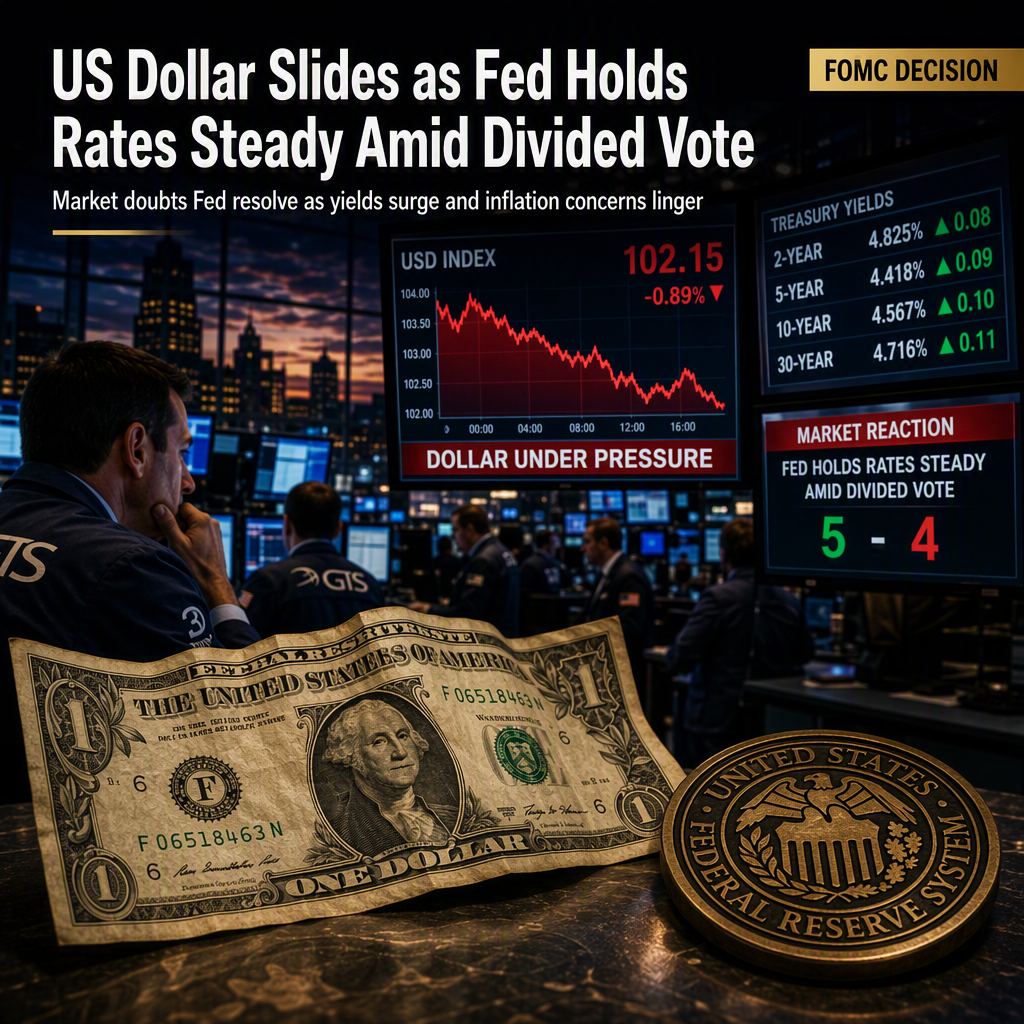
The US Federal Reserve left its benchmark interest rate unchanged at 3.50%–3.75% following a closely watched Federal Open Market Committee (FOMC) meeting, but the decision was marked by a notable split among policymakers. Three regional Fed presidents—Beth Hammack (Cleveland), Neel Kashkari (Minneapolis), and Lorie Logan (Dallas)—dissented, favoring a 25-basis-point hike instead of a hold, resulting in a 9–3 vote [1][2][3][4]. Despite the hawkish dissent, the majority opted to keep rates steady, citing solid economic growth, robust productivity, and a strong labor market, while acknowledging that inflation remains elevated, partly due to energy-related supply shocks [1][2][3].
Chairman Kevin Warsh emphasized the Fed's unwavering commitment to returning inflation to its 2% target, stating, "there is only one target, and the Fed intends to deliver it" [3]. However, Warsh also made clear that the path forward would not be easy or quick, remarking, "We've got no magic wand. This isn't something that we're going to be able to carry out in days or weeks" [4]. The Fed's policy statement remained concise and avoided forward guidance, with Warsh noting that the Committee is "steering clear of forecasting" and will focus on incoming data and inflation trends ahead of the next decision in seven to eight weeks [3][4].
The market reaction was swift: the US Dollar Index (DXY) fell around 0.5% to near 100.90, hitting a six-day low, as the decision raised doubts about the likelihood of a rate hike at the September meeting [1][2]. Major currency pairs such as EUR/USD and GBP/USD advanced by approximately 0.7% and 0.5%, respectively, reflecting broad-based dollar weakness [1]. Meanwhile, US Treasury yields saw significant volatility. The 30-year yield surged by more than 10 basis points to 5.211%, its highest level since 2007, while the 2-year yield dipped, signaling market skepticism about the Fed's inflation-fighting resolve and concerns over future inflation risks [2][4].
Silver (XAG/USD) held firm near $57.17, little changed on the day, as the weaker dollar and surging long-end yields drove choppy trading. Technical analysis suggests silver remains in a bearish near-term trend, with price action capped within a broader descending channel [2].
Looking ahead, the Fed provided no explicit guidance on the September meeting, leaving investors to focus on upcoming economic data, including Q2 GDP figures and the Fed's preferred inflation gauge [1][2][4]. Warsh reiterated that the Committee would remain data-dependent and avoid committing to a predetermined policy path [3][4].
CONCLUSION
The Fed's decision to hold rates steady, despite a divided vote and hawkish rhetoric, triggered a sharp decline in the US Dollar and a surge in long-term Treasury yields. Markets remain unconvinced by the Fed's inflation-fighting stance, and uncertainty persists regarding future policy moves. Investors will closely watch upcoming economic data for clues on the Fed's next steps.