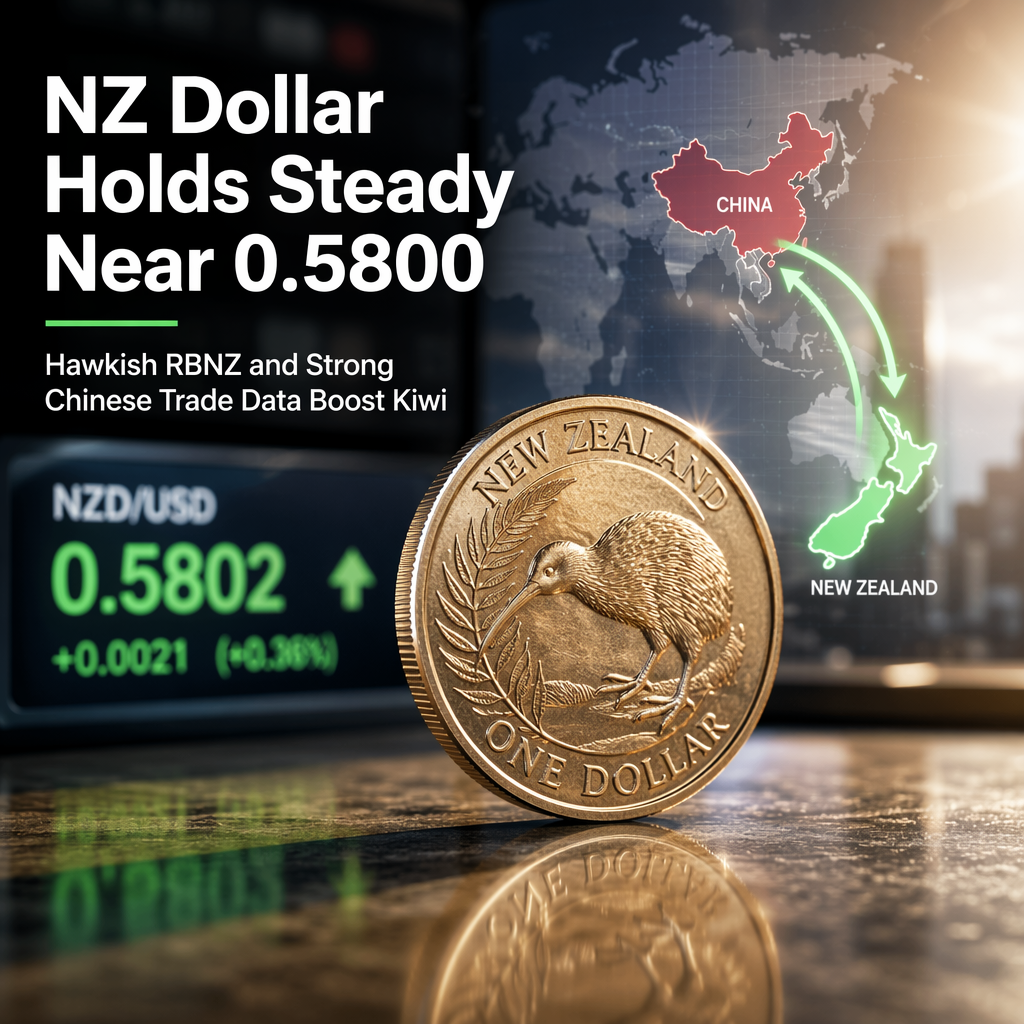
The New Zealand Dollar (NZD) appreciated against the US Dollar (USD) on Tuesday, maintaining gains near the 0.5800 level despite a risk-averse market environment [1]. This resilience was attributed to investor expectations of further rate hikes by the Reserve Bank of New Zealand (RBNZ) and stronger-than-anticipated trade data from China, New Zealand’s largest trading partner [1]. RBNZ official Paul Conway stated that the central bank will have to 'act more firmly to re-anchor inflation expectations,' reinforcing the hawkish tone from the latest RBNZ monetary policy statement and suggesting the possibility of additional rate hikes in the coming months [1].
China’s trade surplus for June widened to USD 125.62 billion from USD 105.43 billion in May, surpassing expectations of a USD 121 billion surplus. This positive data from China provided further support to the NZD, given the close economic ties between the two countries [1].
On the US side, the Dollar remained supported by hawkish remarks from Federal Reserve Governor Christopher Waller, who indicated that the Fed may be compelled to raise rates in the near term if inflation stays above the 2% target [1]. Market participants are anticipating June’s Consumer Price Index (CPI) to ease to a 3.8% year-over-year rate from 4.2% in May, with the core CPI expected to remain steady at 2.9% [1]. Additionally, Fed Chairman Kevin Warsh is set to appear before the US Congress, where his comments could provide further insight into the Fed’s policy trajectory, although he is not expected to offer explicit guidance [1].
Overall, the NZD’s recent strength reflects a combination of domestic monetary policy expectations and supportive external data, even as global risk sentiment remains cautious due to ongoing geopolitical concerns [1].
CONCLUSION
The New Zealand Dollar’s ability to hold gains near 0.5800 highlights the market’s focus on potential RBNZ rate hikes and robust Chinese trade data. While global risk aversion persists, the NZD remains supported by these positive drivers, with upcoming US inflation data and Fed commentary likely to influence future moves.