
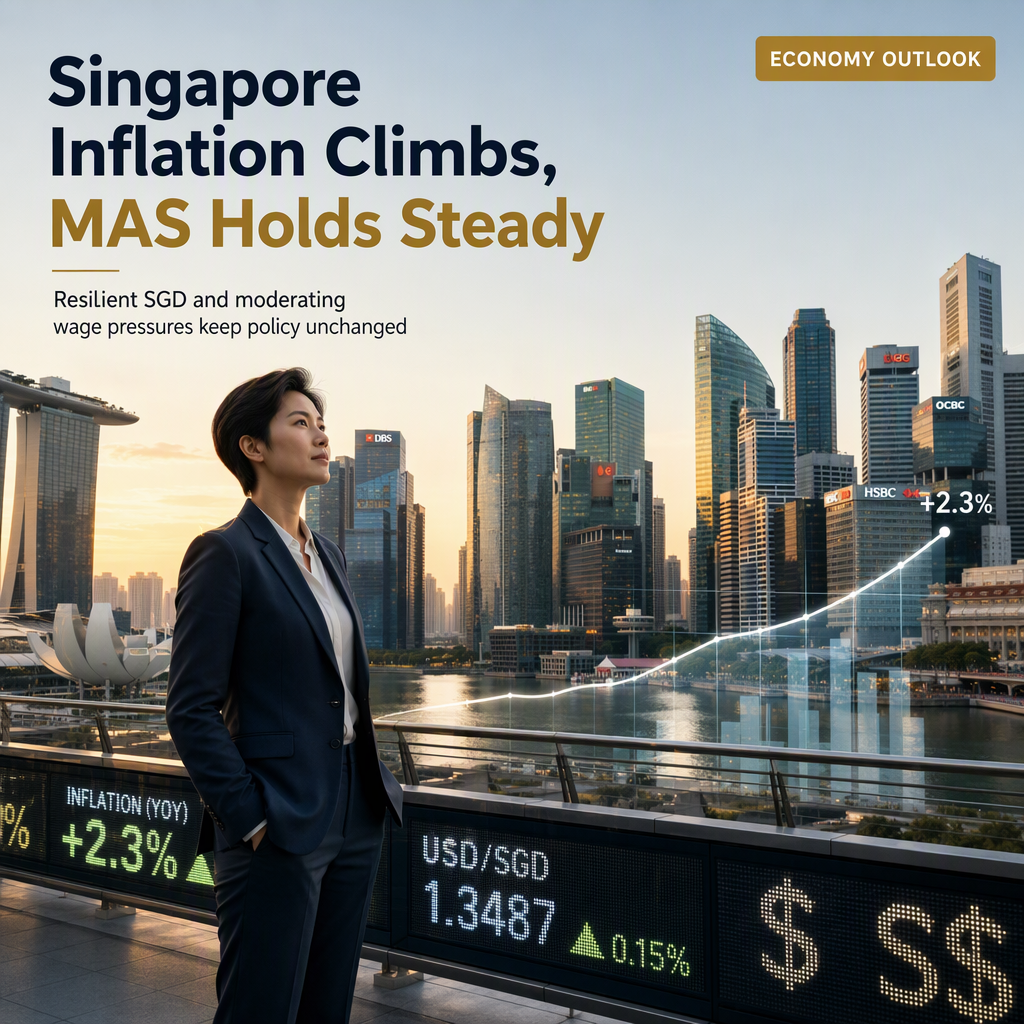
Singapore's August headline inflation increased to 2.3% year-on-year, up from 2.2% in July, marking the highest level since July 2024 and representing the third consecutive month of acceleration. This figure matched market expectations. Core inflation, which excludes accommodation and private transportation, also rose to 2.2% year-on-year from 2.0% in July, aligning with the Bloomberg consensus. Both headline and core inflation remained in the upper half of the Monetary Authority of Singapore's (MAS) 2026 forecast range of 1.5-2.5% for the second month in a row [1].
Commerzbank analysts Dr. Henry Hao and Moses Lim noted that the increase in inflation was driven by services, retail goods, food, and utilities. Despite the firmer inflation data, they expect wage pressures to moderate in the coming months, which should reduce the urgency for further monetary tightening by MAS. Unless there is a significant broadening of inflation pressures or a persistent rise in imported inflation due to higher global energy prices, MAS is likely to keep its policy unchanged at the next review in October [1].
In the foreign exchange market, the USD/SGD pair rose 0.4% to 1.2800, closing at its highest level since 13 August, primarily due to broad dollar strength. Despite this, the Singapore dollar has remained resilient, ranking as the third best-performing Asian currency this year. Year-to-date, the SGD is up 0.4% against the USD, compared to an average depreciation of 1.71% for Asian currencies excluding Japan [1].
CONCLUSION
Singapore's inflation remains elevated but within the MAS forecast range, supporting expectations that the central bank will hold policy steady in October. The Singapore dollar continues to outperform regional peers, reflecting underlying economic resilience despite recent currency movements.