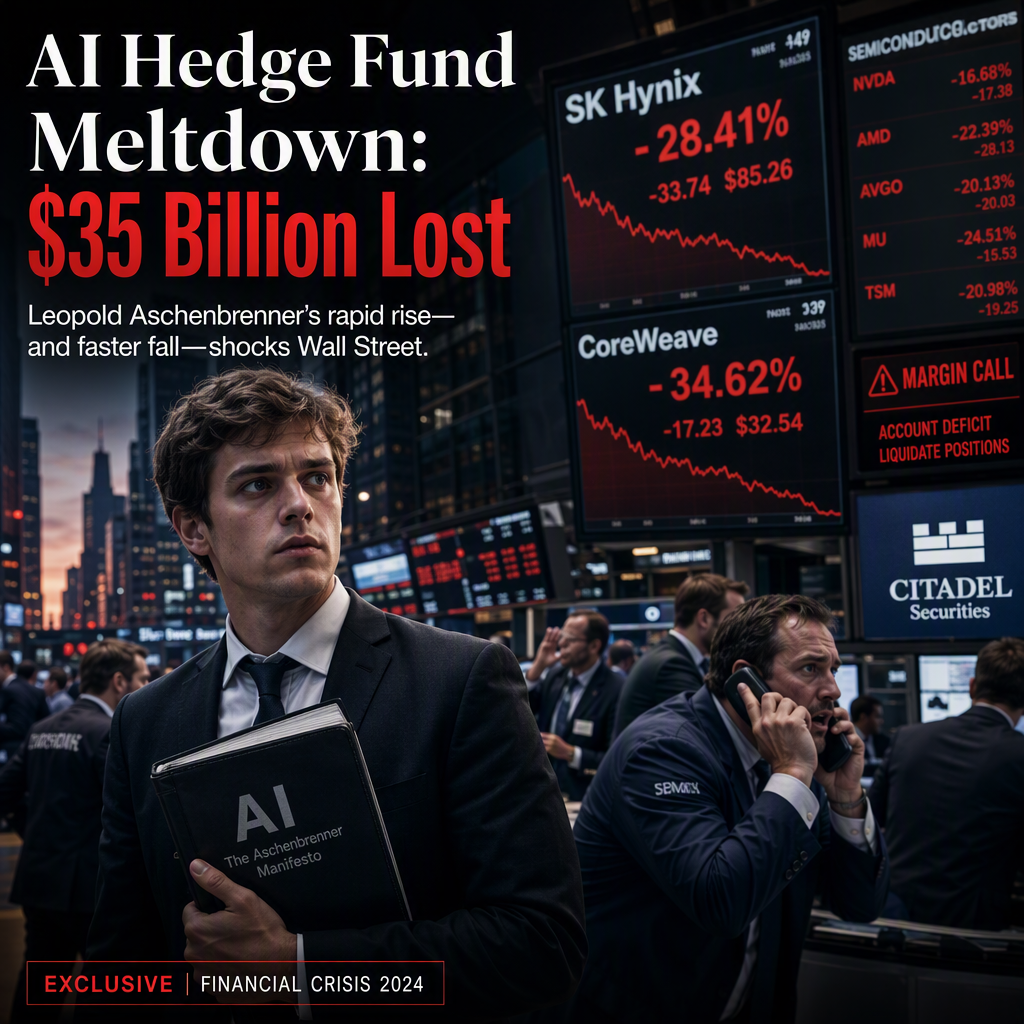
Leopold Aschenbrenner’s AI-focused hedge fund, Situational Awareness, experienced a dramatic collapse, shrinking from $45 billion to approximately $10 billion in assets within days due to falling semiconductor stocks and mounting margin calls [1]. The fund, which reportedly used leverage of up to 400%, was forced to liquidate all its leveraged public stock positions—including significant holdings in SK Hynix and CoreWeave—selling them at a discount to Ken Griffin's Citadel [1].
Aschenbrenner, a former OpenAI researcher and Columbia University valedictorian, had launched the fund in July 2024 after gaining notoriety for his 165-page AI manifesto, which became influential in Silicon Valley [1]. Prior to the collapse, Situational Awareness had achieved gains of over 1,000% since inception, and Aschenbrenner was just 24 years old, according to the Wall Street Journal [1].
Despite his rapid rise, critics highlighted Aschenbrenner’s lack of money management experience and his previous association with the failed crypto firm FTX, where he worked with Sam Bankman-Fried [1]. Some Wall Street professionals, referencing the fund’s extreme leverage, suggested the collapse was anticipated, with one trader stating, “A lot of people saw this blow-up as a matter of not if, but when” [1].
The fund’s downfall has made Aschenbrenner a high-profile casualty of the volatility surrounding the AI investment boom, drawing attention from both Wall Street and technology circles [1].
CONCLUSION
Leopold Aschenbrenner’s Situational Awareness fund’s rapid collapse underscores the risks of extreme leverage and sector concentration, especially in volatile markets like AI and semiconductors. The event has sent shockwaves through both financial and tech communities, highlighting the importance of experience and risk management in hedge fund operations.