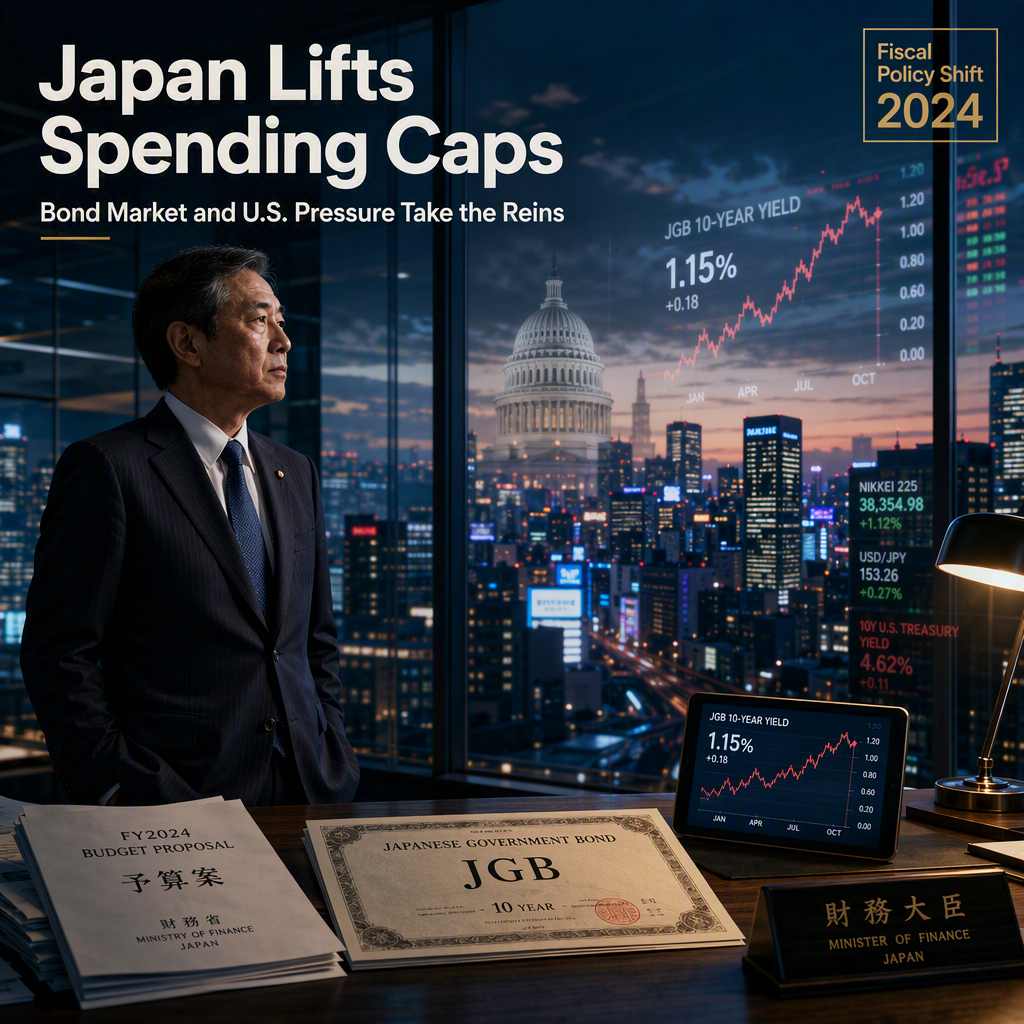
Japanese Prime Minister Sanae Takaichi's government has eliminated spending caps in strategic fields for the fiscal 2027 budget, shifting the primary checks on government spending to the bond market and pressure from the United States [1]. This policy change is intended to facilitate increased public investment in sectors such as artificial intelligence and the semiconductor industry [1]. However, the move has raised concerns among investors about the potential for increased government borrowing to drive up Japanese government bond (JGB) yields [1].
Recent developments in the bond market have already reflected these concerns, with yields on JGBs spiking due to fears over the expanding budget and uncertainty regarding the U.S. response to Japan's fiscal stance [1]. Market participants are closely monitoring the situation for further signs that increased debt issuance could put additional upward pressure on yields, which would in turn raise borrowing costs for the government [1].
The elimination of spending caps comes at a time when Japan is facing a fiscal shortfall of $63 billion, attributed to planned food tax cuts and a defense buildup [1]. Total budget requests for fiscal year 2027 are projected to reach a record $895 billion [1]. Analysts warn that a significant rise in JGB yields could force the government to reconsider the scale of its spending ambitions, particularly in areas such as rare-earth mining, technology, and defense [1].
In the absence of traditional spending caps, market discipline and foreign (notably U.S.) pressure are now seen as the main constraints on fiscal expansion, and their influence is expected to play a key role in shaping Japan's fiscal policy going forward [1].
CONCLUSION
Japan's removal of spending caps for the 2027 budget has heightened market concerns, as reflected in rising JGB yields and increased scrutiny from the U.S. The bond market and foreign pressure are now the primary checks on fiscal expansion, and any further rise in yields could force a reassessment of government spending plans.