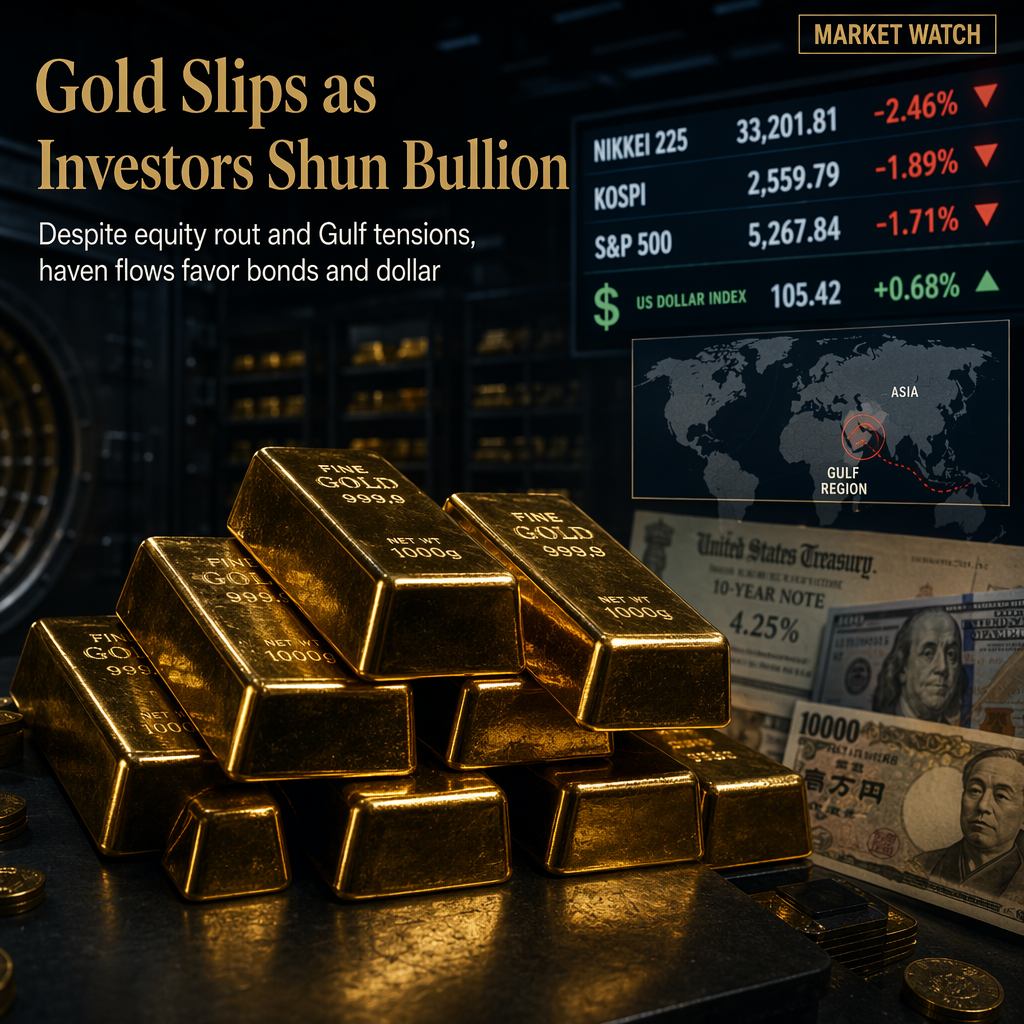
Gold traded near $4,020 in the New York morning session, marking a decline of approximately 1.4% from its opening near $4,075, and failed to attract significant buying interest even as global equities experienced a sharp selloff [1]. The day's low was just above the $4,000 level. The overnight market turmoil was most pronounced in Asia, where Korean shares dropped nearly 11%, the Nikkei 225 fell close to 4%, and the regional benchmark lost 3%, driven by renewed skepticism about returns on artificial intelligence investments [1]. Despite the risk-off sentiment, investors favored government bonds and the US Dollar over gold, with the Dollar Index reaching a one-month high near 101.50 and the Dollar trading just below 164.00 against the Yen [1].
Ordinarily, falling Treasury yields would support gold, which does not pay interest, but gold prices declined, indicating that the demand for safe-haven assets was expressed through currencies and bonds rather than bullion [1]. Geopolitical tensions in the Gulf region also failed to boost gold, as American strikes on Iran were paused for a fourth day. While Washington claimed Tehran requested the pause, Tehran denied any negotiations beyond talks with Oman on safe passage. Shipping through the Strait of Hormuz remained severely restricted, with fewer than 10 vessels passing daily compared to about 100 before the conflict, yet gold prices behaved as if the chokepoint was open [1].
Market focus has shifted to a key economic report due at 18:00 GMT on Wednesday, which is expected to influence the Federal Reserve's rate outlook. The probability of a rate hike at the upcoming meeting has remained near 36% since last week, with markets pricing in an 80% chance of at least one increase by September and no rate cuts expected through 2026 [1]. June's inflation data showed a headline rate of 3.5% year-over-year, just below the 3.75% upper bound, turning the real policy rate positive after two months, while core inflation stood at 2.6%, widening the gap to over a full percentage point [1]. This environment of rising or steady policy rates is unfavorable for gold, which offers no yield.
June fund flows further illustrate the bearish sentiment, as physically backed gold exchange-traded products saw outflows of approximately $8.9 billion, reducing holdings by 74 tonnes to just above 4,000 tonnes, with most of the selling occurring in North America as investors sought higher yields elsewhere. However, the first half of the year still saw net inflows of about $8 billion, with Asian funds accounting for a record $12 billion of that total [1].
CONCLUSION
Despite significant global equity losses and ongoing geopolitical risks, gold prices fell as investors favored the US Dollar and government bonds for safety. The market's focus remains on upcoming economic data and Federal Reserve policy, with rising or steady rates weighing on gold's appeal. Fund flows reflect a regional divergence, with North American outflows offset by strong Asian demand earlier in the year.