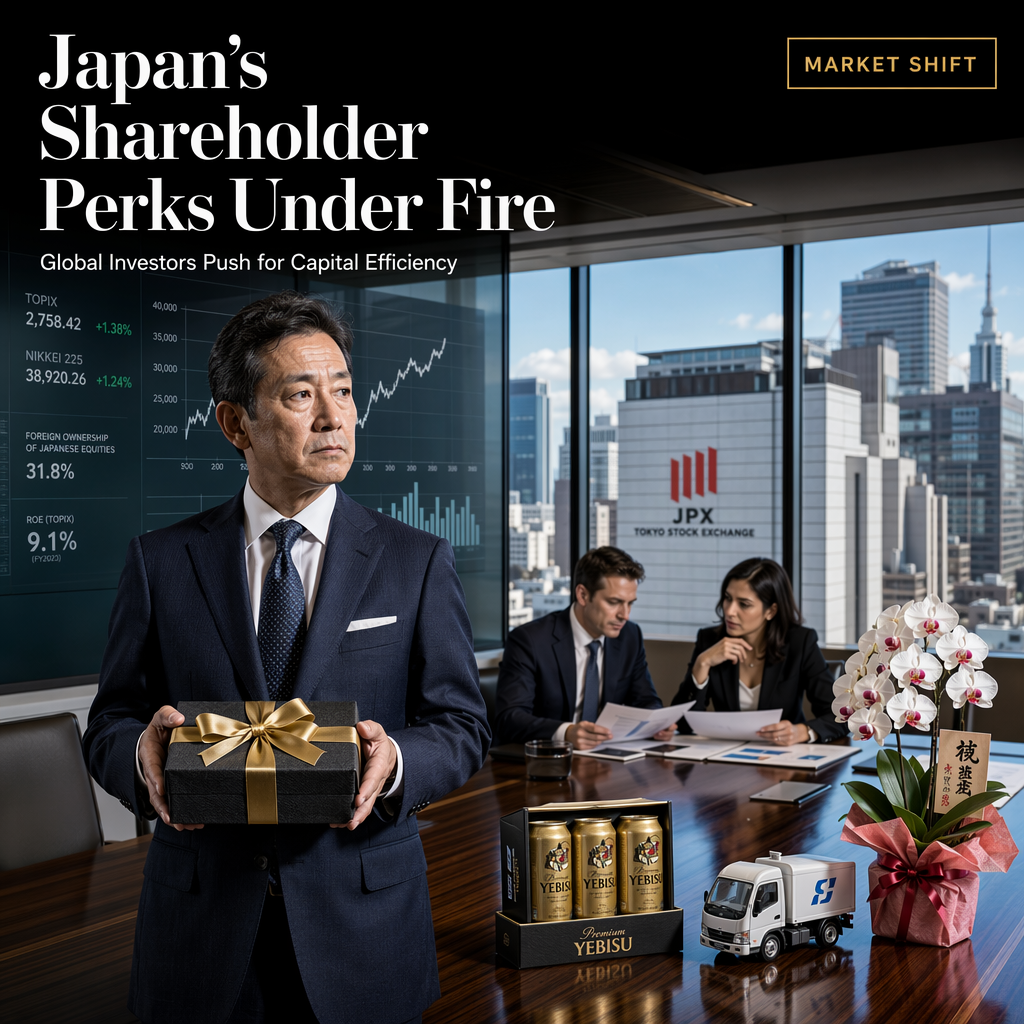
Japanese companies are rethinking the long-standing practice of offering shareholder perks, known as kabunushi yutai, which include gifts such as orchids, beer, and toy trucks to reward shareholders beyond standard dividends [1]. This tradition is being scrutinized as Japan Inc. faces increasing pressure from global investors and the Tokyo Stock Exchange to improve capital efficiency and justify all expenditures, including these perks [1].
Some companies reportedly spend millions of yen annually on shareholder gifts, a practice that may foster goodwill among retail investors but does not necessarily align with the interests of institutional investors or those seeking maximum returns [1]. Market analysis indicates a gradual shift, with more companies reconsidering their capital allocation strategies and some already scaling back or eliminating perks in favor of higher dividends or share buybacks, aligning with global best practices [1].
A Tokyo-based fund manager emphasized the need for boards to evaluate every yen spent on perks against potential investment returns, suggesting that funds used for gifts could be better allocated to generate higher profits or return capital to shareholders [1]. Trading sentiment among institutional investors remains cautious toward companies that prioritize perks over financial returns, with analysts highlighting return on equity (ROE) and price-to-book ratios (PBR) as key benchmarks for investment attractiveness [1].
The article notes that while there is no specific technical analysis or chart provided, the broader market trend is clear: companies with low ROE and high spending on non-essential gifts are increasingly seen as less attractive investment targets [1].
CONCLUSION
Japanese companies are under growing pressure to justify shareholder perks as part of their capital allocation strategies. The market is increasingly favoring firms that prioritize financial returns over non-essential gifts, signaling a shift toward global best practices and improved capital efficiency.