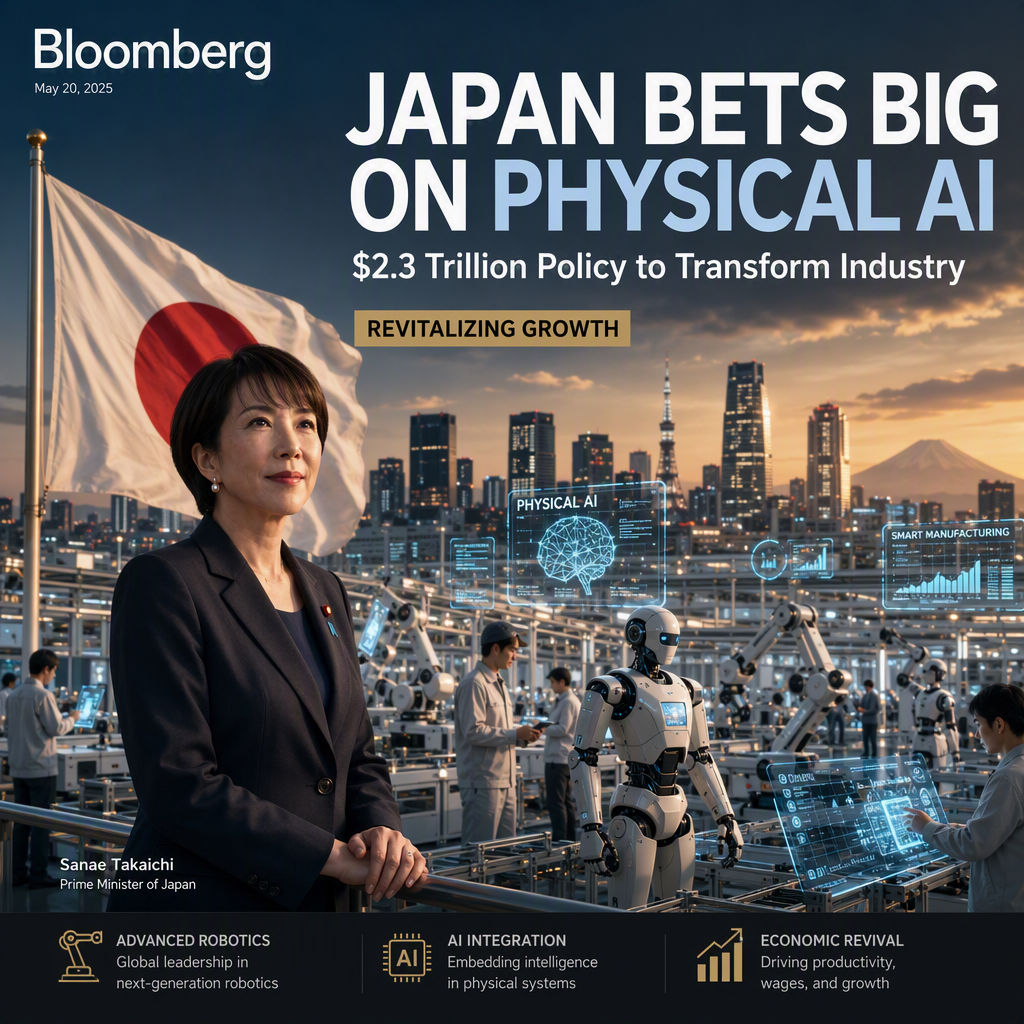
Prime Minister Sanae Takaichi has announced a sweeping $2.3 trillion industrial policy plan aimed at revitalizing Japan's economic growth through targeted investment in next-generation industries and technologies, with a particular emphasis on 'Physical AI'—the integration of artificial intelligence into manufacturing processes [1]. The policy seeks to leverage Japan's strengths in robotics and advanced manufacturing, supporting companies that develop and deploy such technologies with significant state financial backing [1].
The plan allocates $2.3 trillion over a multi-year period to incentivize innovation, support strategic sectors, and drive the digital transformation of traditional industries [1]. Key measures include massive subsidies for research and development in AI, robotics, and green technologies, tax incentives for companies investing in automation and digital infrastructure, and public-private partnerships to accelerate commercialization of advanced manufacturing solutions [1].
A core objective is to address Japan's demographic challenges and labor shortages by promoting automation and upskilling workers for high-tech roles. Prime Minister Takaichi emphasized the need to transform Japan's economic structure to adapt to rapid technological change and an aging population [1].
The policy has sparked debate among economists and policymakers. Critics warn of potential inefficiency and misallocation of resources, questioning whether the plan can deliver sufficient returns to justify the massive public spending, especially given Japan's already high debt-to-GDP ratio [1]. Supporters argue that aggressive action is necessary to avoid economic stagnation and further fiscal deterioration, with a senior government official stating, 'We need to bet on productivity and innovation to escape the low-growth trap' [1]. Financial markets are closely monitoring the policy's implementation for signs of impact [1].
CONCLUSION
Japan's $2.3 trillion industrial policy marks a bold attempt to boost productivity and economic growth through advanced manufacturing and AI integration. While the plan has generated both optimism and skepticism, its success or failure is expected to have significant implications for Japan's economic trajectory and market sentiment.