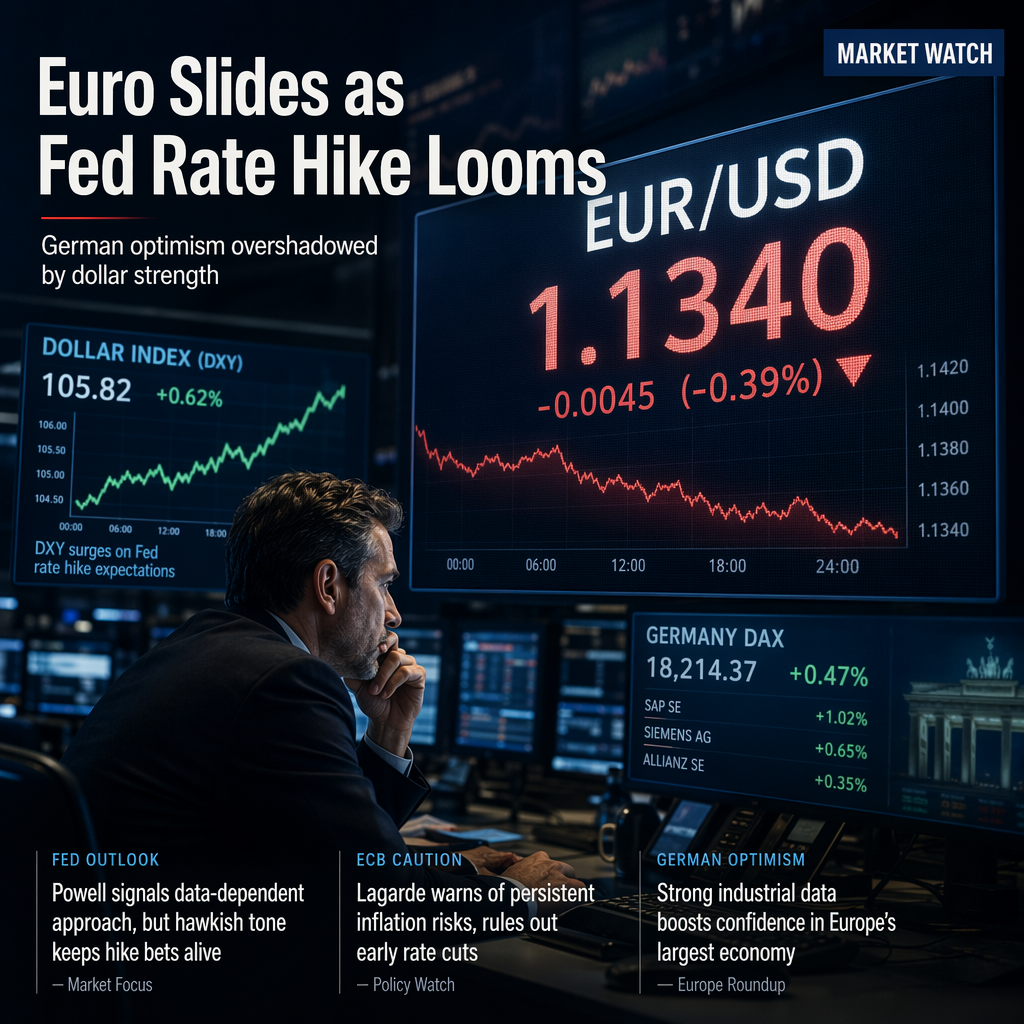
The Euro (EUR) weakened for the third straight day, with EUR/USD trading around 1.1340, down 0.39% on the day, as the US Dollar (USD) gained renewed support from expectations of further monetary tightening in the United States. This move follows last week’s Federal Reserve (Fed) meeting, where policymakers signaled a more hawkish stance in response to persistent inflationary pressures. The Fed’s latest projections indicated that more officials now anticipate the need for higher rates before year-end, and the CME FedWatch tool shows investors assigning a high probability to a rate hike in the coming months, which continues to underpin the Greenback [1].
The US Dollar Index (DXY), which tracks the USD against a basket of six major currencies, remains near its highest levels in over a year, intensifying pressure on the Euro [1]. On the European front, Germany’s IFO Business Climate Index rose to 85.6 in June from 85 previously, matching expectations. The Current Assessment Index surpassed forecasts, and the Expectations Index also saw modest improvement, signaling a gradual recovery in confidence within the Eurozone’s largest economy. Despite these positive signals, Commerzbank cautioned that Germany could still see weak or slightly negative growth in the second quarter due to the lingering effects of high energy prices, though the latest IFO survey suggests a moderate recovery may be possible in the second half of the year [1].
Comments from European Central Bank (ECB) Chief Economist Philip Lane further limited support for the Euro. Lane noted that uncertainty remains high despite improving geopolitical prospects in the Middle East and warned that inflation could remain above the ECB’s 2% target until the first half of 2027. This reinforces expectations that the ECB will maintain a cautious policy stance in the coming months [1]. Analysts at Scotiabank emphasized that the widening yield differential between US and Eurozone bonds continues to weigh on the Euro, with the recent hawkish repricing of Fed expectations, while ECB expectations remain largely unchanged, representing a key bearish factor for EUR/USD in the near term [1].
Looking ahead, investors are focused on Thursday’s release of the US Personal Consumption Expenditures (PCE) Price Index, the Fed’s preferred inflation gauge, which could provide further guidance on US monetary policy and influence the next direction for EUR/USD [1].
CONCLUSION
The Euro’s decline is being driven by a combination of hawkish Fed expectations and a cautious ECB outlook, despite some improvement in German business sentiment. Market participants are closely watching upcoming US inflation data for further direction. The widening yield gap and persistent inflation concerns suggest continued pressure on the Euro in the near term.