
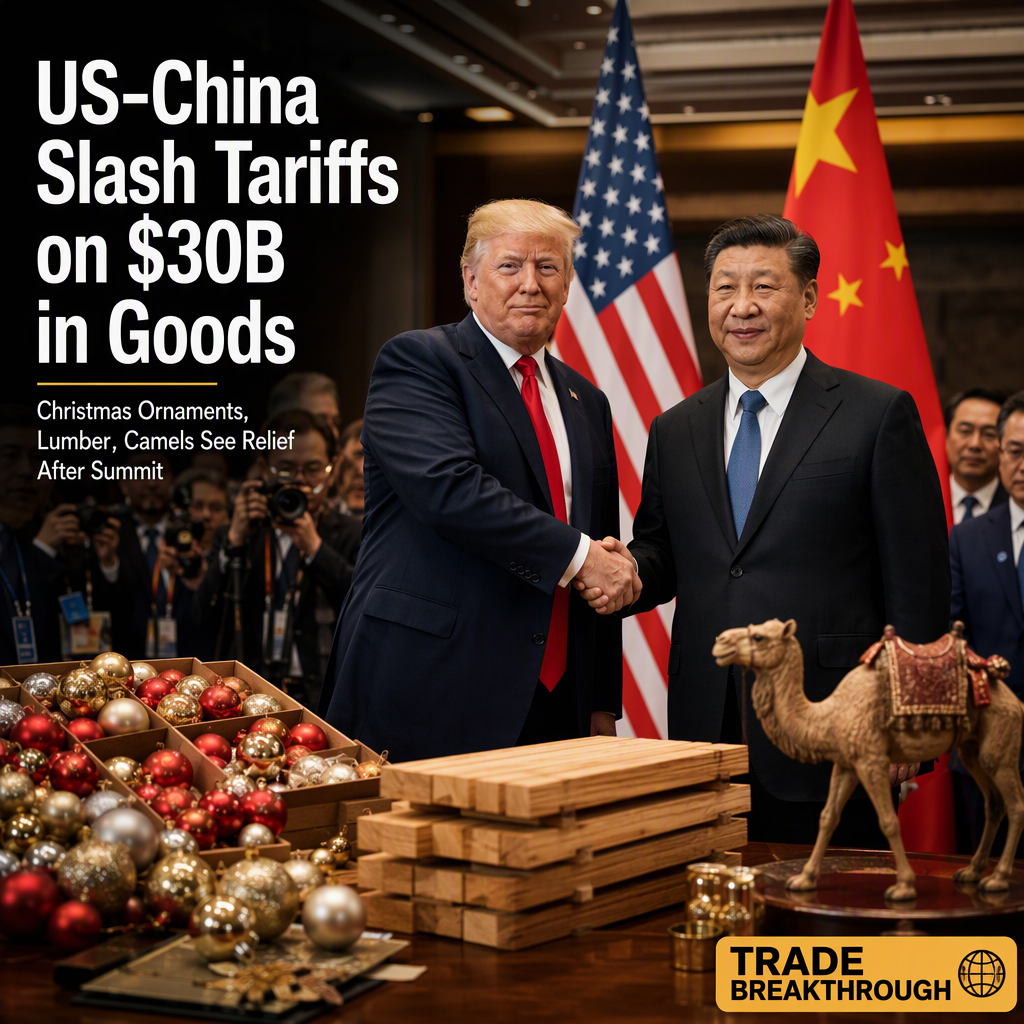
The United States and China have released lists of products on which they will reduce import tariffs, following a recent summit between President Donald Trump and President Xi Jinping in Washington [1]. The lists, published by both governments, include items such as Christmas ornaments, lumber, and camels, and are intended as a gesture to ease ongoing trade tensions and stimulate bilateral commerce [1].
According to China's Ministry of Commerce, the tariff reductions will be implemented on selected products 'simultaneously,' though no specific effective date was provided [1]. The targeted tariff cuts apply to nonsensitive goods, with each side agreeing to relief for approximately $30 billion worth of products [1]. The products affected have historically faced import duties ranging from 10% to 25%, but the precise updated tariff levels were not disclosed [1].
Industry observers note that reducing tariffs on seasonal and agricultural products could benefit exporters in both countries, particularly ahead of the holiday season [1]. Lumber, a significant input for construction and manufacturing, is expected to see increased cross-border sales as a result of the tariff relief [1]. U.S. trade officials described the agreement as 'incremental progress' in resolving broader trade disputes [1].
Analysts suggest that the announcement may help stabilize commodity markets and improve investor sentiment in sectors previously affected by tariffs [1]. There is cautious optimism that further rounds of tariff reductions could be negotiated if the initial results are favorable for both economies [1].
CONCLUSION
The US-China agreement to reduce tariffs on $30 billion worth of goods marks a positive step toward easing trade tensions and supporting exporters in both countries. While the market response is cautiously optimistic, the lack of a specified implementation date and undisclosed updated tariff levels leave some uncertainty. Further progress may depend on the outcomes of this initial round of tariff relief.