
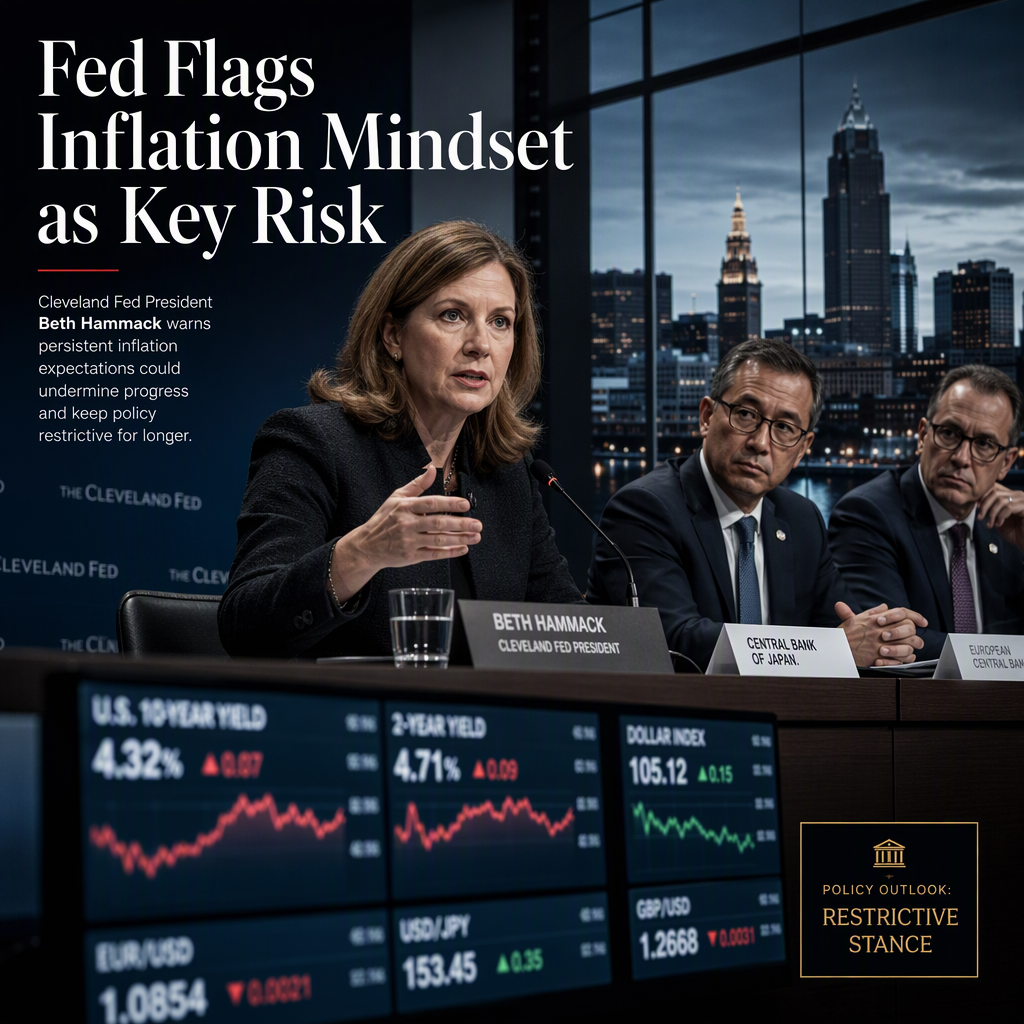
Cleveland Federal Reserve President Beth Hammack emphasized that the biggest risk facing the US economy is the development of an inflationary mindset, warning that persistent above-target inflation could shift public expectations and complicate economic planning [1][2]. Speaking at a panel hosted by the Cleveland Fed alongside ECB Vice President Vujcic and Banxico Deputy Governor Jonathan Heath, Hammack reiterated the need for the Federal Reserve to make further progress in lowering inflation and stressed the importance of maintaining restrictive policy rates [2].
Hammack stated that current monetary policy is not yet restraining the economy, particularly outside of the housing sector, and highlighted that inflation expectations remain reasonably well anchored for now [1]. She noted that growth has held up well and the job market remains stable, but expressed concern over demand-related pressures on inflation, including consumer spending and capital expenditures, which she believes will continue to exert upward pressure on prices for some time [2].
Hammack also pointed out that high inflation has real costs, such as pressuring wages and complicating economic planning, and warned that if progress is not made in reducing inflation, expectations could shift, increasing the risk of entrenched inflation [1][2]. She mentioned that rising bond yields are being driven by several factors, including a good economic outlook and competition from AI investment demand, as well as reactions to Fed and government policy [1].
On the currency front, both articles provided tables showing the US Dollar's performance against major currencies, with the USD being strongest against the Swiss Franc on the day reported [1][2]. However, the exact percentage changes differed slightly between the two sources, with USD/CHF up 0.05% in one table and 0.15% in the other [1][2].
CONCLUSION
Fed President Hammack’s comments underscore the central bank’s concern about persistent inflation and the risk of shifting public expectations. Her call for more restrictive policy rates signals that further tightening may be necessary to anchor inflation expectations and prevent an inflationary mindset from taking hold. The market impact is medium, as her remarks reinforce the Fed’s cautious stance and highlight ongoing inflationary pressures.