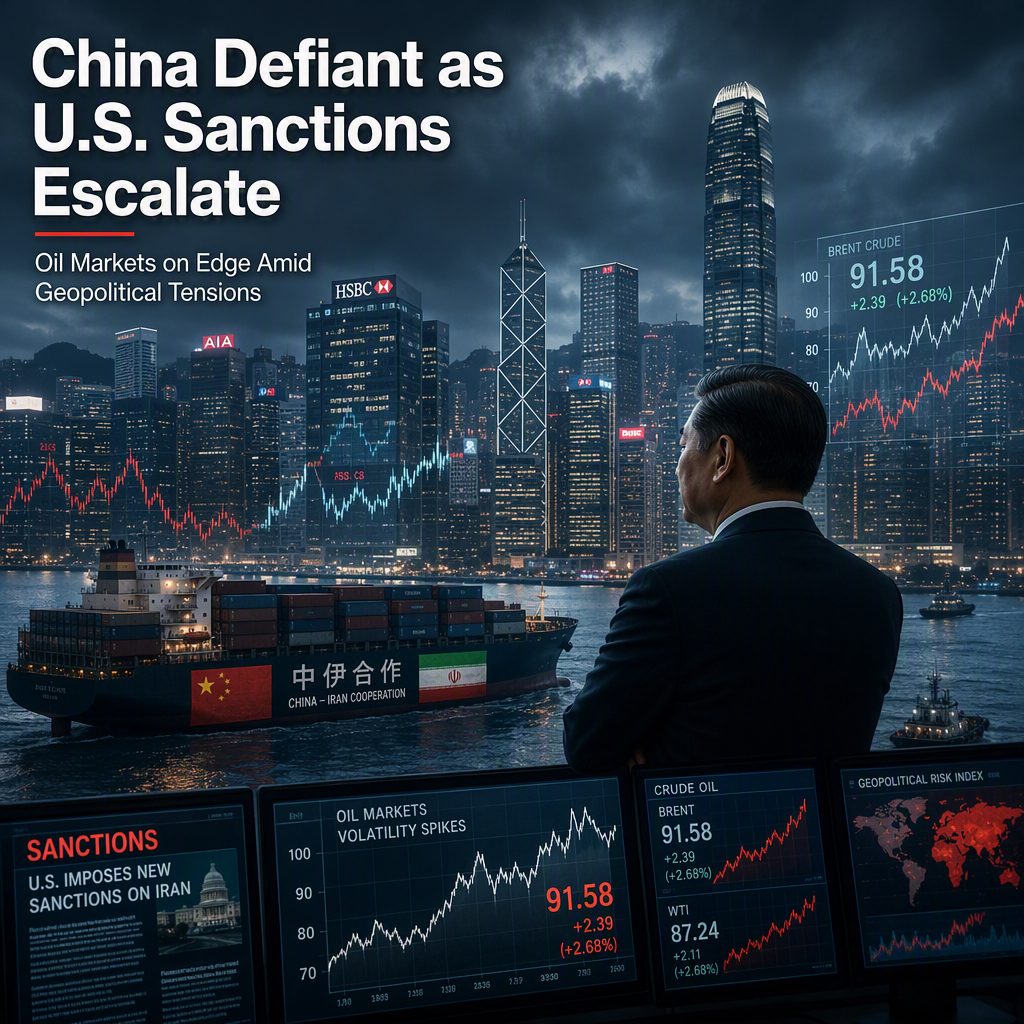
The United States has imposed new sanctions targeting Chinese and Hong Kong companies, specifically financial institutions and shipping firms accused of facilitating Iranian oil sales, as part of a broader campaign to economically isolate Iran [1]. U.S. Treasury Undersecretary for Terrorism and Financial Intelligence Brian Bessent stated, 'No one is above American sanctions,' underscoring Washington's intent to halt all business with Iran [1]. In response, China strongly rejected these unilateral sanctions, labeling them 'economic warfare' and asserting that such measures undermine global trade and threaten the stability of international markets [1]. Chinese officials emphasized their commitment to 'normal economic and trade cooperation' with Iran, which remains a key energy supplier to China [1].
Analysts highlighted that the U.S. campaign could further disrupt global oil markets and supply chains, particularly as Asian economies continue to rely heavily on Iranian crude [1]. A Tokyo-based commodities strategist noted, 'The risk premium in oil markets is likely to rise,' suggesting that if China and other Asian buyers reduce Iranian imports under U.S. pressure, Brent crude could test resistance at $95 per barrel, with support at $87 [1].
Market participants observed increased volatility among some Hong Kong-listed firms following the announcement, indicating potential ripple effects across the shipping and financial sectors [1]. China's rejection of what it calls 'economic wars' signals its intent to maintain strategic economic partnerships with Iran, despite mounting pressure from Washington [1]. The situation remains fluid, and investors are advised to monitor developments closely for any impact on energy prices and related equities [1].
CONCLUSION
The U.S. escalation of sanctions against Chinese and Hong Kong entities over Iranian oil trade has heightened geopolitical and market tensions. China's firm rejection of these measures and its commitment to continued cooperation with Iran suggest ongoing volatility in energy and related markets. Investors should remain alert to further developments that could impact oil prices and sector equities.