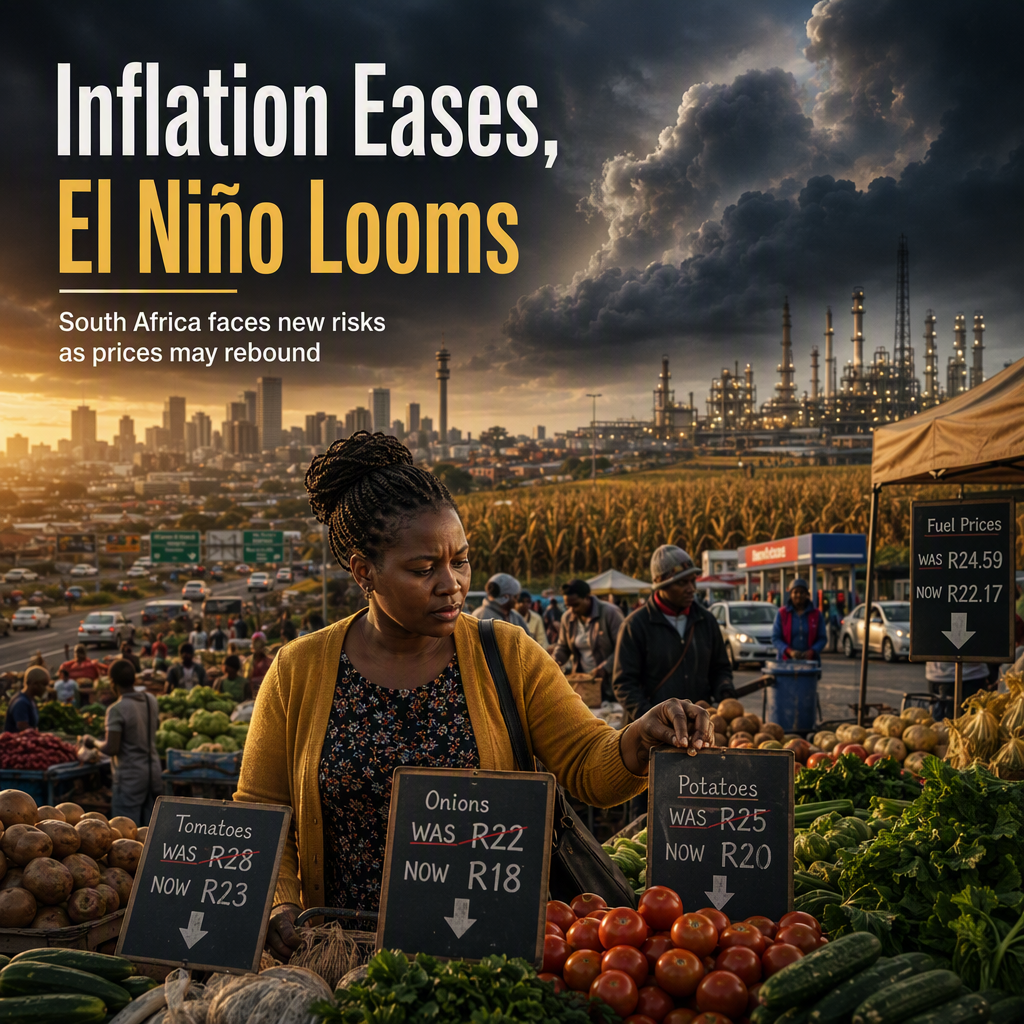
Commerzbank’s Volkmar Baur reports that South African inflation surprised on the downside in August, with the headline Consumer Price Index (CPI) recorded at 4.3% and core CPI at 4.2% [1]. The easing in inflation is mainly attributed to falling gasoline and food prices [1]. However, Baur cautions that this relief may be short-lived, as high global oil prices and the likelihood of a strong El Niño event pose significant risks to future inflation [1].
Baur notes that gasoline prices are unlikely to provide further relief in August, and if global crude oil and petroleum product prices remain elevated, South African gasoline prices are expected to rise again in September [1]. The outlook for food prices is even more concerning, with meteorologists estimating a 90% probability of a very strong El Niño occurring this year, and a 69% chance that it could be the strongest since records began in 1950 [1].
Historical data shows that the last two strong El Niño episodes in 2015/16 and 2023/24 led to a decline in South Africa’s maize harvest—its most important staple food—by between 20% and 50%, resulting in an annual grain price increase of about 15% in 2016 [1]. Given these risks, Baur warns that the likelihood of South Africa missing its inflation target over a prolonged period is increasing as the year progresses [1].
CONCLUSION
While South African inflation has eased for now, Commerzbank highlights significant risks ahead due to high oil prices and a likely strong El Niño. These factors could drive up food and gasoline prices, increasing the risk of sustained inflation target breaches.