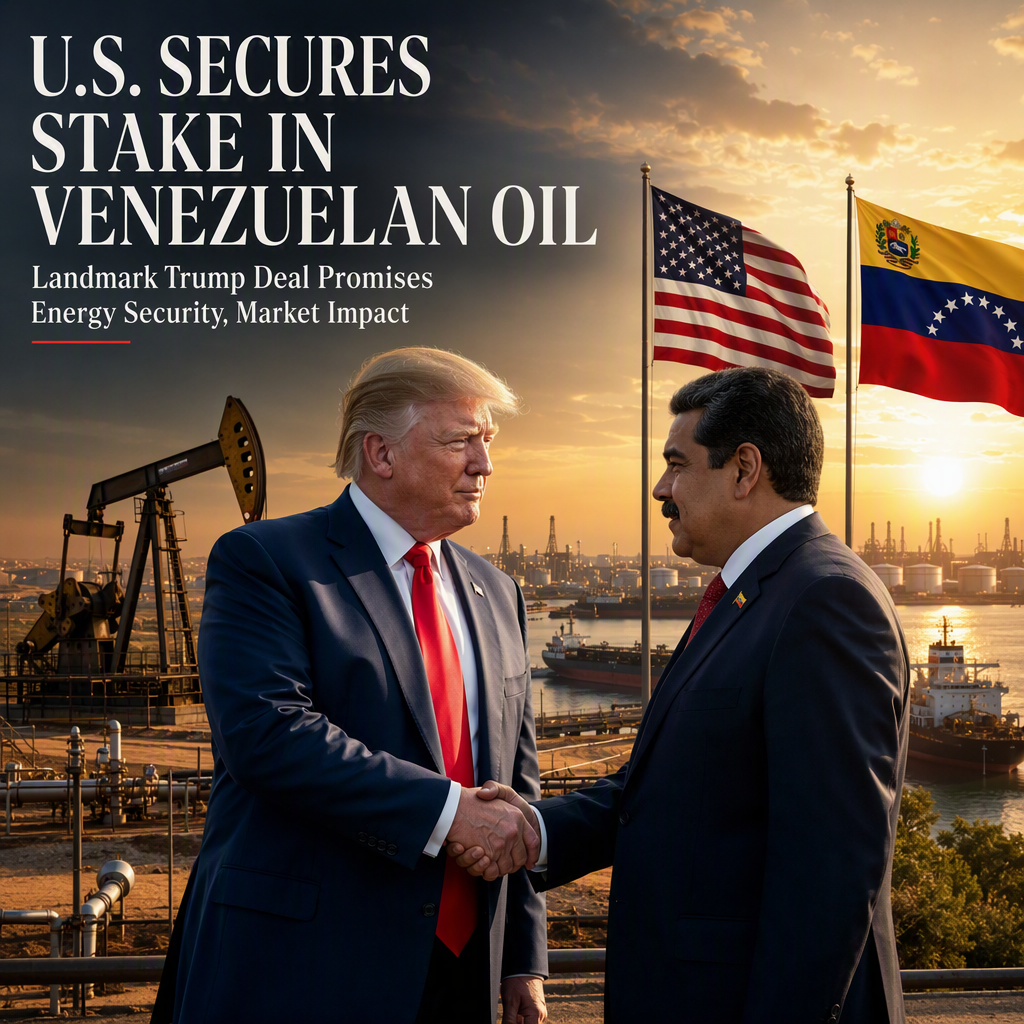
President Donald Trump has brokered a new oil agreement with Venezuela, granting the United States a stake in 17 Venezuelan oil fields that collectively hold an estimated 65 billion barrels of crude oil, according to Venezuela’s government [1]. Venezuela possesses more than 300 billion barrels of crude reserves, accounting for roughly 20% of the world’s total and surpassing even Saudi Arabia’s oil stockpile [1]. Despite its vast reserves, Venezuela has struggled with political instability and deteriorating infrastructure, resulting in the country producing only about 1% of the world’s oil, while holding an estimated 17% of global reserves [1].
The deal is particularly significant for the U.S. because Venezuela produces heavy crude, which is compatible with many Gulf Coast refineries designed for such oil types. Most U.S. production consists of lighter shale crude, and Gulf Coast refiners have historically relied on heavier imports from Canada, Mexico, and Venezuela [1]. Jaime Brito, executive director of refining and oil products at OPIS, described the additional volume of extra heavy crude from Venezuela as an "extraordinarily positive development" for the U.S. oil market [1].
A steadier supply from Venezuela could support Gulf Coast refineries, diversify U.S. oil imports, and provide a buffer against future supply disruptions. It may also help replenish the Strategic Petroleum Reserve, which is currently well below its authorized capacity of 714 million barrels [1]. This prospect has gained importance as the ongoing war with Iran disrupts oil shipments through the Strait of Hormuz. As of Sunday, the average U.S. price for regular gasoline was about $4.07 per gallon, compared to roughly $3.19 a year earlier, according to AAA [1].
While the deal is seen as a strategic move to strengthen U.S. energy security and potentially ease costs for Americans, its impact on gasoline prices will depend on how quickly Venezuela can convert its reserves into market-ready barrels [1].
CONCLUSION
Trump’s agreement with Venezuela is a major step toward securing U.S. access to substantial heavy crude reserves, which could bolster energy security and support Gulf Coast refineries. The deal’s market impact is high, but its effect on consumer gasoline prices hinges on Venezuela’s ability to ramp up production. Analysts view the development as positive for the U.S. oil market, especially amid current global supply disruptions.