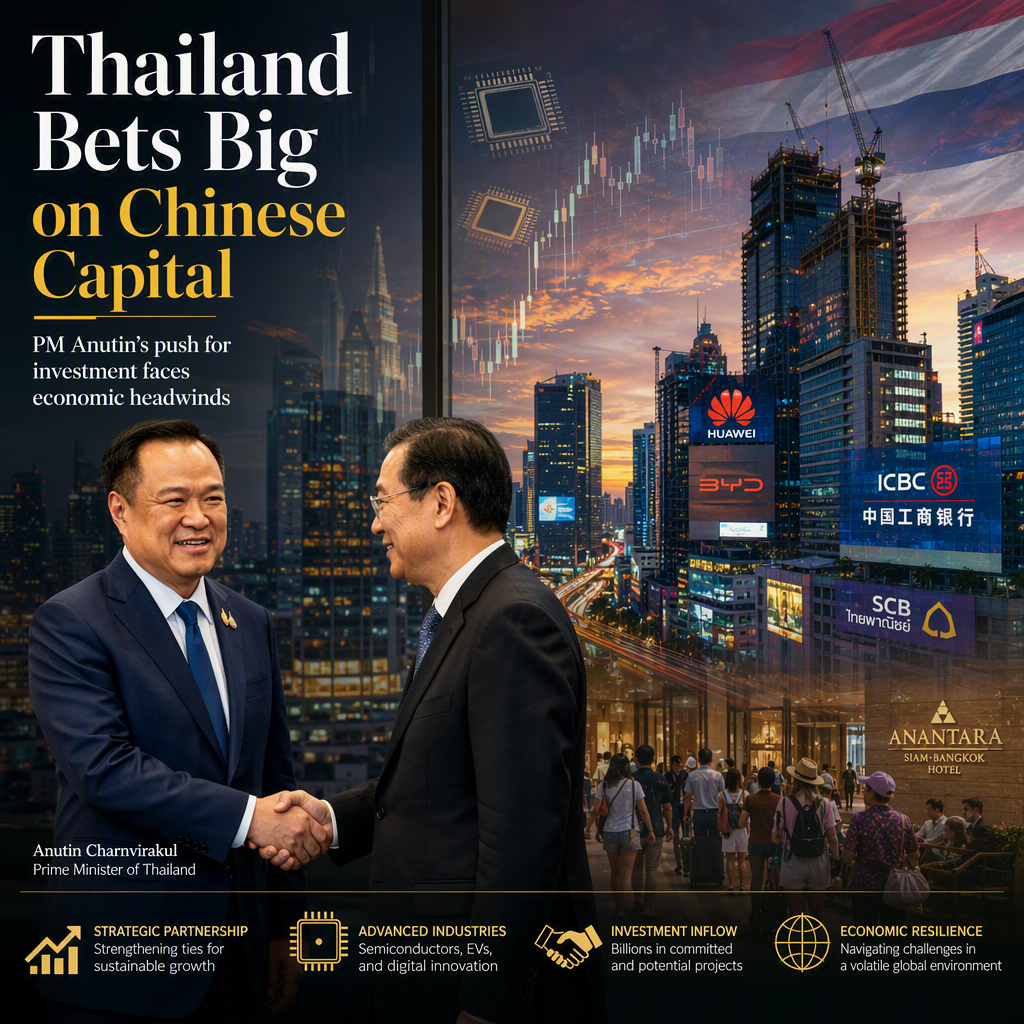
Thai Prime Minister Anutin Charnvirakul, marking his first year in office, is intensifying efforts to attract Chinese capital in order to revive Thailand's sluggish economy, which continues to lag in advanced industries such as semiconductors [1]. Anutin visited China in July, during which Thailand adopted language on Taiwan that aligns more closely with Beijing's position, signaling a stronger diplomatic and economic partnership with China [1].
Thailand's economy remains heavily dependent on manufacturing and tourism, sectors that have been challenged by scandals and slow recovery strategies, impacting government credibility [1]. The administration is prioritizing foreign direct investment, especially from China, to boost growth amid weak domestic demand and slow progress in high-tech sectors. Recent data shows Thailand's Q2 GDP growth slowed to 1.9%, attributed to energy and travel woes [1]. In response, the government is actively courting Chinese capital and implementing policy shifts to make Thailand more attractive for investors, particularly in electric vehicles and semiconductors [1].
Investment applications in Thailand surged 37% in January-June, largely driven by the AI boom, indicating strong interest from technology firms [1]. Despite this uptick, the country faces significant hurdles in scaling up advanced manufacturing. The World Bank has recommended that Thailand also attract Korean and Japanese electric vehicle suppliers to diversify its economy and reduce reliance on traditional sectors [1].
There are concerns from Thai hotels and restaurants that a proposed visitor levy could deter backpackers, potentially impacting tourism revenues [1]. The government has promoted retail investment in $3 government bonds to stimulate domestic participation in financial markets. Trading sentiment remains cautious, with the Thai stock exchange seeking tech listings amid the AI boom, but overall market growth is hampered by slow progress in key sectors [1]. Analysts view Anutin's push for Chinese capital as pragmatic, but emphasize the need to address structural weaknesses and political uncertainties for sustained growth [1].
CONCLUSION
Prime Minister Anutin's focus on Chinese investment is a strategic response to Thailand's slow economic growth and challenges in advanced industries. While investment applications have surged and technology interest is rising, structural and political issues continue to weigh on market sentiment. Analysts suggest that broader diversification and reforms are necessary for Thailand to achieve long-term, sustainable growth.