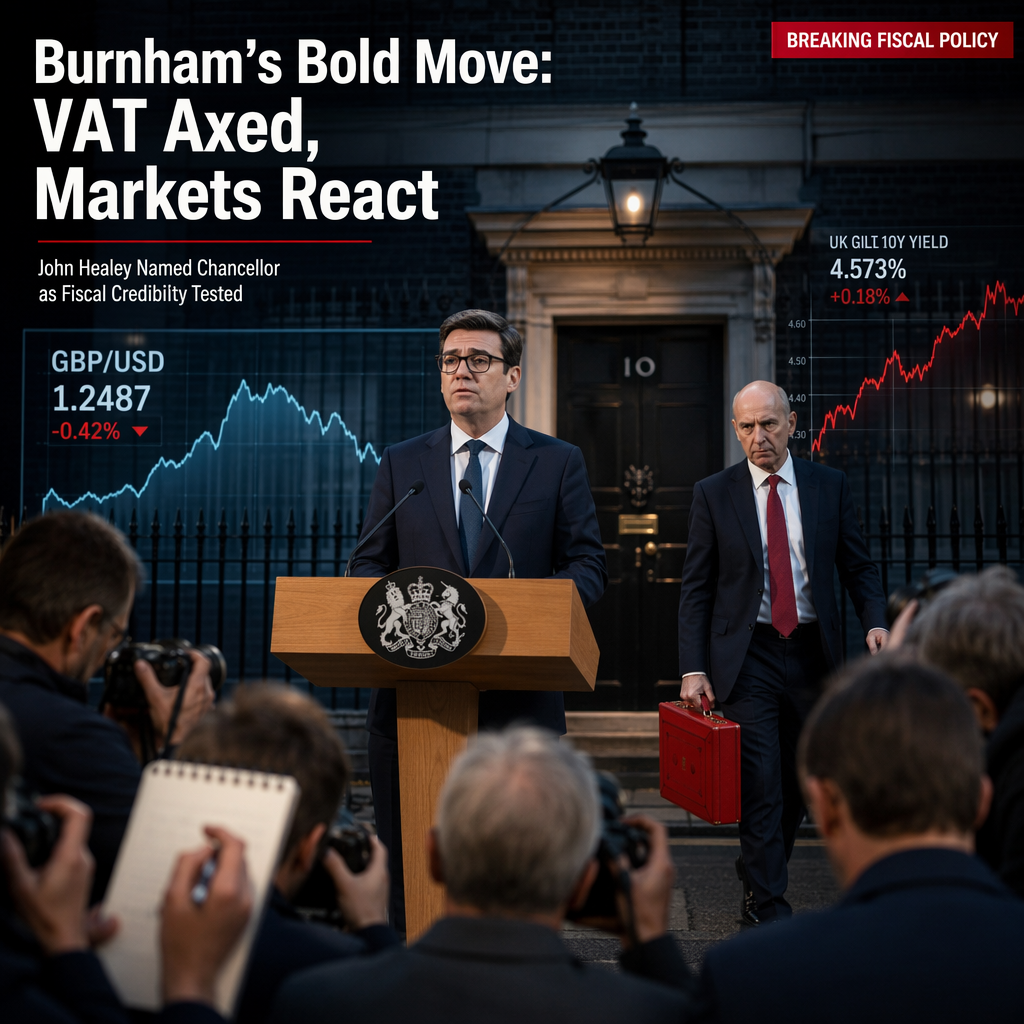
Andy Burnham, the United Kingdom's new prime minister, made his first major fiscal policy move by pledging to remove the value-added tax (VAT) from domestic electricity bills starting October 1, which is expected to save the average household around £45 annually from a typical bill of £1,862 [1][3]. The measure, announced jointly with newly appointed Chancellor John Healey, will reduce the sales tax on household electricity bills from 5% to 0%, costing £850 million in the 2026-27 fiscal year [2][3]. The funding for this tax cut will come from scrapping the £1.8 billion Digital ID program previously planned under former PM Keir Starmer [1][2].
Burnham's appointment of John Healey as Chancellor surprised markets and commentators, as Healey was not among the expected candidates and had recently resigned as Defense Minister over disagreements on defense spending priorities [4]. Healey has a history of advocating for increased defense budgets and previously served in the Treasury under Gordon Brown [4]. Other cabinet appointments include Ed Miliband as Foreign Secretary and Wes Streeting as Defense Secretary, while Shabana Mahmood remains at the Home Office [4].
The announcement of the VAT cut was met with skepticism regarding its fiscal sustainability. UK lawmaker Darren Jones, an ally of former PM Starmer, questioned the funding source for the tax cuts, stating that the government must clarify how it will pay for its new policies at the upcoming budget [1]. Financial markets reacted to the uncertainty, with the British Pound (GBP) experiencing a corrective move: GBP/USD fell to near 1.3440 from an intraday high of 1.3455, though it remained marginally higher than Monday's closing price of 1.3430 [1].
Analysts and commentators highlighted that while the VAT cut offers immediate relief to households, the broader challenge for Burnham's government is restoring confidence in Britain's public finances. UK government bond yields (gilts) continue to trade at a significant premium to Italian equivalents, reflecting ongoing concerns about government borrowing and fiscal credibility [3]. The extra cost of UK financing, including higher mortgage rates, could outweigh the benefits of the VAT cut if fiscal stability is not addressed [3]. Further details on Burnham and Healey's flagship policies are expected to be unveiled later, with Healey likely to prioritize defense spending [2][4].
CONCLUSION
Andy Burnham's swift action to cut VAT on electricity bills and his surprise appointment of John Healey as Chancellor have provided immediate relief to UK households but raised questions about fiscal sustainability. Market reactions have been cautious, with the GBP showing minor volatility and bond yields reflecting ongoing concerns. The real test for Burnham's government will be convincing financial markets of its fiscal credibility while delivering on its promises.