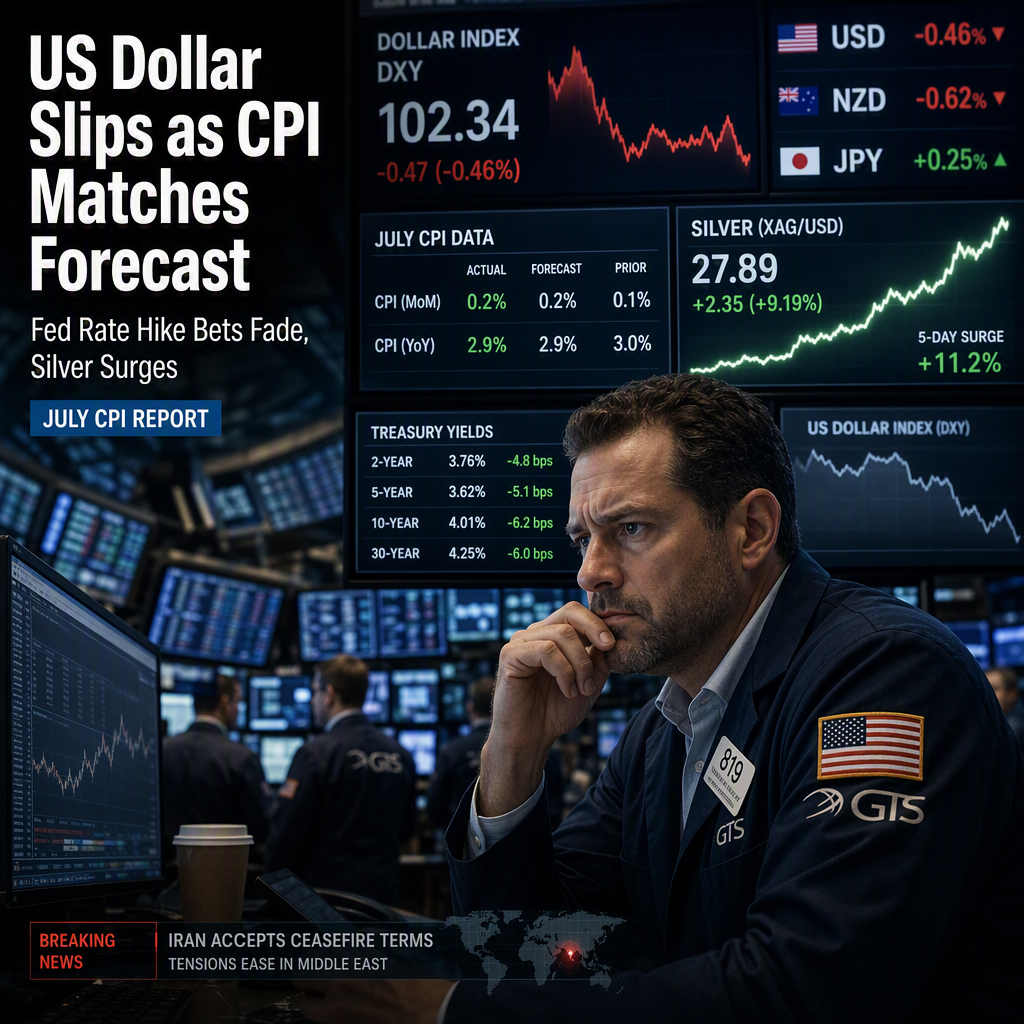
The release of the July US Consumer Price Index (CPI) showed inflation rising 0.1% month-on-month, reversing a 0.4% decline in June, and easing to 3.4% year-on-year from 3.5% in June, in line with market expectations. Core CPI increased 0.2% month-on-month and 2.5% year-on-year, also matching forecasts [1][2][3][4]. The data led to a muted reaction in the US Dollar Index (DXY), which edged slightly lower after the release, trading around 99.82 after bouncing off an intraday low of 99.61 [1][2][3]. US Treasury yields also declined, with the 2-year yield falling by around four basis points to near 4.18% [3].
Market participants further reduced their expectations for a Federal Reserve rate hike in September, with the probability dropping to 38% from 44% before the CPI report, according to the CME FedWatch Tool [2][3]. TD Securities strategists noted that the inflation report supports the case for the Fed to keep its policy stance unchanged this year, citing contained tariff pass-through and signs of normalization in services inflation [1][4]. They expect the July CPI data to translate into slightly softer core PCE inflation at 0.18% month-on-month [4]. However, they also highlight that the Producer Price Index (PPI) report, due Thursday, could influence the outlook further [2][4].
The US Dollar's weakness provided a boost to precious metals, with Silver (XAG/USD) jumping more than 2% to trade around $66.00, benefiting from both the softer Dollar and lower Treasury yields [3]. The combination of persistent geopolitical uncertainty—particularly regarding the lack of progress on a ceasefire extension between the US and Iran—and elevated Oil prices also supported safe-haven demand for Silver [1][2][3].
Currency markets reflected the shifting sentiment. The New Zealand Dollar (NZD/USD) retreated to around 0.5865, down 0.25% on the day, pressured by both domestic political uncertainty and the cautious global environment [1]. The Japanese Yen, after initial gains against the US Dollar, pared back as the market digested the CPI data, with USD/JPY trading around 159.20 [2]. The Yen was the strongest against the New Zealand Dollar among major currencies on the day [2].
Geopolitical risks remained in focus, as Reuters cited a senior Iranian source stating that no discussions are underway regarding an extension of the ceasefire between Washington and Tehran, dampening hopes for de-escalation in the Middle East [1][2][3]. This ongoing uncertainty, along with attacks on vessels in key shipping lanes, continued to limit risk appetite and support demand for safe-haven assets [1][3].
CONCLUSION
July US inflation data met expectations, prompting a modest decline in the US Dollar and Treasury yields while reducing market expectations for a near-term Fed rate hike. The market reaction favored safe-haven assets like Silver, while risk-sensitive currencies such as the New Zealand Dollar remained under pressure amid geopolitical and domestic uncertainties. The overall outlook suggests the Fed is likely to hold rates steady, with upcoming data releases still in focus.