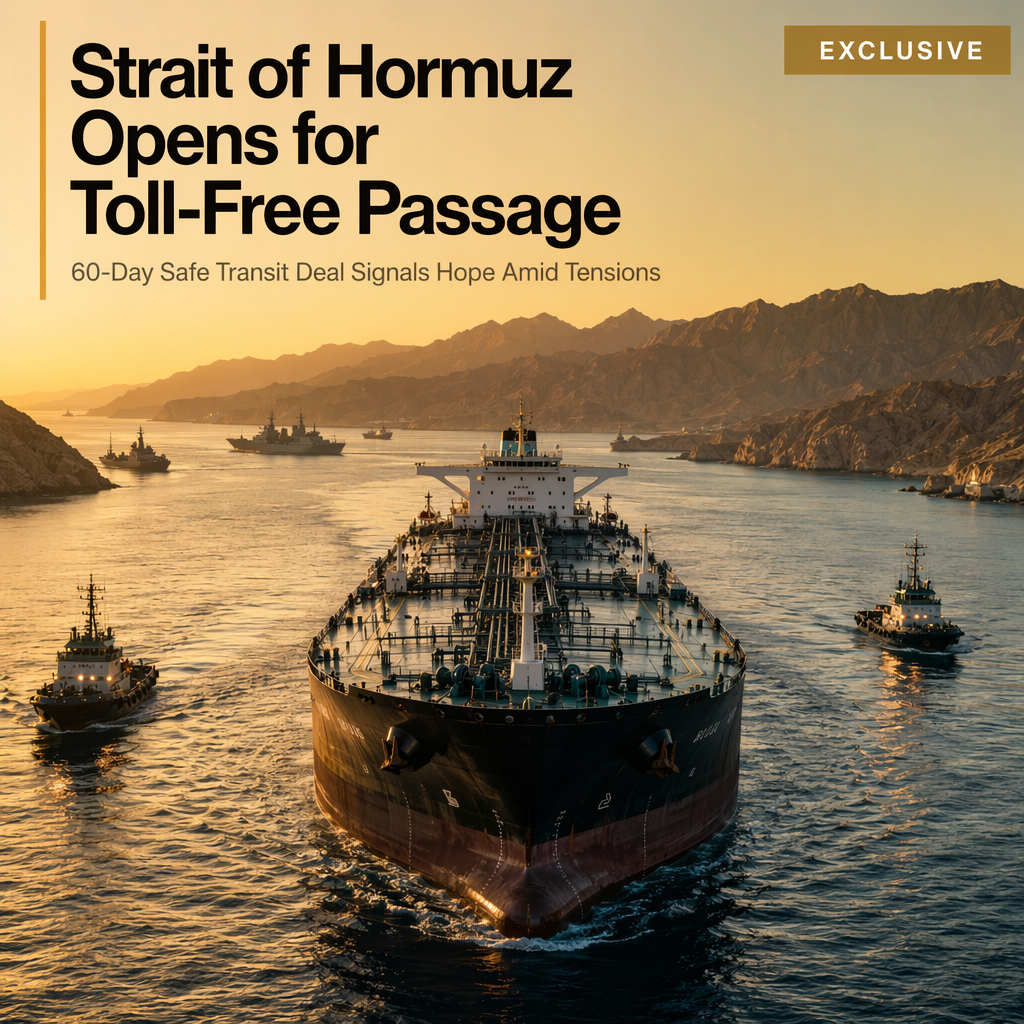
Iran has agreed to permit the safe passage of commercial ships through the Strait of Hormuz without tolls for a period of 60 days, according to senior U.S. officials. This arrangement is part of a memorandum of understanding (MOU) expected to be formally signed by Tehran and Washington in Geneva on Friday, which aims to end the ongoing war in the Middle East. Following this 60-day period, Iran, Oman, and other Gulf states will engage in discussions to define the future administration and maritime services of the Strait of Hormuz, as outlined in the MOU [1].
Prior to the war, ships transited the Strait of Hormuz freely without any tolls imposed by Iran or any other entity. However, since the conflict began, Iran has sought to assert greater control over the strait. President Donald Trump has insisted that the strait remain toll-free after the war, and U.S. officials have indicated that other Gulf states are unlikely to accept any arrangement that does not permit toll-free access [1].
As part of the agreement, the United States will begin lifting its naval blockade of Iranian ports immediately after the MOU is signed, with a complete end to the blockade expected within 30 days. Despite the recent deal announcement, traffic through the Strait of Hormuz remains subdued, with only 13 commercial ships, including six tankers, transiting on Tuesday compared to more than 100 vessels daily before the war. The Joint Maritime Information Center has downgraded the threat level for ships crossing Hormuz from 'severe' to 'substantial,' though it warns that the risk of attack remains significant [1].
A senior U.S. official noted that Iran is likely to assert its rights aggressively in the upcoming regional discussions, but emphasized that the Gulf states will not agree to any arrangement that restricts toll-free access. The MOU specifies that future administration of the strait should align with international law and the sovereign rights of the coastal states [1].
CONCLUSION
The agreement to allow toll-free passage through the Strait of Hormuz for 60 days marks a significant step toward de-escalating tensions and restoring commercial shipping in the region. However, uncertainty remains regarding the long-term administration of the strait, as Iran and Gulf states prepare for further negotiations. Market participants should monitor developments closely, as the outcome will have substantial implications for global energy and shipping markets.