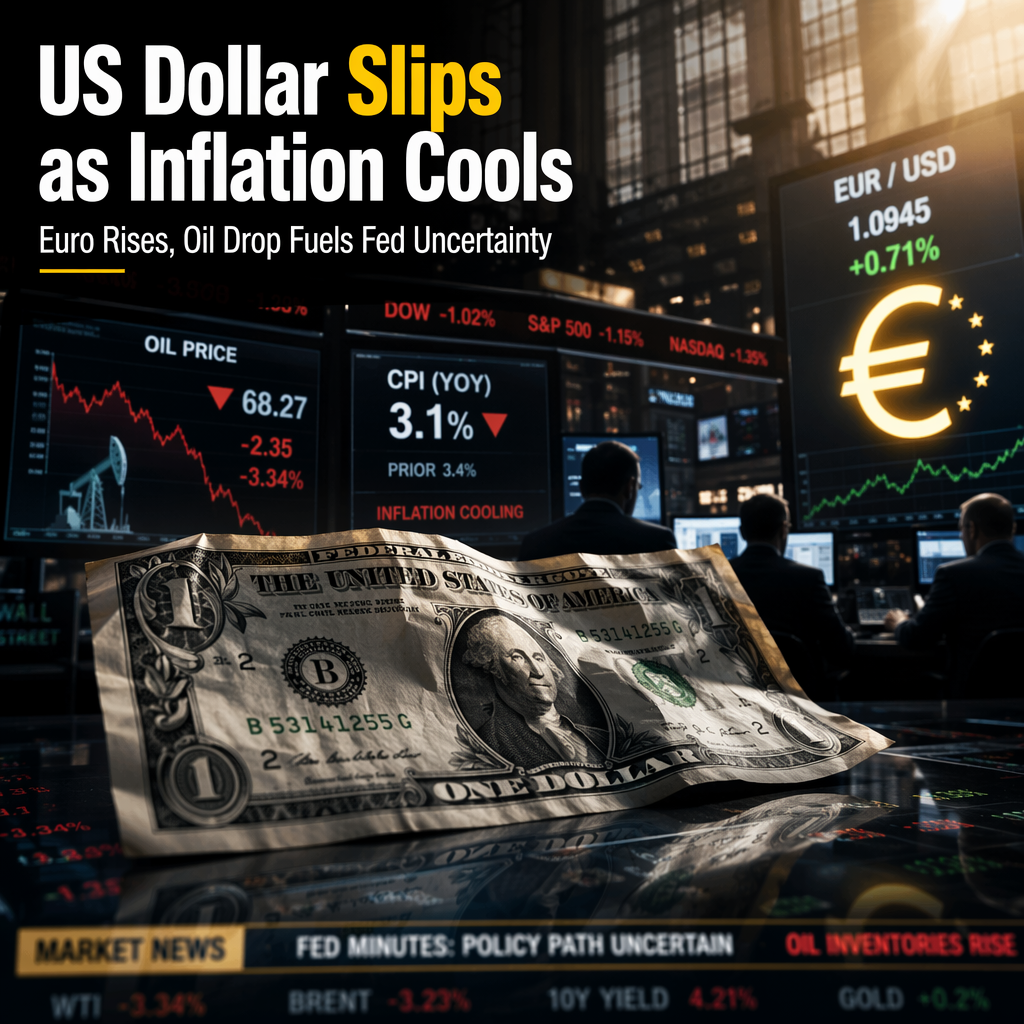
The Euro traded slightly higher against the US Dollar, reaching near 1.1395 during the European session on Tuesday, as the US Dollar corrected ahead of the release of the June Consumer Price Index (CPI) data at 12:30 GMT [1]. The US Dollar Index (DXY) was down 0.13% to 101.15, reflecting bearish sentiment for the Greenback [1]. The CPI report is expected to show a decline in consumer inflation, largely attributed to tumbling fuel prices following a ceasefire announcement between the US and Iran [2]. Crude oil prices dropped by more than 20% in June, returning to pre-war levels, which contributed to forecasts of a 0.1% monthly decline in headline CPI and a retreat to 3.8% year-on-year, down from 4.2% in May [1][2]. Core CPI is expected to remain steady, rising 0.2% month-on-month and 2.9% year-on-year [1][2]. However, Source 3 anticipates a divergence, with a 0.1% decline in headline inflation but a stickier 0.3% increase in the core reading [3]. According to TD Securities analysts, headline CPI may fall 0.22% month-on-month, led by a 10% drop in gasoline prices [2].
Market sentiment remains cautious, with US stock futures declining ahead of the CPI release and major Wall Street lenders' earnings reports. Dow Jones futures fell 0.26% to 52,620, S&P 500 futures dropped 0.03% to 7,560, and Nasdaq 100 futures lost 0.42% to 29,600 during European trading hours [3]. The previous session saw US equity markets close lower, with the Nasdaq Composite down 1.55%, S&P 500 down 0.79%, and Dow Jones Industrial Average down 0.26%, primarily due to a sell-off in the technology sector amid concerns about the sustainability of AI investments [3]. Chipmakers such as Micron, Nvidia, SanDisk, AMD, and Intel experienced significant losses [3].
Crude oil prices have rebounded on renewed supply concerns, raising fears that energy-driven inflation could prompt the Federal Reserve to maintain elevated interest rates [3]. The CME FedWatch Tool now shows a 51% probability of a Fed rate hike in September, up from a 23% chance that rates will remain unchanged [3]. Federal Reserve Governor Christopher Waller warned that if core inflation comes in hot, the FOMC may need to tighten monetary policy in the near term [1]. Investors will also focus on Fed Chair Kevin Warsh's congressional testimony, though he previously indicated that forward guidance is not well-suited at this policy juncture [1][3].
On the Euro side, analysts at MUFG expect the European Central Bank (ECB) to deliver another 25 basis points rate hike in September, following its June rate increase and commitment to remain data-dependent [1].
According to [1] and [2], the CPI data is expected to show cooling inflation, but [3] reports that core inflation may remain sticky, highlighting a discrepancy in analyst forecasts.
CONCLUSION
The US Dollar is under pressure as markets anticipate cooling headline inflation in June, driven by falling oil prices and a ceasefire between the US and Iran. However, core inflation may remain persistent, fueling expectations of further Federal Reserve rate hikes. Equity markets are cautious, with technology stocks retreating and investor focus shifting to upcoming CPI data and Wall Street lender earnings.