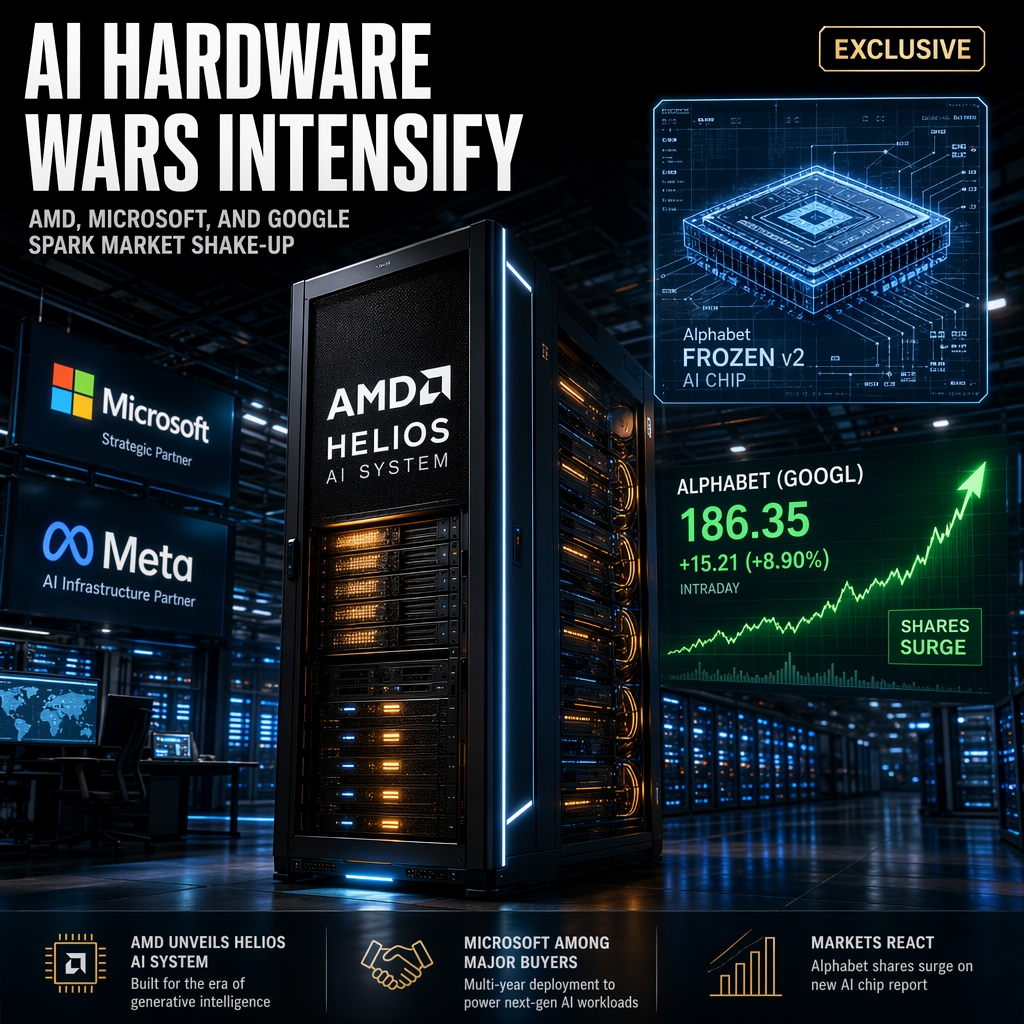
Advanced Micro Devices (AMD) announced the launch of Helios, its first rack-scale artificial intelligence system, marking a significant challenge to Nvidia's dominance in the AI hardware market. Microsoft revealed it will deploy Helios in its data centers, joining other major customers such as Meta, OpenAI, Oracle, and Tata Consultancy Services. Shipments to these customers, including Microsoft, are scheduled to begin later this year, though specific financial terms and compute capacity details were not disclosed [1]. Microsoft CEO Satya Nadella stated that the addition of Helios will expand Azure's infrastructure portfolio, providing enhanced performance, scale, and choice for AI applications. Microsoft will also introduce two new computing instances powered by AMD's latest 'Venice' CPUs, targeting agentic AI, data pipelines, and semiconductor design [1].
Meta previously announced plans to use up to 6 gigawatts of AMD GPUs over time, starting with 1 gigawatt deployed on Helios racks later this year. OpenAI and Oracle have also committed to deploying Helios in 2026, and AMD claims that eight of the top ten AI companies now run workloads on its Instinct GPUs [1]. The Helios system offers four customizable configurations, with Meta set to deploy one of these later in the year [1].
In a separate development, Alphabet shares rose 3% on Monday following a report by The Information that the company is developing a new server chip, internally named 'Frozen v2,' designed to run Gemini AI models more efficiently. The chip aims to embed parts of Gemini's architecture directly into the silicon, potentially serving six to ten times more tokens per unit of power compared to Google's current TPUs. The project targets a 2028 deployment and is intended to address internal compute shortages that have led Google Cloud to turn away external business. Last month, Google agreed to pay SpaceX nearly $1 billion a month to help meet its enterprise compute commitments [2].
The Frozen v2 chip is described as a specialized addition to Google's custom-chip portfolio and is not intended to replace general-purpose TPUs. Its compatibility is limited to future Gemini models if Google maintains the same architecture. Alphabet has not commented on the report, and the chip is currently viewed as a trial run with limited production plans [2].
Market reactions were notable: Alphabet's stock climbed 3% following the news of its new chip development, reflecting investor optimism about the company's efforts to improve AI compute efficiency [2]. While AMD's announcement did not specify immediate stock movement, the addition of major customers like Microsoft and Meta signals increased competition in the AI hardware sector [1].
CONCLUSION
AMD's launch of the Helios AI system and the addition of Microsoft as a major customer underscore intensifying competition in the AI hardware market, challenging Nvidia's dominance. Meanwhile, Alphabet's reported development of the Frozen v2 AI chip and the resulting 3% stock surge highlight strong investor interest in AI infrastructure innovation. Both developments signal significant shifts in the competitive landscape for AI compute solutions.