
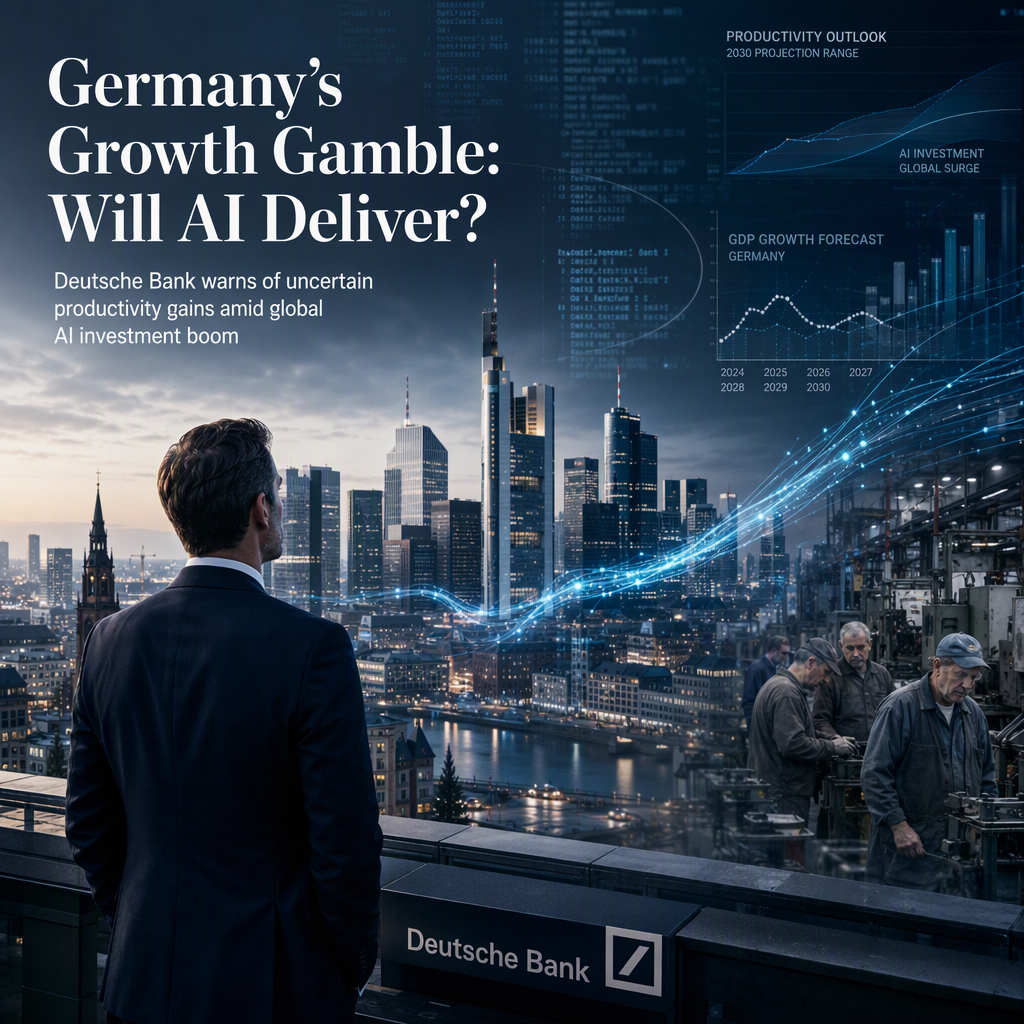
Deutsche Bank’s Robin Winkler has reviewed Germany’s consensus economic outlook, noting that GDP growth is projected to be around 1% in 2027 before declining towards 0% by 2030 due to demographic pressures on potential growth [1]. This forecast assumes that Germany will not experience significant AI-driven productivity gains, despite a robust global AI capital expenditure boom that is currently supporting expectations for solid global and German growth [1].
Winkler points out that Germany's economic institutes agree on this outlook, which may serve as a warning to the government that fiscal stimulus will eventually lose effectiveness without structural reforms [1]. The near-term growth of 1% is attributed to fiscal expansion and a cyclical recovery, underpinned by global growth increasingly powered by AI investment [1]. However, the anticipated slowdown towards 0% growth assumes that productivity improvements will not be sufficient to counteract demographic challenges [1].
The consensus scenario suggests a paradox: AI is strong enough to fuel a global investment and asset-price boom, but not potent enough to deliver meaningful productivity gains in Germany by 2030 [1]. Winkler notes that Germany could be slow to capture AI benefits, or other headwinds may offset them [1]. Alternatively, if AI fails to boost productivity, the global capex boom could become vulnerable as new datacenters come online and investors demand revenue growth that matches the scale of investment [1].
Winkler concludes that several outcomes are possible: productivity could rise strongly by the end of the decade, the investment bubble could burst next year, or both scenarios could occur. He finds it unlikely that the current AI capex boom will continue without eventually producing significant productivity gains [1].
CONCLUSION
Deutsche Bank’s analysis underscores uncertainty about Germany’s ability to harness AI-driven productivity gains amid demographic headwinds. While global AI investment is supporting near-term growth, the outlook warns of a potential slowdown and risks to the investment boom if productivity does not materialize. The market takeaway is a cautious optimism tempered by structural concerns and the need for reforms.