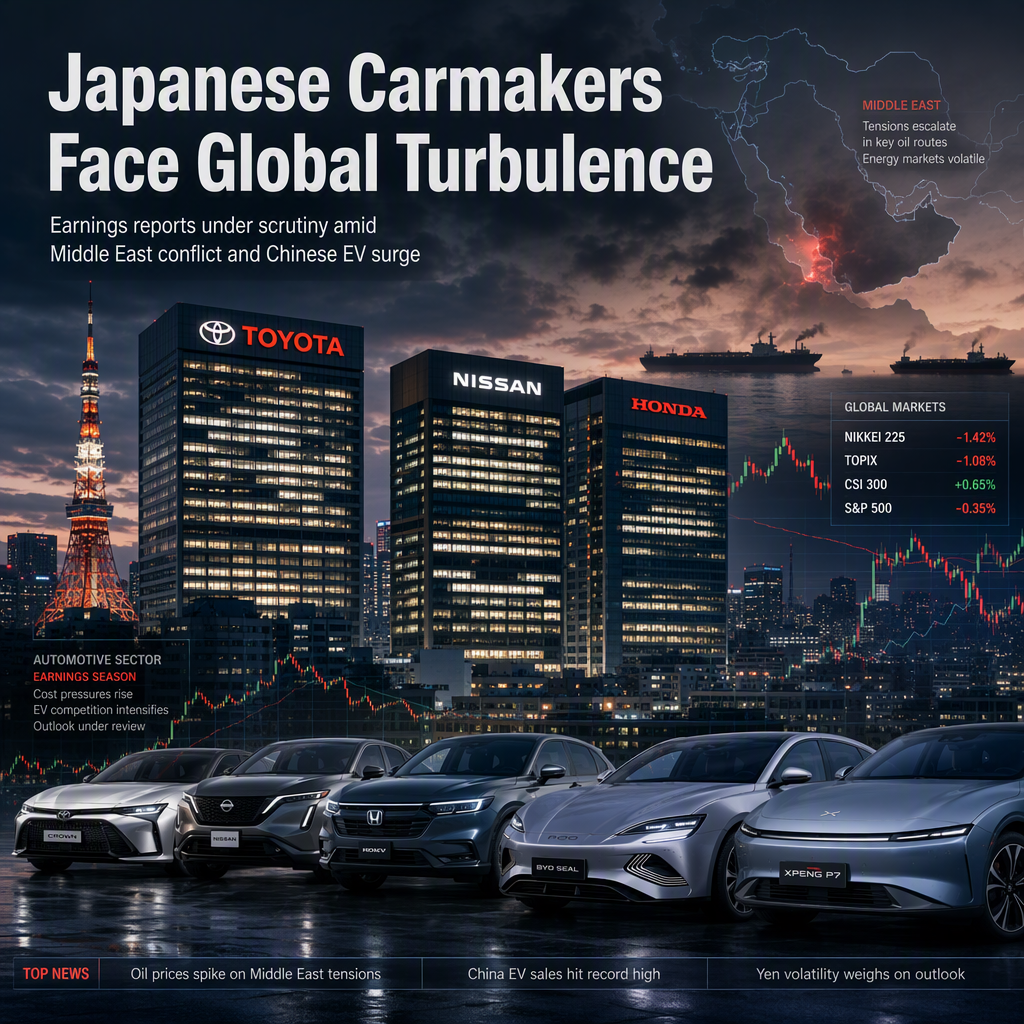
Japanese automakers are set to release their earnings for the April-June quarter, with Nissan Motor and Mitsubishi Motors reporting on Monday, followed by Toyota Motor and Mazda Motor on Tuesday, and Honda Motor and Suzuki Motor on Wednesday [1]. The industry is currently facing significant challenges, including disruptions caused by the ongoing U.S.-Iran war and intensifying competition from Chinese companies [1]. According to the International Energy Agency, electric vehicles—a segment where Japanese carmakers have been slow to expand but which is dominated by Chinese manufacturers—have seen a substantial sales boost since the start of the Middle East conflict, driven by rising fuel prices and supply chain disruptions [1].
Investors are expected to closely monitor each company's outlook and strategic responses to these challenges, particularly in light of additional geopolitical risks such as U.S. tariff policies and the ongoing conflict in the Middle East [1]. The earnings releases come at a time when the Japanese auto industry is under pressure to adapt to rapidly changing market dynamics and increased competition from emerging players [1].
The market is also paying attention to broader economic indicators, including inflation and trade data from Vietnam and Indonesia, as well as the outcome of Indonesia's Financial System Stability Committee meeting, which will address issues such as the rupiah, inflation, capital flows, and coordination between fiscal and monetary authorities [1].
CONCLUSION
Japanese automakers are navigating a challenging environment marked by geopolitical tensions and increased competition from Chinese electric vehicle manufacturers. The upcoming earnings reports will provide insight into how these companies are responding to market disruptions and evolving industry trends. Investors are expected to scrutinize the results and outlooks for signs of strategic adaptation and resilience.