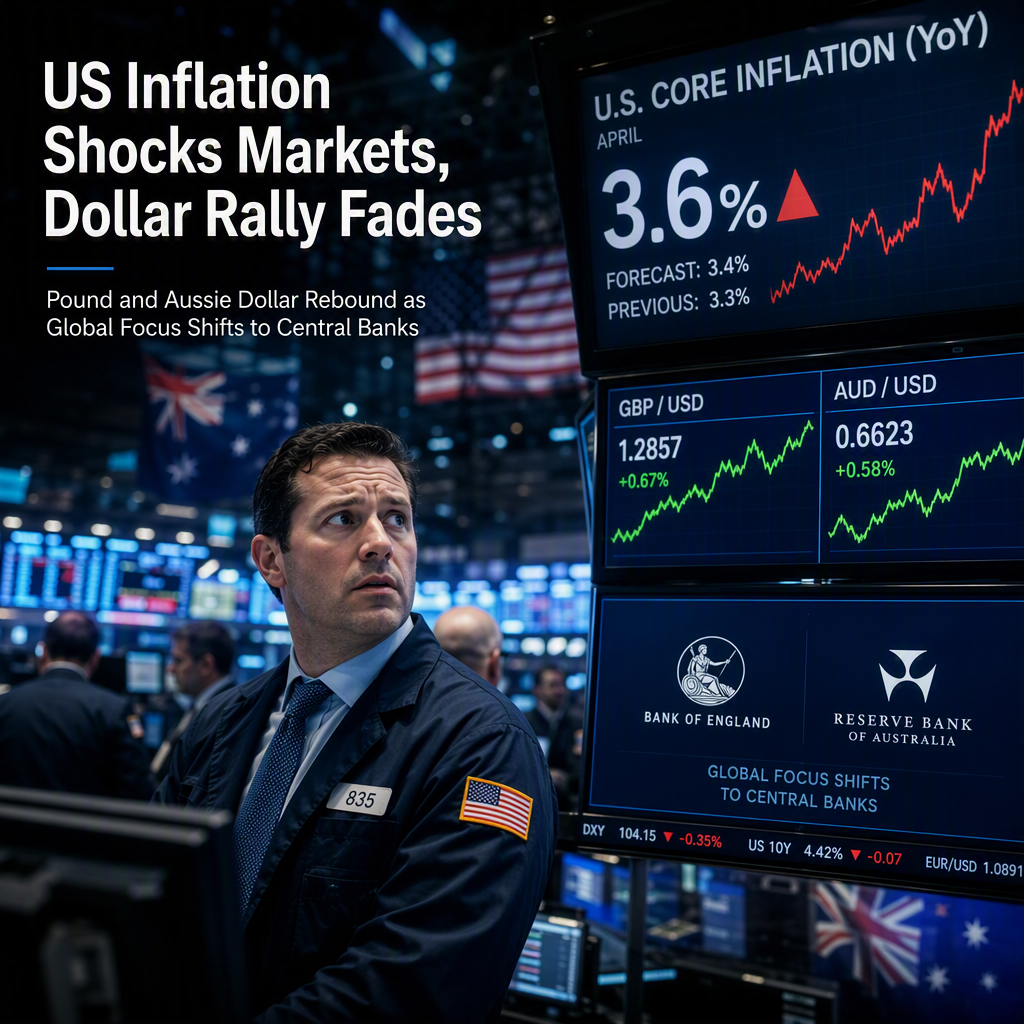
The US Consumer Price Index (CPI) report for August showed headline inflation rising 0.4% month-over-month and 3.4% year-over-year, both matching forecasts, while core CPI increased by 0.3%, surpassing the 0.2% consensus and marking its fastest pace since April [1][2]. This firmer-than-expected core inflation reading strengthened expectations for a Federal Reserve (Fed) rate hike at next week's meeting, with money markets now pricing in an 88% probability of a 25 basis point increase to the 3.75%-4% range, up from 60% a day earlier [1][2]. The 2-year US Treasury yield, sensitive to Fed policy, rose to around 4.62%, gaining roughly 3 basis points on the day [2].
Despite the initial US Dollar strength following the CPI release, both the British Pound (GBP) and Australian Dollar (AUD) recovered. GBP/USD climbed 0.10% on Friday, trading at 1.3524 after dipping to around 1.3470 post-CPI, as attention shifted to stronger-than-expected UK GDP data [1]. The UK economy grew at its fastest pace in 18 months in July, with GDP up 1.6% year-over-year (versus 1.2% expected) and 0.4% month-over-month (versus 0% expected) [1]. This robust growth led money markets to expect the Bank of England (BoE) to keep rates unchanged, despite the UK's status as a net energy importer [1]. BoE Governor Andrew Bailey clarified that further rate hikes are not imminent, even as markets anticipate additional tightening [1].
The AUD/USD pair also edged higher, trading at 0.7176, as the US Dollar struggled to maintain its advantage despite higher front-end yields and elevated crude prices [2]. The pair remains capped below key technical resistance levels, with the Relative Strength Index (RSI) around 40 indicating fading bullish momentum [2]. Energy markets remain volatile, with Brent Crude above $107 a barrel and the International Energy Agency (IEA) warning of a worsening global oil supply deficit this year [2].
US consumer sentiment deteriorated, as the University of Michigan Consumer Sentiment index for September fell from 51.7 to 47.8, missing forecasts of 51. Inflation expectations also rose, with one-year expectations jumping to 4.6% from 4% and five-year expectations ticking up to 3.4% from 3.3% [1].
Looking ahead, the key near-term catalysts are next week's Federal Reserve policy decision on Wednesday and the Bank of England meeting on Thursday. Analysts note that a decisive Fed hike with firm guidance could bolster the US Dollar, while a softer stance may reinforce perceptions of policy reluctance to tackle persistent inflation [2].
CONCLUSION
US core inflation surprised to the upside, prompting a rise in Fed rate hike expectations and a brief surge in the US Dollar. However, both the British Pound and Australian Dollar recovered as local factors and technical resistance limited further Dollar gains. Market focus now shifts to upcoming central bank decisions, which are expected to set the tone for currency markets in the near term.