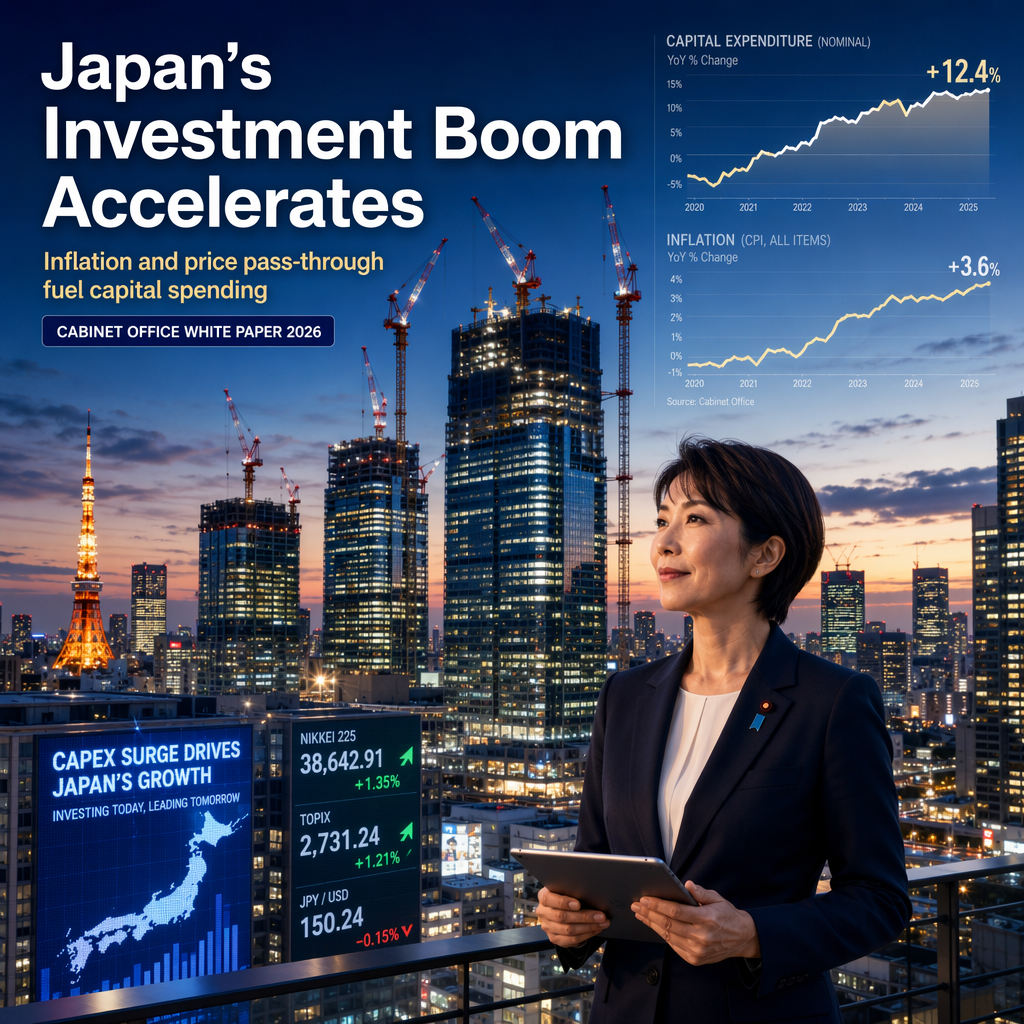
Japan's business capital investment is on the rise, fueled by inflation and an improved ability for companies to pass on higher costs to consumers, according to a Cabinet Office white paper for fiscal 2026 released on Friday [1]. The report highlights that these factors have enabled businesses to increase capital expenditure, effectively offsetting the impact of higher input costs [1]. This trend is viewed as a positive development for Japan's economic growth, as sustained investment is expected to drive productivity and innovation [1].
Prime Minister Sanae Takaichi has outlined an ambitious investment strategy, targeting more than 370 trillion yen in capital spending by fiscal 2040 [1]. The white paper emphasizes the necessity for clear public and private investment strategies, urging both sectors to align their efforts to ensure effective resource allocation [1]. Policy clarity and targeted incentives are underscored as crucial for maximizing the impact of capital spending [1].
While the article does not provide specific trading advice or technical analysis, it notes that the sentiment is constructive for Japanese equities, especially in sectors that benefit from increased capital investment and can manage cost pressures through price pass-through [1]. The overall market sentiment is positive, with inflation supporting capital expenditure and enhancing economic growth prospects [1].
CONCLUSION
Japan's capital expenditure is receiving a boost from inflation and improved price pass-through, with the government targeting over 370 trillion yen in investment by 2040. The Cabinet Office's white paper suggests that clear strategies and policy alignment are essential to sustain this positive momentum for economic growth.