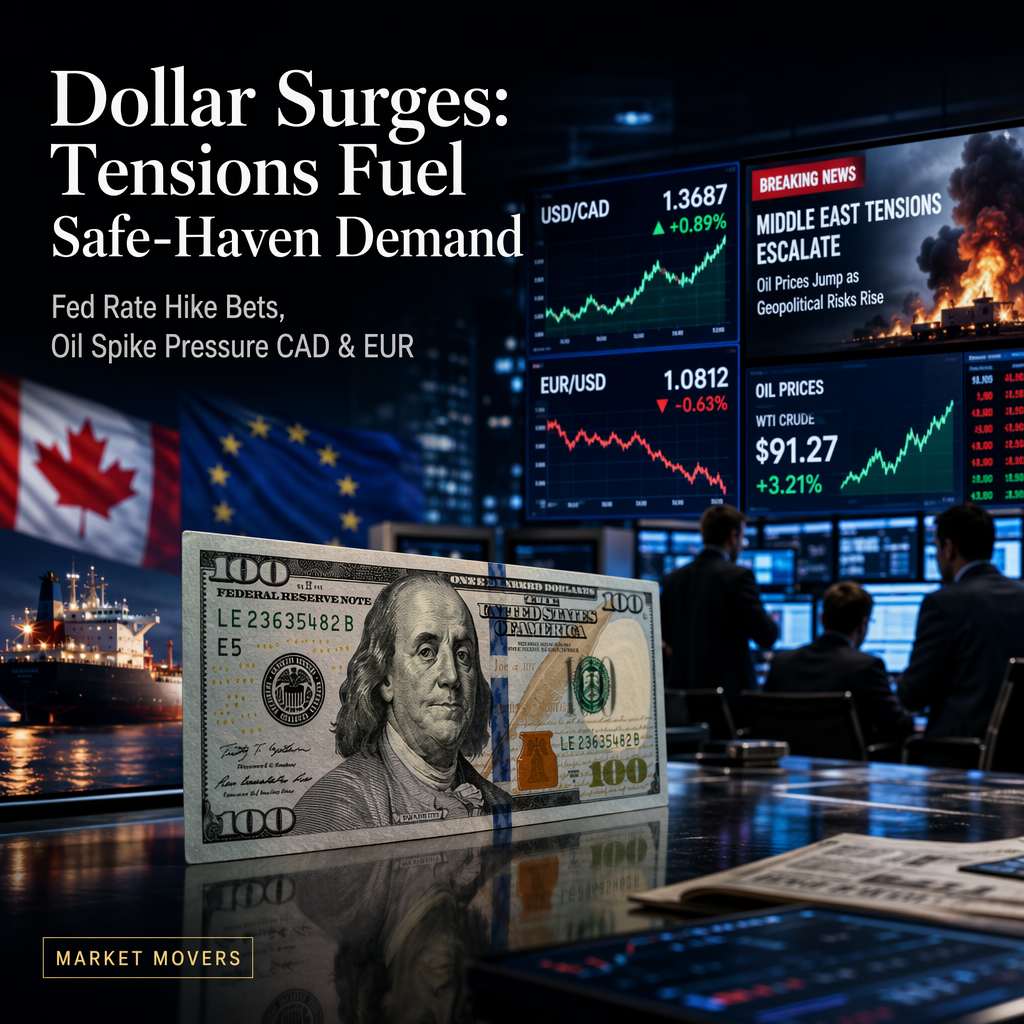
The US Dollar (USD) rebounded on Thursday, gaining momentum against both the Canadian Dollar (CAD) and the Euro (EUR), as geopolitical tensions in the Middle East escalated and market expectations for a Federal Reserve (Fed) rate hike increased sharply. The USD/CAD pair traded around 1.4088, recovering from an intraday low of 1.4056, while EUR/USD hovered near 1.1385 following the European Central Bank's (ECB) decision to keep its key interest rates unchanged at its July meeting, with the main refinancing rate at 2.4%, the marginal lending facility at 2.65%, and the deposit facility at 2.25% [1][2].
Canadian Retail Sales rose by 1.0% month-over-month in May, matching expectations and accelerating from a 0.4% increase in April. Retail Sales excluding autos climbed 1.2%, which was below the 1.4% forecast, after remaining flat in the previous month [1]. Despite stronger retail data and rising oil prices—West Texas Intermediate (WTI) crude traded near $89.90 per barrel, its highest since June 11—the Canadian Dollar struggled to gain support due to robust US Dollar demand and diverging monetary policy expectations [1].
In the Eurozone, the ECB maintained its rates and emphasized a data-dependent approach, citing ongoing volatility in energy prices and the uncertain inflationary impact of recent energy shocks. The ECB reiterated it is not pre-committing to any particular interest rate path [2]. The Euro remained under pressure, with the US Dollar benefiting from safe-haven flows as the United States and Iran exchanged attacks for the twelfth consecutive day, and supply disruptions in the Strait of Hormuz and Bab el-Mandeb Strait pushed oil prices higher. Attacks by Yemen's Houthis on Saudi oil tankers further intensified energy market tensions, with WTI up roughly 28% so far this month according to [2], while [1] reports WTI at $89.90 per barrel, its highest since June 11.
Market expectations for a Fed rate hike in September surged to 78%, up from 52% a week ago, according to the CME FedWatch Tool [1][2]. The Fed is widely expected to leave rates unchanged at its next meeting, but traders still price in around a 32% chance of an immediate hike [1]. The US Dollar Index (DXY) traded around 101.30, rebounding from an intraday low of 100.94 [1]. The Bank of Canada (BoC) is expected to keep rates unchanged in the coming months as core inflation remains close to its 2% target [1].
The US Dollar also drew support from comments by US Secretary of State Marco Rubio, who warned that military strikes against Iran could intensify if Tehran refuses to negotiate and urged the Houthis to halt their attacks [2]. This ongoing geopolitical uncertainty continues to support safe-haven flows into the Greenback, limiting the Euro's and Canadian Dollar's ability to recover [1][2].
CONCLUSION
Rising geopolitical tensions and surging oil prices have fueled safe-haven demand for the US Dollar, overshadowing positive Canadian retail data and keeping the Euro under pressure despite the ECB's steady policy stance. With market expectations for a Fed rate hike in September climbing to 78%, the USD is likely to remain supported in the near term, while the CAD and EUR face headwinds from diverging monetary policy outlooks and persistent global uncertainty.