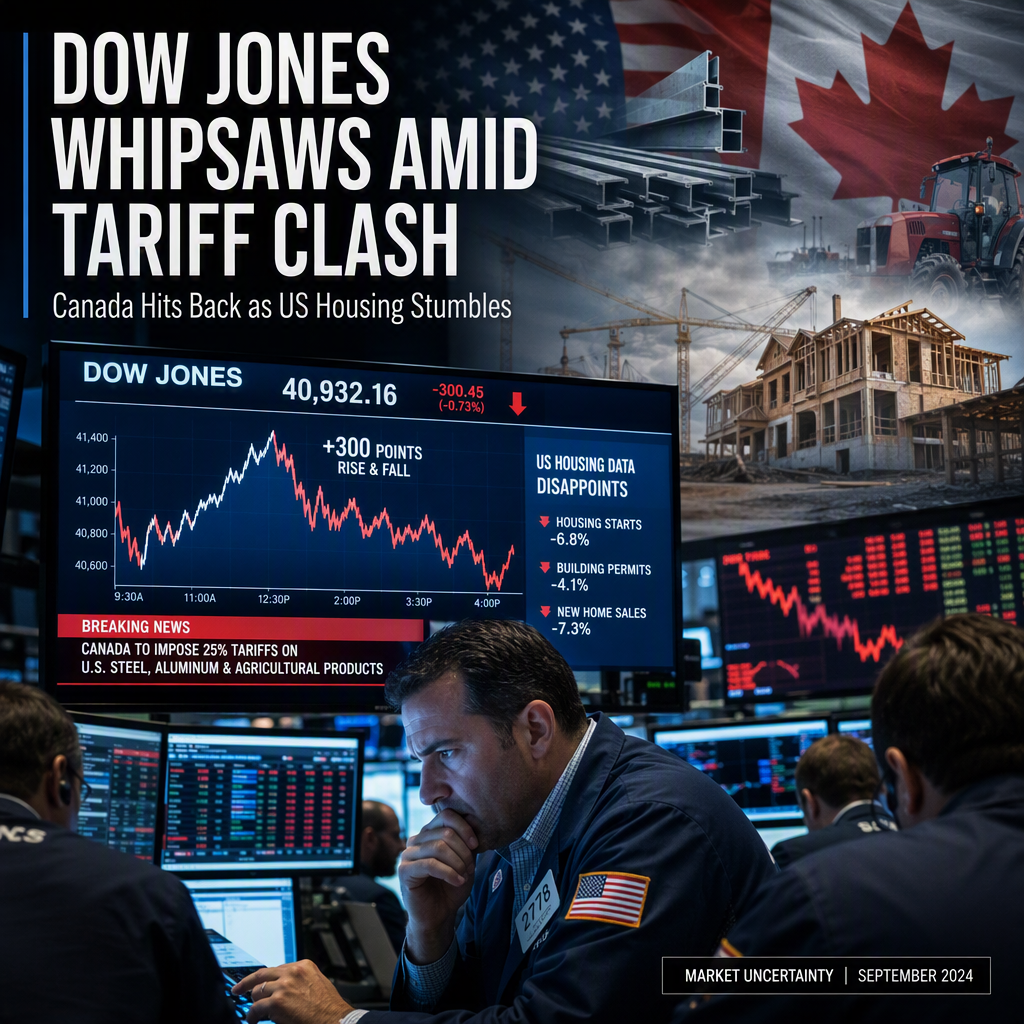
The Dow Jones Industrial Average experienced significant volatility, building a 300-point advance before relinquishing all gains within a single session, ultimately trading just below 53,500 for a modest gain of approximately 0.1% [1]. The index's session range exceeded 320 points, but the net change was only 67 points, reflecting market indecision amid two major policy shocks [1].
On one side, falling Treasury yields and anticipation of Nvidia's (NVDA) earnings report provided support, while on the other, weaker-than-expected consumer confidence and deteriorating housing data weighed on sentiment [1]. August consumer confidence dropped to 89.4, missing the 90.2 consensus, with the decline attributed to worsening expectations for the next six months rather than current conditions [1]. New home sales fell 10.5% month-over-month in July following a 7.6% decline in June, resulting in a nearly 17% drop over two months. The June Housing Price Index was flat, missing the 0.2% consensus and down from a 0.3% prior reading, indicating a demand problem in the housing market [1].
In addition to domestic data, Canada announced retaliatory tariffs on Tuesday morning, matching US duties imposed over the weekend. The Canadian countermeasures include tariffs of 15%, 25%, and 50% on more than 700 American goods valued at approximately $27.6 billion, effective September 8, alongside a $7.5 billion support package for affected Canadian businesses [1]. Key sectors targeted include steel, aluminum, dairy, seafood, appliances, agricultural equipment, pulp and paper, and electronics. Caterpillar (CAT), a major Dow component and top performer this year, is directly impacted as farm and construction machinery is among the targeted categories [1]. The US tariffs, implemented over the weekend, placed 50% duties on about $28 billion of Canadian goods, including lumber and cement, which could affect companies like Home Depot (HD) and the already contracting new-build market [1].
Market reactions were mixed, with Dick's Sporting Goods (DKS) plunging over 27%—its worst session on record—though it is not a Dow component. Walmart (WMT), which is in the index, declined about 1% [1]. Both the US and Canadian tariff schedules are set ahead of the September 16 meeting, but neither has yet appeared in July price indices [1].
CONCLUSION
The Dow Jones faced heightened volatility as investors weighed disappointing US housing and consumer confidence data against escalating US-Canada trade tensions. With major Dow components like Caterpillar and Home Depot potentially exposed to new tariffs, and sentiment dampened by weak economic indicators, market uncertainty remains elevated. The upcoming September 16 meeting may provide further direction as the impact of these developments unfolds.