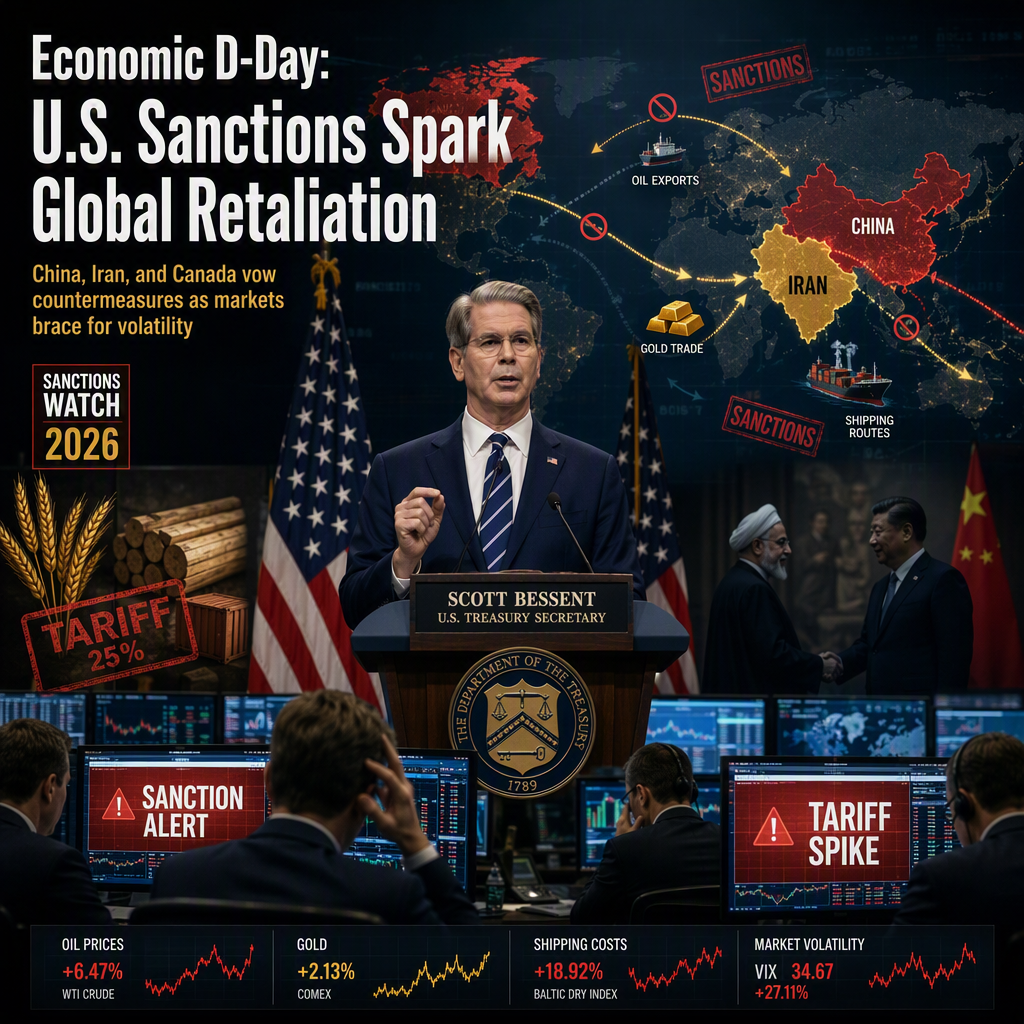
On August 25, 2026, the United States, under President Donald Trump, escalated its economic pressure campaign against Iran by imposing a new round of sanctions targeting nearly 60 foreign entities, individuals, and vessels across multiple jurisdictions, as part of what the administration called 'Operation Economic Outcast' [1][2][3]. U.S. Treasury Secretary Scott Bessent described the measures as an 'economic D-Day,' warning that any nation financially partnering with Tehran would risk being cut off from the U.S. financial system [2][3]. The sanctions specifically expanded to cover five critical sectors: digital assets, technology, gold, aviation, and shipping [2].
The U.S. also issued explicit threats to countries continuing business with Iran, including China and Russia, with Bessent stating that entities facilitating Iranian oil transactions would be targeted [2][3]. China, which previously purchased around 90% of Iran's exported oil—about 12% of its total crude imports—was directly warned that its banks could face sanctions if they helped Iran evade restrictions [3]. In response, Chinese officials reiterated their opposition to 'illegal unilateral sanctions' and vowed to 'take all necessary measures' to protect their interests [2][3].
Iran condemned the U.S. actions as an 'economic terrorist attack,' with Economy Minister Ali Madanizadeh warning that Washington should 'expect an attack' in retaliation, though he did not specify the nature of the response [2]. Madanizadeh also noted that Iran had a two-year plan to address the economic impact of the sanctions [2]. On the ground in Tehran, some citizens expressed indifference, suggesting that such U.S. measures were not new [2].
Meanwhile, the U.S. also imposed 50% tariffs on certain Canadian goods, prompting Canada to prepare retaliatory measures. Prime Minister Mark Carney asserted that Canada has leverage in global markets, stating, 'We have what the world wants' [1]. Analysts highlighted that these developments are expected to heighten volatility in commodities and cross-border trade sectors, with potential impacts on supply chains and price levels [1]. Investors were advised to closely monitor U.S.-Canada trade relations and the evolving sanctions regime for potential effects on stocks, commodities, and currencies [1].
The U.S. did not provide specific timelines for countries to comply with the new sanctions, and there was no public disclosure of which nations might be targeted with secondary sanctions [2][3]. The situation is further complicated by an upcoming summit between President Trump and Chinese President Xi Jinping, as both sides navigate the economic and diplomatic fallout [3].
CONCLUSION
The U.S. has significantly escalated its economic campaign against Iran, broadening sanctions and threatening secondary measures against major trading partners like China and Canada. Both China and Iran have vowed to retaliate, while Canada is preparing its own countermeasures in response to new U.S. tariffs. The heightened tensions are expected to drive volatility across global markets, particularly in commodities and cross-border trade.