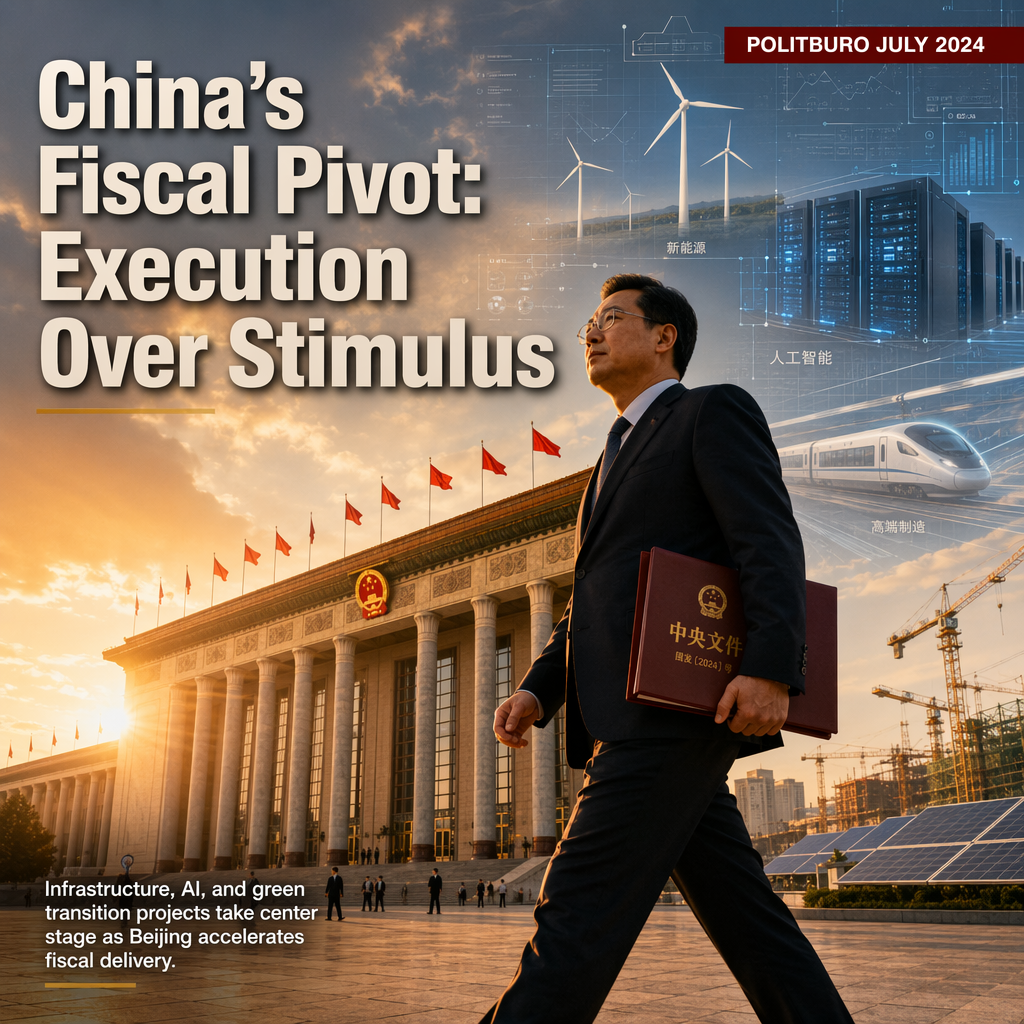
According to Standard Chartered economists Carol Liao and Shuang Ding, China's upcoming July Politburo meeting is anticipated to emphasize the implementation of existing fiscal plans rather than introducing new stimulus measures [1]. The economists note that fiscal execution is expected to accelerate in the second half of the year (H2), following a significant slowdown after front-loaded spending in the first quarter (Q1) [1]. This slowdown in infrastructure investment during the second quarter (Q2) is described as a deliberate adjustment after robust Q1 growth [1].
Infrastructure investment is projected to rebound in H2, with a growing focus on projects related to artificial intelligence (AI) and the green transition, as well as social and livelihood initiatives [1]. The economists highlight that funding for the goods trade-in programme is being distributed evenly, and that infrastructure spending will be critical for stabilizing near-term growth [1].
Market participants are reportedly focused on whether the July Politburo meeting will announce additional stimulus, but Standard Chartered expects the meeting to prioritize accelerating fiscal execution, with monetary policy serving a supplementary role [1]. The economists also mention that a contingency plan will be kept in place, suggesting a cautious approach to policy adjustments [1].
CONCLUSION
China's July Politburo meeting is expected to focus on accelerating the execution of existing fiscal plans, particularly in infrastructure, AI, and green transition projects, rather than introducing new stimulus. This approach is seen as key to stabilizing near-term growth, with monetary policy playing a supporting role. Market attention remains on the potential for additional stimulus, but current expectations point to a focus on fiscal delivery.