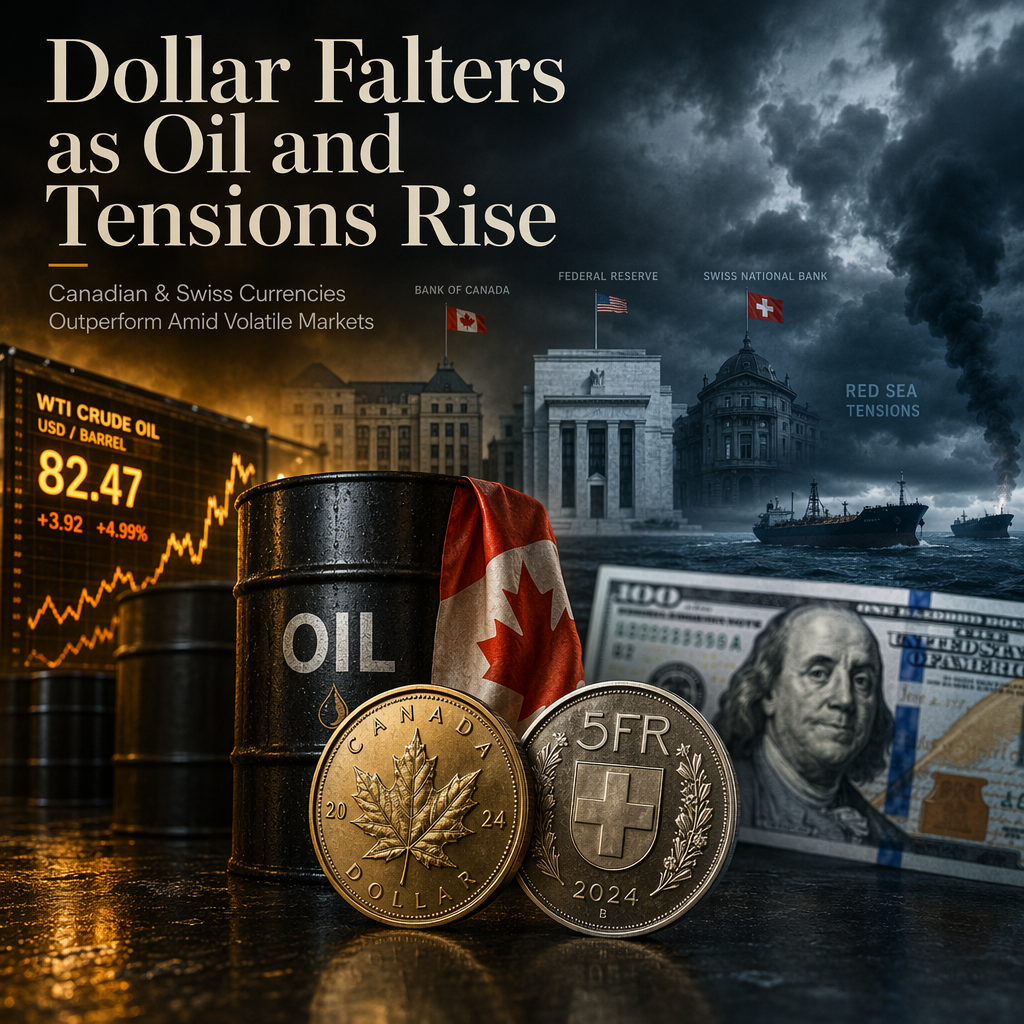
The US Dollar (USD) experienced declines against both the Canadian Dollar (CAD) and the Swiss Franc (CHF) during Friday's European trading session, driven by a combination of geopolitical tensions, oil price volatility, and shifting monetary policy expectations. The USD/CAD pair traded marginally lower at around 1.4033, with the Canadian Dollar outperforming its peers amid concerns that oil prices could accelerate further following threats from Iran to close the Red Sea if the United States strikes Iranian infrastructure [1]. This environment has favored currencies from net energy exporters like Canada. The Bank of Canada (BoC) left its interest rate unchanged at 2.25%, but Governor Tiff Macklem indicated that rates might need to rise if oil prices remain elevated [1]. Technical analysis shows USD/CAD below its 20-day EMA at 1.4107, with downside momentum suggested by an RSI of 39.6 and a potential target at 1.3967 [1].
Meanwhile, the USD/CHF pair also turned lower, trading at 0.8073 after failing to break above the 0.8100 resistance level [2]. The US Dollar's weakness was attributed to softer US inflation figures released earlier in the week, which have reduced expectations for immediate Federal Reserve rate hikes. Both the Consumer Price Index (CPI) and Producer Price Index (PPI) indicated moderated inflationary pressures in June, aided by a sharp pullback in oil prices [2]. As a result, the likelihood of a Fed rate hike in July or September has diminished [2]. Technical indicators for USD/CHF remain neutral-to-bearish, with support seen at 0.8030 and 0.8010, and resistance at 0.8100 and the 0.8135-0.8150 range [2].
Geopolitical risks remain elevated, with ongoing reciprocal attacks between the US and Iran and threats to close key energy routes, which could impact global economic stability and keep risk appetite subdued [1][2]. The Swiss Franc was the strongest against the Australian Dollar among major currencies, while the Canadian Dollar also showed relative strength [2].
Forward-looking statements from BoC Governor Macklem suggest a potential for rate hikes if oil prices continue to rise, while US monetary policy appears likely to remain on hold in the near term due to moderated inflation data [1][2].
CONCLUSION
The US Dollar's recent weakness against both the Canadian Dollar and Swiss Franc reflects a confluence of geopolitical tensions, oil price volatility, and shifting central bank expectations. With the Bank of Canada signaling possible future rate hikes and the Federal Reserve likely to pause, currency markets remain sensitive to further developments in energy prices and global risk sentiment.