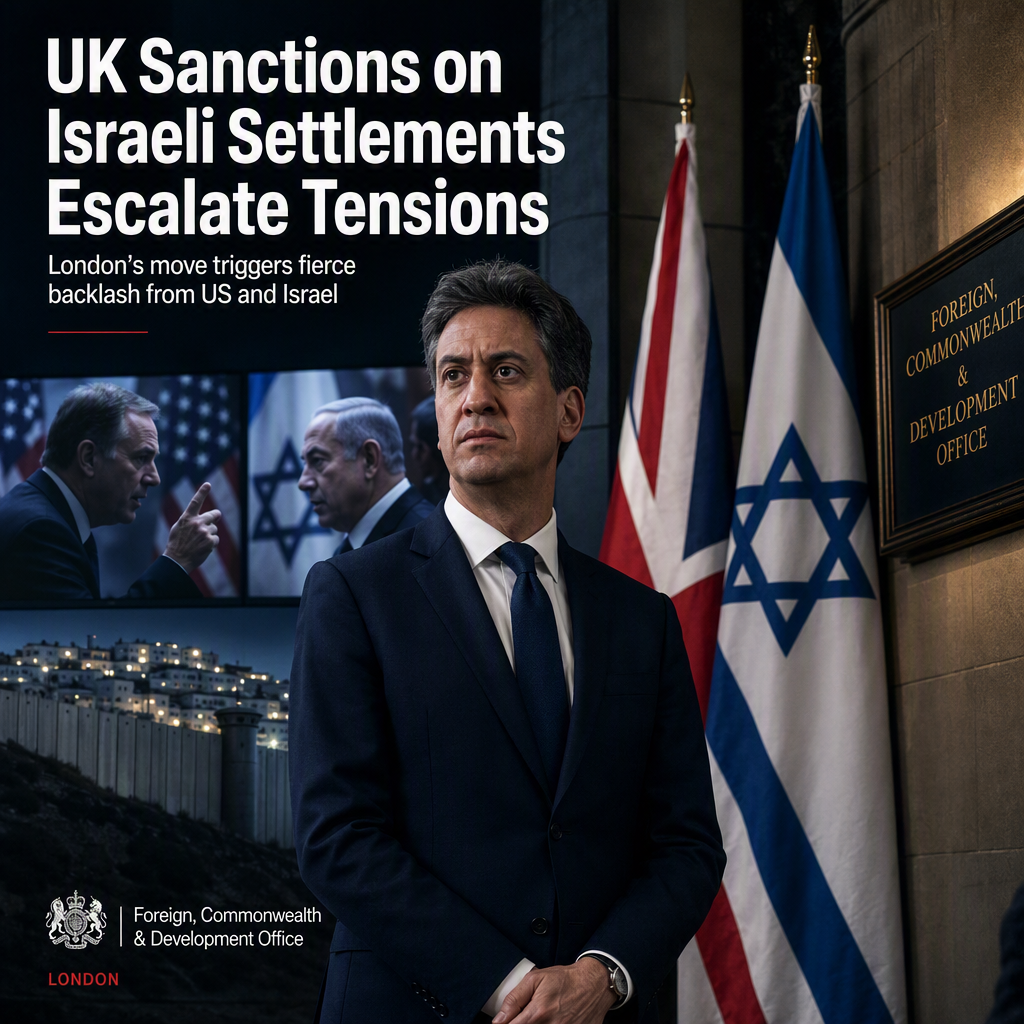
The United Kingdom is expected to announce restrictions targeting trade with Israeli settlements in the West Bank on Tuesday, marking a significant escalation in London’s pressure on Israel under new Prime Minister Andy Burnham [1]. The measures, described as sanctions, will likely include an embargo on goods and some services involving West Bank settlements [1]. This move has already drawn strong pushback from U.S. and Israeli officials, with a US State Department official stating that Washington is 'tracking the plans closely' [1].
The announcement is anticipated to follow a phone call between Prime Minister Burnham and President Donald Trump, during which Burnham emphasized the UK's commitment to a two-state solution and regional peace and security, although the readout did not mention the planned sanctions [1]. Bloomberg reported that the timing of the call suggested Burnham may have briefed Trump on the measures, potentially creating an early point of friction between Burnham and Washington, given the Trump administration's strong support for Israel [1].
Foreign Secretary Ed Miliband is expected to formally unveil the sanctions, having already pledged a 'comprehensive reset' of Britain’s policy toward Israeli settlements in the West Bank [1]. Miliband previously signaled that the measures were in response to Israeli settlement expansion, specifically referencing the E1 project east of Jerusalem, which he described as a longstanding 'red line' for the UK [1].
The planned sanctions have provoked sharp criticism in Israel and the United States. Israeli Finance Minister Bezalel Smotrich called for the British ambassador’s expulsion, stating, 'We will not be a doormat for an antisemitic government in a country occupied by radical Islam that is trying to escape economic and social collapse by attacking Jews and the State of Israel. The British Mandate in Israel is over.' National Security Minister Itamar Ben-Gvir also condemned the planned restrictions [1].
CONCLUSION
The UK’s expected sanctions on Israeli settlements represent a major policy shift and have already triggered strong negative reactions from both Israel and the United States. The move is likely to strain diplomatic relations and could have significant geopolitical and market implications, especially given the firm stance of Prime Minister Burnham and Foreign Secretary Miliband. Investors and policymakers will be closely watching for further developments and official announcements.