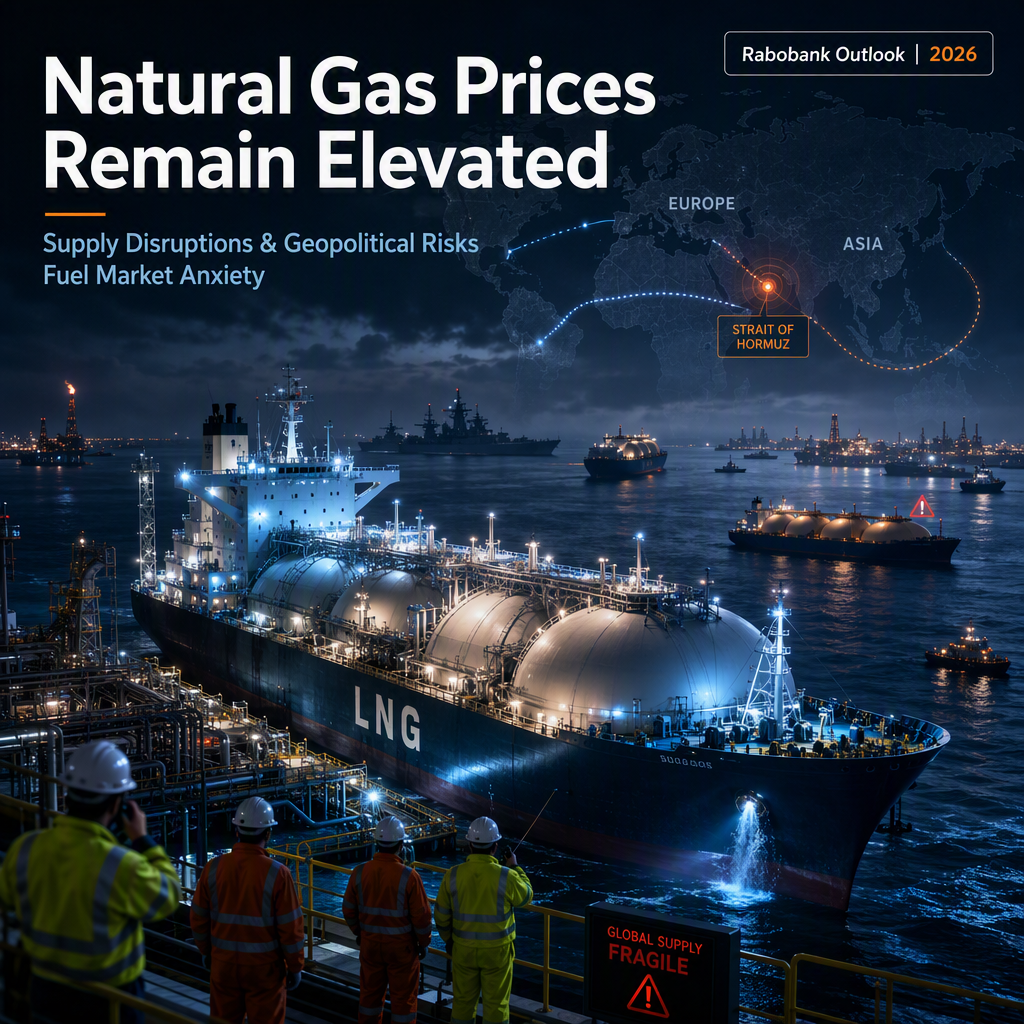
Rabobank’s Florence Schmit highlights that the European benchmark TTF Natural Gas remains highly vulnerable to supply disruptions, particularly due to ongoing risks in the Strait of Hormuz and QatarEnergy’s extension of force majeure through mid-October. While there has been some recovery in Qatari LNG flows, Rabobank expects TTF prices to remain elevated at around €51-52/MWh for Q3 and Q4 2026, with corresponding JKM gas prices forecasted at $17.00-18.50/MMBtu during the same period [1].
The report underscores that the Strait of Hormuz is a critical chokepoint for global LNG trade, and any sustained interruption could have significant consequences for both Asian and European gas balances. Rabobank notes that the extension of force majeure by QatarEnergy signals a prolonged period of constrained LNG availability, prompting the bank to slightly raise its TTF and JKM gas forecasts for the latter half of 2026 [1].
Rabobank’s base case anticipates a gradual easing of prices only once the global LNG market moves into oversupply next year. However, the bank warns that with limited alternatives for LNG in the short term, price risks remain skewed to the upside, even if a U.S.-Iran deal is reached in the coming weeks. Should geopolitical tensions escalate or shipping confidence deteriorate, the risk of further supply disruptions could push TTF prices to approximately €60/MWh and JKM prices to $21/MMBtu during the winter [1].
Overall, Rabobank’s analysis points to a market environment where natural gas prices are likely to stay elevated due to fragile supply chains and persistent geopolitical uncertainties, with significant upside risk if current disruptions are prolonged or worsen [1].
CONCLUSION
Rabobank expects natural gas prices to remain elevated through the end of 2026, driven by ongoing supply risks and geopolitical tensions. The market outlook remains highly sensitive to developments in the Strait of Hormuz and the timing of Qatari LNG supply resumption, with upside price risks persisting in the near term.