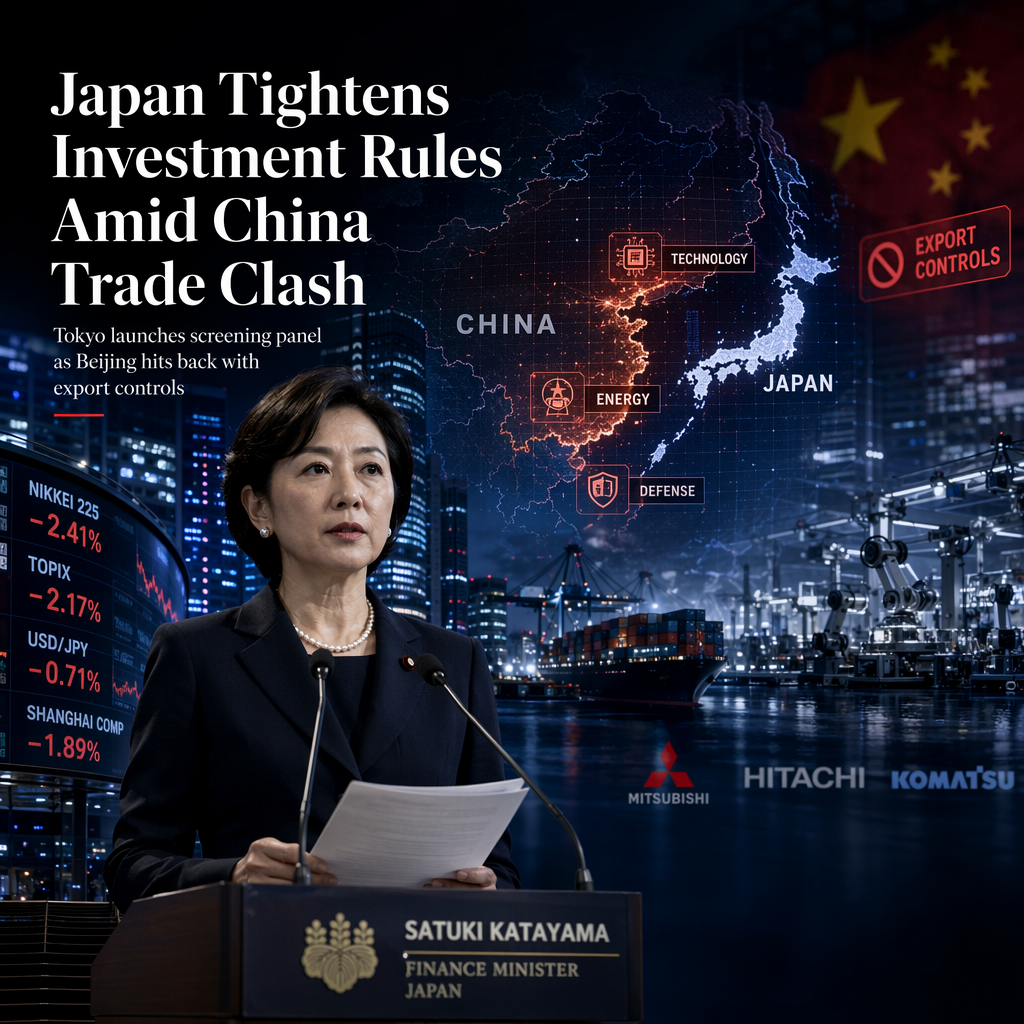
Japan has established the Japan Foreign Investment Committee, a cross-ministerial body designed to prescreen foreign investments and enhance oversight against economic security risks, mirroring the U.S. Committee on Foreign Investment (CFIUS) [1]. Finance Minister Satsuki Katayama introduced the committee, which will review and screen foreign investment proposals to mitigate potential threats to Japan's economic security, particularly in sensitive sectors such as technology, energy, and defense [1]. This move follows recent legislative changes that tightened foreign investment laws in Japan, aiming to align with international best practices and strengthen protection against cross-border economic threats [1].
On the same day, China announced export controls targeting dozens of Japanese companies, including units of Mitsubishi, Hitachi, and Komatsu, focusing on dual-use items with both civilian and military applications [2]. Beijing described the measures as a response to what it called Tokyo's "new form of militarism" and an "unrepentant" stance, escalating tensions between the two countries [2]. The export controls are expected to increase compliance risks for Japanese exporters, potentially disrupt supply chains for critical materials and components, and prompt Japanese firms to reassess their risk exposure in China [2]. No specific financial figures or estimated impacts were provided [2].
Analysts cited in the sources note that these developments could have ripple effects across Asian markets, with companies in sectors reliant on dual-use goods facing increased scrutiny and higher compliance costs [2]. Market sentiment is described as cautious, with traders monitoring for any official response from the Japanese government or potential countermeasures that could further escalate the dispute [2]. The situation underscores the ongoing risks faced by multinational corporations operating in politically sensitive sectors amid tightening export controls and rising protectionism [2].
The establishment of Japan's new investment screening committee and China's retaliatory export controls highlight the intensifying economic and geopolitical tensions between the two countries, with significant implications for cross-border investment and trade [1][2].
CONCLUSION
Japan's launch of a CFIUS-style investment screening panel and China's swift imposition of export controls on major Japanese firms mark a significant escalation in bilateral economic tensions. The measures are expected to increase compliance burdens, disrupt supply chains, and heighten market uncertainty, particularly for companies operating in sensitive sectors. Investors and multinational corporations are advised to closely monitor further developments and potential government responses.