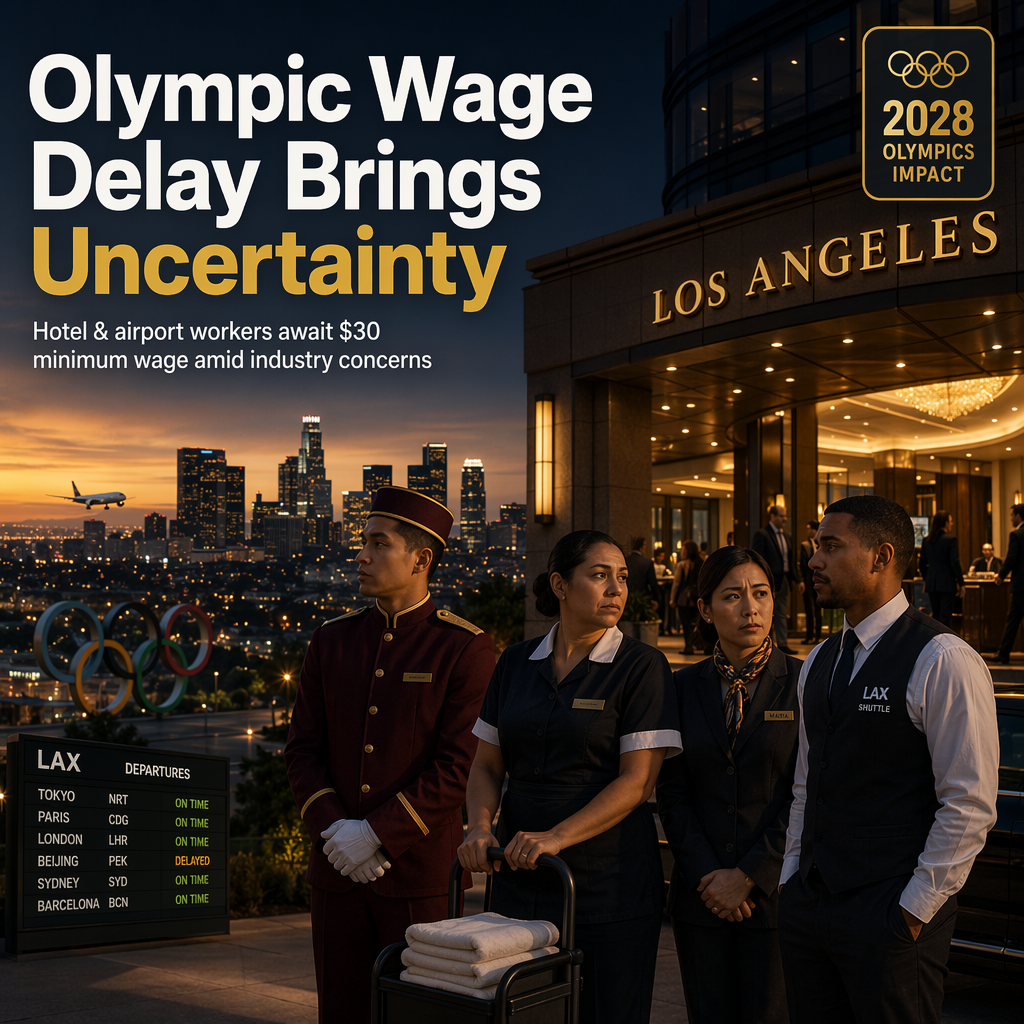
Los Angeles officials have decided to delay the implementation of a proposed $30 per hour minimum wage for hotel and airport workers, known as the 'Olympic Wage,' until after the 2028 Summer Olympics. The measure was originally set to take effect by 2028 as the city prepares to host major international events, including the 2026 FIFA World Cup and the 2028 Olympics, but city leaders voted to push back full implementation to 2030 due to concerns from the hospitality industry about rising labor costs and potential economic fallout [1].
The hospitality industry, particularly hotel owners, warned that the wage mandate could result in layoffs, reduced hiring, and increased automation. According to Rebekah Paxton, research director at the Employment Policies Institute, some hotels had already reduced hiring and staffing in anticipation of the higher labor costs, citing a report from the Los Angeles hotel industry [1]. Paxton stated, 'There was some data that came out that the hotels were struggling ahead of the Olympics, even as we're approaching the World Cup this summer.' She added that the delay gives hotels 'a little bit of breathing room as we ramp up toward the Olympics,' but emphasized that the underlying concerns about sustaining such a wage increase remain unresolved [1].
Currently, hotel workers in Los Angeles earn a minimum wage of roughly $22.50 an hour, so the proposed increase to $30 would represent about a one-third raise over a few years [1]. Supporters of the wage hike argue that it is necessary to help workers keep pace with the city's high cost of living, especially as Los Angeles expects to welcome millions of visitors for the upcoming sporting events [1]. The debate in Los Angeles mirrors similar discussions in other cities, such as New York, where officials are considering a plan to raise the minimum wage to $30 an hour over several years [1].
While the delay is seen by some as a positive step for the hospitality industry, it does not fully address their concerns. Paxton noted, 'A $30 minimum wage is still a $30 minimum wage. A pause is certainly a step in the right direction, but it's not going to solve the ultimate problem, which is a lot of folks saying that they can't sustain that level of a wage increase' [1].
CONCLUSION
The decision to delay the $30 'Olympic Wage' until 2030 provides temporary relief for Los Angeles hotel operators facing rising labor costs ahead of major international events. However, the hospitality industry's concerns about the long-term sustainability of such a wage increase remain unresolved, and the debate over balancing worker pay with economic viability is likely to continue.