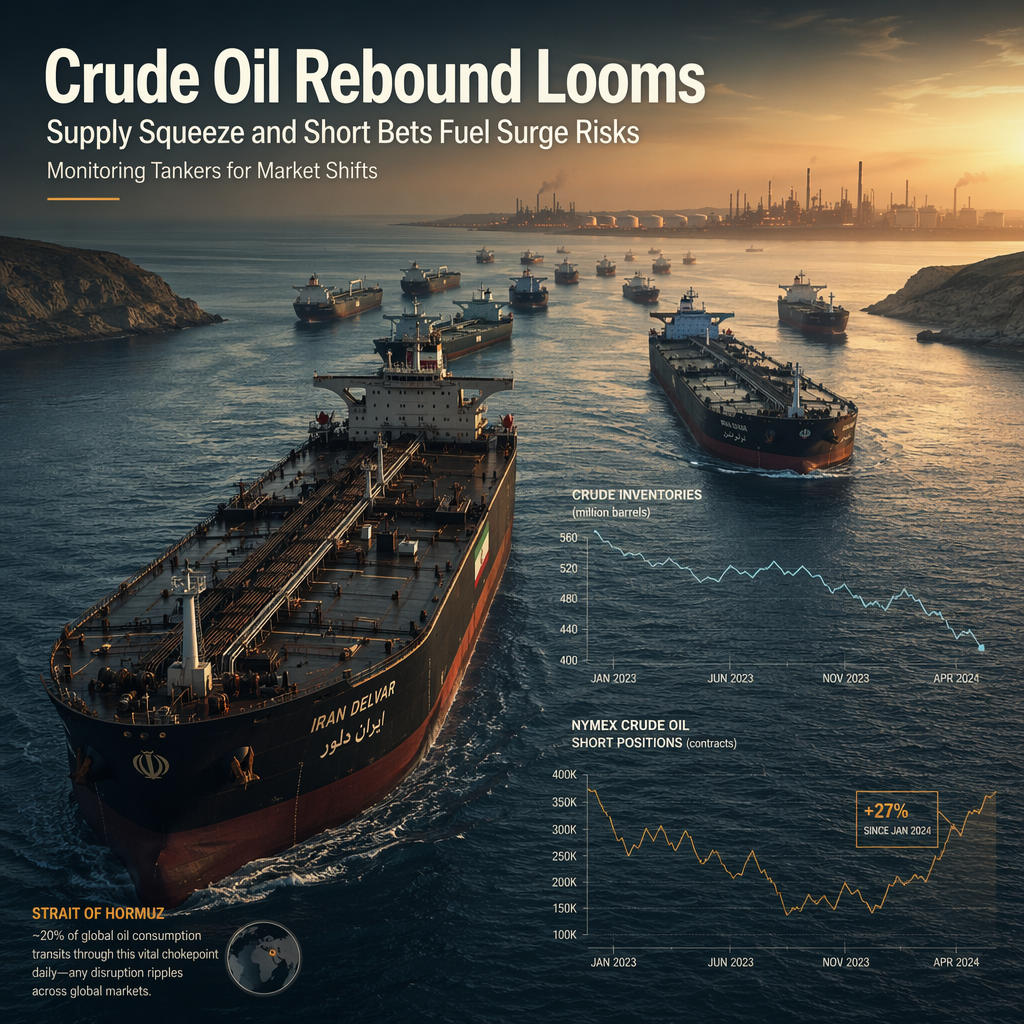
TD Securities commodity strategists Ryan McKay and Bart Melek report that crude oil flows through the Strait of Hormuz are gradually normalizing, but approximately 10–11 million barrels per day (m b/d) of Middle East production remains offline [1]. Fresh tanker loadings in the Mideast Gulf are currently around 3.5m b/d this week, primarily from Kuwait, the UAE, and Iran, which is seen as a key indicator of where flows may stabilize once stranded cargoes exit the Strait [1]. The majority of tanker entries are from the Iranian and/or sanctioned tanker fleet, and Middle East production remains significantly curtailed [1].
In the United States, global inventories are drawing down rapidly, with another 15 million barrels withdrawn from commercial and Strategic Petroleum Reserve (SPR) storage [1]. Commodity Trading Advisors (CTAs) have been only modest sellers of crude oil, but speculative positioning overall is described as 'dangerously skewed short' [1].
TD Securities strategists argue that if Middle East production does not recover swiftly in the coming weeks, the combination of ongoing inventory draws and heavy short positioning could set the stage for a recovery in WTI and Brent crude oil prices [1]. They recommend monitoring tanker entries and new loadings as leading indicators for potential normalization in flows [1].
CONCLUSION
TD Securities highlights that persistent supply constraints and significant short positioning in crude oil markets could trigger a price rebound if Middle East production fails to recover soon. Market participants are advised to closely watch inventory trends and tanker activity for early signs of a shift in market dynamics.